
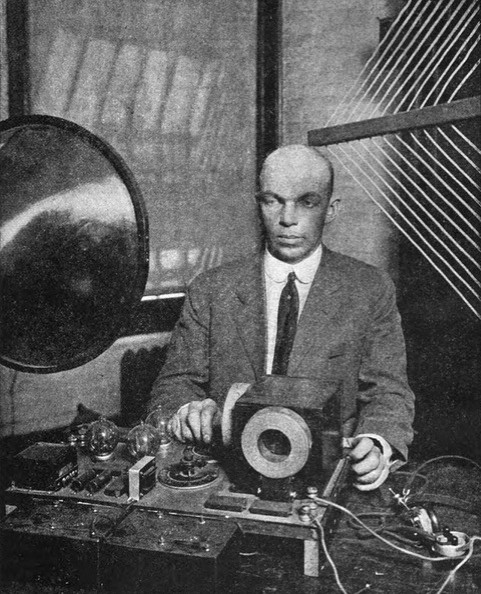
Edwin Armstrong demonstrating his new invention in 1922, the Superregenerative Receiver
By Mary Hoar, City of Yonkers Municipal Historian, 1977 recipient of the Key to the City of Yonkers, President Emeritus Yonkers Historical Society, recipient of the 2004 Key to History, Yonkers Landmarks Preservation Board Member, Founder of Revolutionary Yonkers 250 and President Untermyer Performing Arts Council
Monday, August 3rd
August 3, 1639: The three Weckquaskeck chiefs who owned Keskeskich– Fecquemeck, Rechgawae, and Packanniens– sold the tract of land called “Nepperhaem,” present-day Yonkers, to the West India Company.
August 3, 1945: Following efforts in New Rochelle, a group of Yonkers men and women met to try to stop execution of Private Daniel Jones of Elm Street. Jones, who was Black, had written a letter to his father protesting his innocence of the charges of mutiny. The letter, read at the meeting, explained what really happened. He enclosed a letter from another soldier stating 25 witnesses wanted to testify for Jones and the condemned men… every one of the soldiers volunteering to speak in their defense immediately was transferred to another company.
The Yonkers people created the Committee to Stay the Execution of Private Jones.
Jones was one of seven men sentenced to die; four other men were sentenced to life imprisonment. Why? An argument with a captain who did not like Black soldiers! The soldiers repeatedly had tried to transfer out of the captain’s command.
He had them report to Military Police, obstensibly for transfer. Once there, the men were arrested, accused of shooting a MP officer.
August 4th
August 4, 1926: Supervisor James Sullivan, Democratic leader of the Westchester County Board, had a major clash with members of the board when they again delayed paving Yonkers Avenue for another year. Sullivan reminded them Yonkers paid 27% of the county tax… yet did not nearly get its share of improvements.
August 4, 1935: To commemorate the 296th anniversary of the transfer of Yonkers area land to Europeans, Native Americans pitched a tent on the shores of the Hudson to relive the days when they ruled the area.
Wednesday, August 5th
August 5,1927: The trial of Yonkers Alderman William McGeory, President of the Westchester County Building Trades Council, opened before Federal Judge Jacob Trieber in New York City. He was charged with conspiracy. The government alleged he conspired not to “permit others to set cast stone manufactured outside the district.” Officials alleged the monopoly cost NYC builders more than $1,000,000 a year. James Vahey of Boston represented Alderman McGeory.
August 5, 1933: Alexander Smith and Sons Carpet Company reduced the number of hours its employees worked from 48 to 40 hours… yet paid them for 48-hours. Yonkers largest industry was putting into effect a new carpet industry code; the industry was waiting for President Franklin Roosevelt’s approval. This was equivalent to a 20% pay raise for the company’s 4,000 workers. This raise almost doubled the number of Yonkers employees “under the Blue Eagle” of the National Recovery Act.
Thursday, August 6th
August 6, 1781: George Washington wrote in his diary about reconnoitering the land between the North River and the Bronx River, to the Philipse home to Valentine’s Hill. He found the deep ravines between our hills created by the Saw Mill River, and he made careful notes about the Widow Babcock’s property, now St. John’s and Oakland Cemeteries.
August 6, 1945: Maurie Cesarotti, President of the Westchester CIO Council, and William Berlin, Vice President of our Yonkers U.E., visited Representative Ralph Gwinn at home to plead for Private Daniel Jones, scheduled for death. Gwinn agreed to help.
Representatives from the Yonkers Committee to Stay the Execution of Private Jones visited Mayor Frank at City Hall. While they were there, Frank called Representative Gwinn during the meeting; both men promised the group to join Westchester Congressman Gamble in requesting the War Department stay the execution of all the men.
Friday, August 7th
August 7, 1916: Yonkers’ longest trolley strike ended when union and company officials reached an agreement 17 days after the last time conductors and motormen had driven their cars into the barn. The agreement required both sides to meet by August 20th to discuss wage and working conditions, and specified employees had the right to organize and bargain collectively.
They won the right to organize without intimidation, their real objective.
August 7, 1937: Architect John Keenan announced he would primary anti-shorts proponent William Slater for the Democratic slot for Ninth Ward Alderman. Slater had received the unanimous nod from the ward committee a few days earlier; Keenan said he was running in the “best interests of the Democratic Party… at the request of a number of taxpayers.”
Saturday, August 8th
August 8, 1882: After much discussion, the Yonkers Board of Education voted to make both School Two and School Six co-educational! They also voted to hire female Teaching Principals for both schools.
Upper grades from these schools were moved to create the new Central School on Hudson Street, relieving overcrowding at both schools.
Charles Gorton was appointed Principal of Central School; the Board of Education Trustees also voted to hire two woman assistant principals.
August 8, 1927: Reservoirs and aqueducts, factories and public utility company plants in Yonkers were under heavy armed guards today to prevent damage by sympathizers of Sacco and Vanzetti as the death hour for the two condemned men drew near.
Sunday, August 9th
August 9, 1776: Colonel Frederick Philipse was arrested at Manor Hall by order of George Washington
August 9, 1937: Yonkers High School graduate Major Edwin Armstrong ordered a 600-foot steel tower built on top of the Palisades! To be manufactured by the American Bridge Company in Pittsburgh, it would be one of the tallest towers ever built in the US.
While studying at Yonkers High, Armstrong was an early pioneer of radio.
Any questions on this column, email yonkershistory1646@gmail.com.
For information on the Yonkers Historical Society, the Sherwood House Museum on Tuckahoe Road or their upcoming events, please call 914-961-8940, visit their website www.yonkershistoricalsociety.org, or email info@yonkershistoricalsociety.org.