
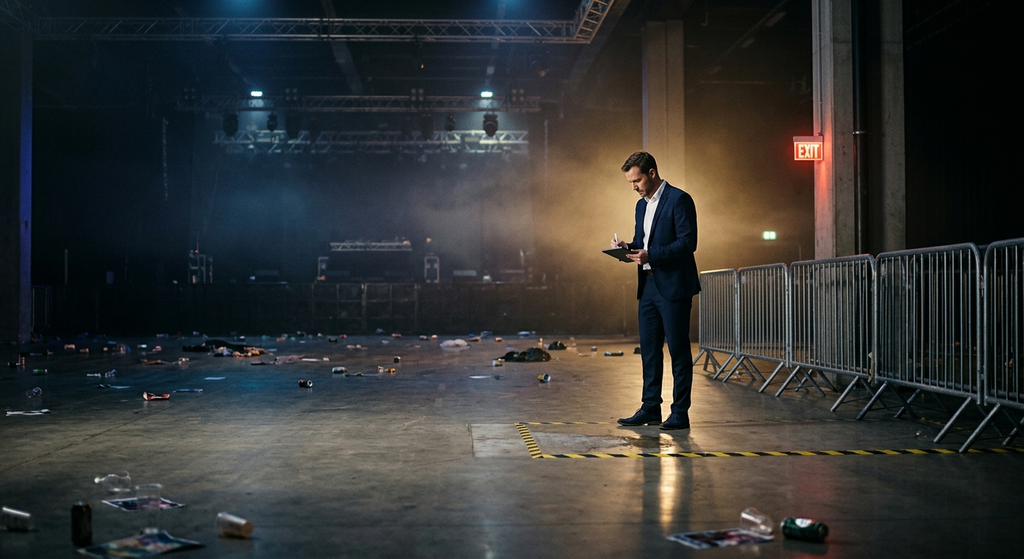
A venue at capacity is a genuinely difficult environment to keep safe. The floor is wet with spilled drinks, the lighting is designed to disorient, the sound makes warnings useless, and several thousand people are moving toward the same exits at the same moment.
When someone is hurt there, the answer to who pays is rarely a single name. California law spreads responsibility across several parties and, in one area that surprises almost everybody, deliberately removes it from the most obvious one.
The Alcohol Rule Runs Opposite to What People Assume
Ask anyone who was overserved and then hurt, and they will assume the bar is liable. In California, the opposite is the default.
The Legislature reversed the courts on purpose
Business and Professions Code section 25602 makes it a misdemeanor to sell or furnish alcohol to an obviously intoxicated person. Then subdivision (b) states that no person who does so shall be civilly liable to any injured person for injuries inflicted as a result of the consumer’s intoxication.
Subdivision (c) explains why in unusually direct language. The Legislature declares that the section is to be interpreted so that a set of earlier California Supreme Court decisions is abrogated, in favor of the view that consumption, rather than service, is the proximate cause of injuries inflicted by an intoxicated person.
So the conduct is criminal and the civil door is closed at the same time. That is not an accident of drafting. It was the point.
The exception is narrow and specific
Business and Professions Code section 25602.1 creates one route through. A cause of action may be brought against a licensee, or someone required to be licensed, who serves an obviously intoxicated minor, where that service is the proximate cause of the injury or death.
Read the elements together. The person served must be a minor, and obviously intoxicated, and the service must be the proximate cause. All three, not any one.
That is why claims arising from an adult patron being overserved almost never proceed against the venue on that theory, however unreasonable the service was.
Where the Venue Is Actually Responsible
Removing the alcohol theory does not remove the venue from the case. It relocates the argument to the physical condition of the premises and the adequacy of the operation.
The conditions that generate real claims
Stairs and ramps that are inadequately lit or lack a compliant handrail. A floor that has not been cleared during the set. Barricades that fail. Overcrowding beyond posted occupancy. Exits that are blocked, locked or unmarked.
Security is its own category. Inadequate security where violence was foreseeable, and injuries caused by the manner in which security staff removed or restrained someone, are both ordinary claims rather than exotic ones.
Foreseeability does most of the work
The question is generally what this venue knew or should have known. Prior incidents at the same venue, the nature of the event, the crowd’s known behavior and the staffing level all feed into whether the harm was foreseeable and what precautions were reasonable.
A venue with a documented history of the same problem is in a materially different position from one where something genuinely novel happened.
This is why prior complaints matter so much. Noise complaints, police call logs, past citations and earlier injury reports at the same address all speak to what the operator already knew.
The Defendants Multiply, and the Damages Split
Concert injuries are unusual in how many separate businesses are involved in a single evening.
Who is standing in the room
The venue owner. The venue operator, where those differ. The promoter. The touring production. A separate security contractor. A staffing agency supplying bar staff. A company that built the stage or the barricade.
Each has its own insurance and its own contractual carve-outs, and the agreements between them frequently assign responsibility in ways that bear no relation to who actually caused the harm.
Proposition 51 changes the arithmetic
Civil Code section 1431.2 provides that in an action for personal injury based on comparative fault, each defendant’s liability for non-economic damages is several only and not joint. Each is liable only for the amount allocated in direct proportion to that defendant’s percentage of fault.
Economic damages, meaning medical expenses and lost earnings, are treated differently. Non-economic damages, meaning pain and suffering, get split by percentage.
The practical effect is that a defendant found 15 percent at fault pays 15 percent of the pain and suffering. If another defendant is insolvent or uninsured, that share is not picked up by the others.
What Is Worth Doing That Night
Most of the useful evidence at a concert exists for a very short time.
Photograph the actual condition, the lighting and the surroundings, before the crowd clears and before anything is repaired or mopped. Note the exact location, which is far harder to reconstruct in a large dark room than anyone expects. Count doors, name the section, photograph a landmark.
Get medical attention the same night even where the injury seems manageable, because adrenaline masks a great deal and a gap in treatment becomes an argument later.
Ask venue staff to complete an incident report and request a copy. Find witnesses and take numbers, because everyone there is a stranger who will be impossible to locate afterward.
Then get the footage requested in writing, quickly. Trusted advocates for slip and fall victims in Costa Mesa, CA often find that the security camera covering a stairwell is the only neutral account of what happened, and those systems overwrite themselves within weeks.