
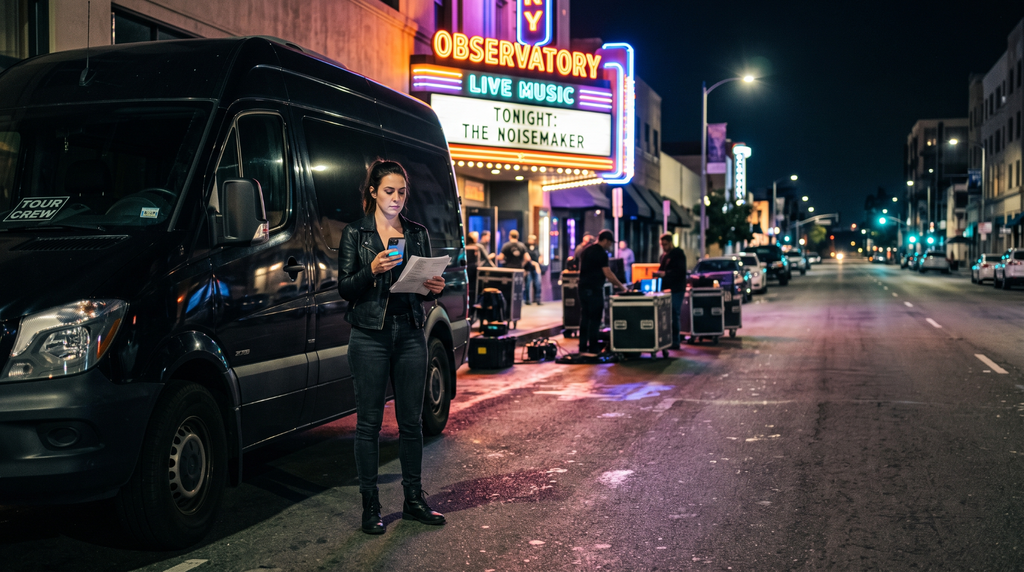
Live music runs on a schedule that puts people on the road at the hours enforcement is heaviest. Load out ends after midnight, the drive home crosses several jurisdictions, and the crew that worked the room has been up for eighteen hours.
For anyone whose income depends on being somewhere specific on a given night, the most useful thing to understand about a California impaired driving charge is not the maximum penalty. It is the set of obligations that attach afterward and how long they last.
Sentencing Does Not Get Postponed
California removes a flexibility that exists in many other cases. On a conviction for impaired driving, the court is directed not to stay or suspend pronouncement of sentencing, and to pronounce sentence in conjunction with the conviction within a reasonable time.
That forecloses the informal arrangement people expect, where sentencing is pushed out until after a tour, a residency or a production wraps. The scheduling conversation has to happen inside the case rather than around it.
Probation Runs Three to Five Years
This is the provision that reshapes a working calendar, and it is routinely underestimated because attention goes to fines and classes.
Where probation is granted, the statutory terms require a period of not less than three nor more than five years. Not months. A first offense resolved quietly still carries a supervision period that can outlast an album cycle.
The conditions that matter on the road
Three mandatory conditions come with it.
The person shall not drive a vehicle with any measurable amount of alcohol in their blood. That is not the ordinary limit; it is zero tolerance, and it applies for the entire probation period.
The person shall not refuse a chemical test if arrested again for impaired driving. And the person shall not commit any criminal offense.
For someone who plays bars, works catering, or drives between venues, the first condition is the operative one. One drink at a wrap party followed by a traffic stop is a probation violation regardless of impairment.
Your License and Your Case Are Different Problems
Two proceedings begin on the same night and neither waits for the other. The criminal case runs in court. A separate administrative action runs through the motor vehicle agency on a much shorter fuse, and the window to request a hearing on it is measured in days rather than weeks.
Missing that window does not affect guilt or innocence. It simply forfeits the challenge, and the license consequence proceeds on its own.
Why touring schedules lose this one
The deadline falls in the week after the arrest, which for touring personnel is often the week they are furthest from home. Nothing about being on the road extends it. The request can be made on a defendant’s behalf, but only if someone knows to make it.
Anyone who cannot get to the paperwork the same week should have someone do it for them. It is the cheapest deadline in the entire process and the most commonly blown.
Out of State Performers Have Extra Problems
A visiting artist or crew member arrested in Orange County faces the same case with worse logistics.
Court dates are set for the convenience of the court. Depending on the charge and the county’s practice, a defendant may or may not be able to appear through counsel, and that answer should be confirmed early rather than assumed, because a missed appearance produces a warrant that surfaces at the least convenient moment.
A California license suspension also reaches a home state license through reciprocal reporting between states. The idea that a case stays in California because the arrest happened there is wrong in almost every practical respect.
Insurance and vehicle access
The downstream problem for touring personnel is not only the license. Rental companies and production insurers run driving records, and a recent entry frequently disqualifies someone as an approved driver.
For a crew member whose role assumes they can move a van or a truck, that can end the engagement even where the license itself is eventually restored.
What a Dismissal Does and Does Not Do
People plan around the relief available after probation, and it is worth knowing its limits before relying on it.
Under the dismissal statute, a defendant who fulfills the conditions of probation may withdraw the plea and have the accusation dismissed, releasing them from penalties and disabilities resulting from the offense, with exceptions.
Three of those exceptions matter here. The relief does not disturb the motor vehicle agency’s action. In any later prosecution, the prior conviction may still be pleaded and proved with the same effect as if probation had never been granted, which means it remains a prior. And the order expressly does not relieve the obligation to disclose the conviction in response to a direct question on an application for public office, for licensure by a state or local agency, or for contracting.
Sorting It Out Before the Next Booking
Write down everything while it is fresh. Where you were, what you consumed and when, who you were with, what the timeline of the evening actually was. Venue and rideshare records disappear on ordinary retention schedules.
Handle the administrative deadline immediately, before anything else, because it is the only one that expires almost at once.
And map the next three to five years honestly against your work before agreeing to any resolution. General court self-help resources cover the procedural basics, but the question of which disposition fits a life spent working nights and traveling is where a Santa Ana DUI lawyer is usually most useful, because the probation term shapes far more of the next few years than the fine ever will.