
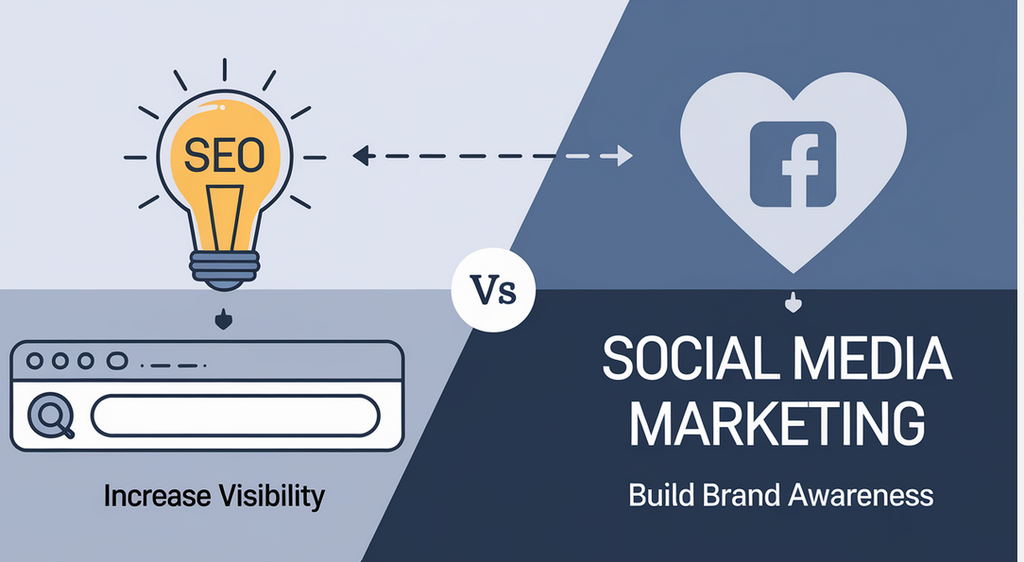
When marketing your brand online, two of the most popular options you will likely consider are SEO and social media marketing. SEO involves optimizing your website for search engines. On the other hand, social media marketing consists of connecting with, building relationships, and generating traffic from social media platforms such as Facebook, Instagram, X, and TikTok. These two are interrelated, especially now that Google ranks Instagram posts, which is one reason it pays to optimize Instagram for Google Search.
Each of these social media strategies has its pros and cons. Here are the key differences and how to decide which one is better for your digital marketing needs.

Key Differences Between SEO and SMM
Now that we understand the meaning of SEO and SMM, we must appreciate their different qualities. Here are some of the most significant differences:
Content
Content is needed in both social media marketing and SEO. Let’s examine writing for each of these channels:
SEO Writing
In SEO, you must create high-quality content that ranks highly on search engines. The best SEO content provides in-depth answers to search queries. When creating SEO content, your goal should be to answer the search query in the most comprehensive and detailed manner. Some of the key features of SEO content that rank highly on the search engines are:
- Long-form content. Focus on creating content of at least 1,500 words that is relevant to your target audience. Long-form content is more effective for SEO because it can more easily answer search queries. This can be particularly essential for your content pillars.
- Quality content. Quality content delivers relevance, value, and usefulness to its target audience. It’s designed to enable it to meet the users’ needs by providing them with content in an engaging format that enhances their online presence. It should provide a thorough analysis of a deep topic and offer in-depth data and insight. It should be easy to navigate and read with clear headings, subheadings, bullet points, and a logical flow. The content should offer a new perspective on the topic.
- Well optimized for search engines. It can be challenging to rank well in search engines unless your content is well optimized for them. One way to ensure relevance is by identifying keywords that your target audience uses to search for articles in your niche. You should then optimize for the keywords. This is an essential step in social media competitor analysis.
Social Media Content Creation
Social media content marketing involves creating content for social media platforms. The goal is to create content that resonates with your target audience. Such content should be concise and attention-grabbing to ensure it resonates with the target audience. Audience size is a separate problem, and some brands buy social media followers from Mixx when a profile is starting from nothing, though the count means little unless the posts behind it hold attention.
Here are tips for creating social media content:
- Create a variety of content. Unlike SEO, which focuses on blog and article writing, social media content creation involves creating various forms of content, including written posts, videos, articles, and other multimedia elements. The type of content you make will depend on your targeted platform. For instance, if you create content for TikTok, focus on creating short-form videos. On the other hand, written text is more suitable for platforms like Facebook (for long texts) and X (for short texts). A good idea is to A/B to find the right content strategy.
- Creativity. You need to understand your social media content creation goals, such as sales, awareness, and driving engagement. Then, you can focus on creating content that aligns with the goal.
- Strategy. Plan your content writing to create content that resonates with your target audience by understanding their behaviors, interests, and challenges.
- Engaging visuals. Include high-quality and well-optimized visuals that are attention-grabbing to drive engagement and interaction. Ensure you generate outstanding headlines, the right hashtags, and impactful and concise captions. You can also use storytelling methods.
- Consistency. You must regularly create social media content to maintain high visibility, relevance, and credibility. Keep the same style, tone, and branding to improve trust and recognition.
- Emotional connection. The most successful social media content sparks an emotional connection, driving responses such as anger, anxiety, and awe.
Audience
Whether you are creating content for SEO or SMM, you need to understand your audience better. Let’s consider how to plan with your audience for both.
Understanding Your SEO Audience
One of the first steps in planning your SEO content is understanding your target audience. You can create marketing personas, which are fictitious representations of your target audience. This will enable you to create a marketing strategy based on the target persona. It will also become possible to create content that meets the needs of your target persona.
Remember that your target audience has questions they are looking for answers to. The more accurate the answer you provide, the more likely they are to trust and patronize your brand. You can use Google Analytics to see how your content performs after publication. You can then use the data to optimize your content to better match the search intent.
Understanding Your Social Media Audience
The advantage of social media marketing is that it makes it easy to understand your target audience through built-in analytics. These built-in analytics will provide insights into the people visiting your social media platform, helping you better understand who they are. This can be especially important because 74% of social media users suggest using these platforms for social commerce.
Success Rate
How you measure your SEO success level differs from that of SMM:
Tracking SEO Success
When measuring SEO success, consider various key performance indicators, including keyword ranking, organic traffic, and click-through rate. You can find this data using tools such as Google Search Console and Google Analytics.
Ensure you measure your performance against established key goals while conducting competitor analysis. This will provide insights into what is working and help you better understand your areas for improvement, leading to better results. Remember that achieving SEO success can be a slow process.
On the flip side, it has better long-term results than social media marketing. Therefore, SEO is an excellent way of bringing visitors to your site by ranking for your target keywords. It is a good option for long-term social media growth.
Tracking SMM Success
While social media marketing requires effort and planning, it can be an effective way to increase brand awareness and engage with your target audience. Imagine a situation where people share your content until it goes viral, giving it a big boost. However, with new content arriving on social media, the success may not last long.
Given the ephemeral nature of social media content, it is essential to post regularly to ensure a successful social media campaign. You also need to understand when your audience is primarily active on social media to ensure they see your content before it is hidden in other content.
While the ROI of social media may be smaller than that of SEO, it doesn’t require much time to post on social media and to see the interaction. Remember that it takes time to grow a social media following. Although uploading content is immediate, it takes time to start seeing real engagement. Tracking the success of social media content isn’t difficult, as you can easily view various engagement metrics, such as likes, shares, and comments.
Conclusion
Both SEO and SMM should be part of your digital marketing strategy. SEO helps to improve your ranking on search engines, increasing website traffic and visibility. On the other hand, social media marketing offers instant results in terms of brand awareness, audience engagement, and community building.
Therefore, SEO is a more long-term investment, while SMM offers fast but short-lived results. The most effective strategy is the one that integrates both SEO and SMM.