
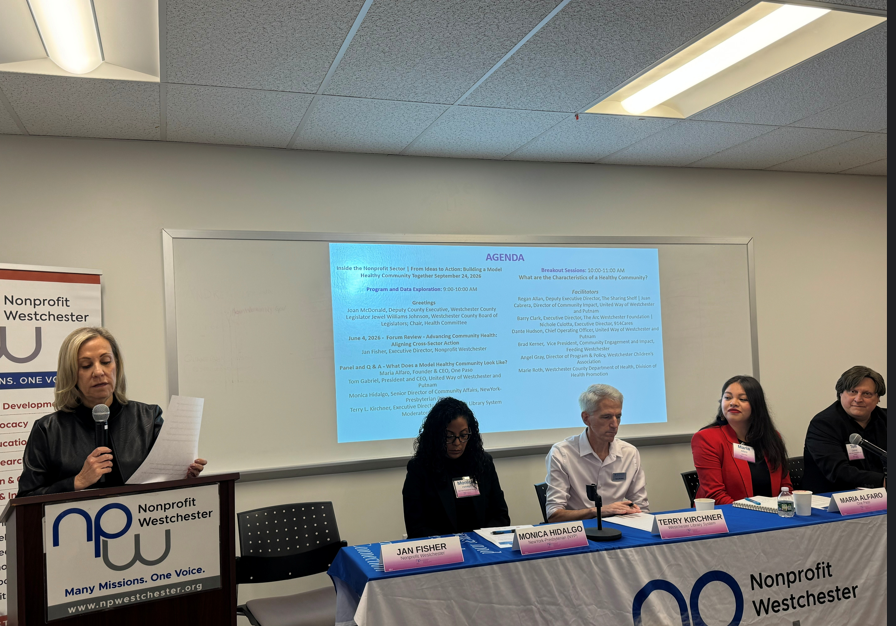
Cross-sector leaders gather in Elmsford to tackle how skyrocketing costs of basics, housing, energy, and health insurance impact community wellness
The surging cost of basic necessities – food, shelter, energy, and health insurance—are a major roadblock to keeping Westchester healthy.
That was the takeaway from Nonprofit Westchester’s (NPW) “From Ideas to Action: Building a Model Healthy Community Together” event at the NPW offices in Elmsford, which convened regional leaders to address how to overcome obstacles to building healthy communities.
Serving as a follow-up to NPW’s landmark June 4th cross-sector summit on healthcare, the event on September 24 featured a panel of experts including Maria Alfaro (Founder & CEO, One Paso), Tom Gabriel (President & CEO, United Way of Westchester and Putnam), Monica Hidalgo (Senior Director of Community Affairs, NewYork-Presbyterian), and Terry L. Kirchner, PhD (Executive Director, Westchester Library System). It was followed by breakout sessions led by the panelists. The program was opened by Deputy Westchester County Executive Joan McDonald and Westchester County Legislator Jewel Johnson, chair of the county board’s health committee.
Jan Fisher, Executive Director of Nonprofit Westchester and the day’s moderator, said building healthy communities involves looking at the wider context of the environment in which we live.
“A model healthy community is about much more than healthcare and the absence of illness. It is about a community where all people have the opportunity to be physically, mentally, socially and economically healthy and where all people have a chance to live, work, learn, connect, create and recreate,’’ she said.
Key Program Takeaways & Speaker Perspectives
Speakers emphasized that the compounding pressures of living costs, health insurance burdens, and a rapidly growing older population continue to act as major roadblocks to achieving long-term community health equity. Health outcomes, they said, cannot be effectively improved while residents face severe financial precarity.
- The Squeezed Middle and Growing Older Population: Program leaders underscored how rising fixed costs and insurance premiums disproportionately affect vulnerable groups and a burgeoning older demographic.
Tom Gabriel, CEO of United Way of Westchester and Putnam, said the most recent findings of the United Way’s bi-annual ALICE report (Asset Limited Income Constrained) released in August shows a steadily increasing gap between wages and the cost of living. The report, he said, shows that 41 percent of area residents are either living in poverty or from paycheck to paycheck – a 39 percent increase from just two years ago. He added that while the aggregate wealth of the top 10 billionaires has gone from $550 billion in 2014 to $2.7 trillion today, salary increases for the average American totaled about only 7 percent during that period.
“So salaries have gone up 7 percent, but food has gone up 200 percent. The math doesn’t math here. It’s really quite simple: You can’t thrive if you can’t put food on the table,’’ he said.
Jan Fisher reminded the group that governments, especially in the area of economic development, – don’t plan with the 41 perccent ALICE in mind but the other 60 percent.
- Inclusive Community Engagement: The dialogue heavily prioritized grassroots inclusion to ensure diverse populations help shape local health frameworks.
Maria Alfaro, Founder & CEO, One Paso, said she became interested in helping people navigate the mental health system after experiencing frustration helping her mother access care for her bi-polar diagnosis.
Alfaro said that her group was dedicated to meeting people where they live and pointed to two programs: one where they partner with a local barber shop and another which offers free salsa dance lessons led by a licensed social worker. She said in the current climate people feel scared to go shopping, walk outside their door or go to the doctor’s office.
“We are able to meet our community in a way that they feel safe, that they understand,’’ she said. “So we are able to help them with things that go beyond salsa dancing or chit chatting at the barbershop.’’