
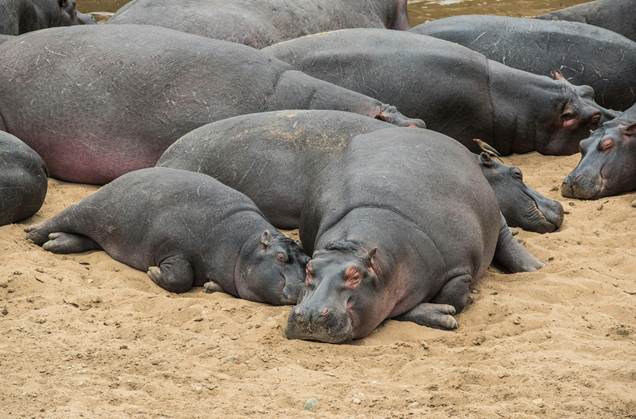
While DR Congo is battling the deadly Ebola Outbtreak, another disease is taking a heavy toll on wildlife in Virunga National Park in eastern Congo. Over 30 Hippos have died after an anthrax outbreak in the Virunga National Park, Africa’s oldest national park.
Over the past four weeks, carcasses of hippos have been discovered in the Semuliki River, west of the Virunga Park. This raised concerns among communities that live adjacent to the river banks.
Following labarotary tests, the Virunga Park has confirmed an anthrax outbreak. The disease is caused by the bacterium Bacillus anthracis and the disease can be transmitted to humans as well.
Anthrax Threatens Wildlife and Local Communities
A hippo does not ask for much. A cool river, a patch of grass at night and a little peace are enough to keep it happy.
It spends most of the day soaking and grumbling, which is probably why it is so hard to imagine something small enough to bring a two-tonne animal down.
Yet that is exactly what has been happening in the Democratic Republic of Congo, where anthrax is killing hippos in Africa’s oldest national park.
Officials say anthrax has killed about 30 hippos in Virunga National Park since September 2026. Park staff first reported the problem in the autumn, and laboratory tests confirmed the cause. Pictures shared by the park showed dead hippos in rivers such as the Semuliki.
There is some good news. According to the park’s conservation chief, Laura Parker, no new cases had been found in the two weeks before the latest update. Park authorities believe the recent heavy rains have helped, and they are hopeful that the outbreak is ending, but monitoring continues.
Why does it keep coming back?
Anthrax is caused by a bacterium called Bacillus anthracis, which lives naturally in the soil in many parts of the world.
It forms tough spores that can sit quietly in the ground for decades, waiting for the right moment. Park officials say outbreaks in Virunga have been seen before during dry spells and drought, when animals crowd around shrinking water and graze on dusty ground.
Hippos are especially exposed. They feed on short grass close to the ground, where spores can be picked up, and they spend a lot of time in the same stretches of water.
This is not the first time it has happened. In 2025, an outbreak killed around 65 hippos in the park, and buffalo were also affected. At that time, staff had to bring in excavators to pull carcasses out of the water.
Anthrax can pass from animals to people, which is why the park takes it so seriously. A person can be infected by touching a sick or dead animal, by butchering it or by eating its meat.
For this reason, the officials of the Virunga Park has told nearby communities to stay away from any dead animal and to report it to the authorities instead of taking it home. This advice is simple, but it matters a great deal for villages beside the lakes and rivers.
Fewer hippos to lose

The outbreak is more worrying because Virunga’s hippos have already suffered. In the 1970s, the park was home to roughly 29,000 hippos, and that number has fallen sharply since then, mostly because of poaching, conflict and instability in the region.
Armed groups have operated in and around the park for years, and many rangers have lost their lives while defending wildlife. When a population is already small, every death counts.
Hippos also matter for the health of the whole area. They move nutrients between land and water, and their presence shapes rivers and lakes, so protecting them helps protect the entire ecosystem.
What conservation needs?
Virunga’s response has been focused on three things: watching closely for new cases, handling carcasses safely and lowering the risk for wildlife and local people. Teams record each new death and work to dispose of the bodies in a safe way, which helps stop the spores from spreading.
Beyond that, experts generally agree on a few longer-term needs. Rangers need steady funding, equipment and security so that they can patrol and respond quickly.
Communities around the park need clear information and reliable ways to report sick animals. Scientists need to keep studying how drought, water levels and soil conditions affect outbreaks.
And the region needs peace, because it is hard to look after wildlife in a conflict zone. Tourism can help with funding, but only when it is safe for visitors to travel.