
A hunting e-bike has to do more than carry a rider. Once hunting gear, water, bags, and other equipment are added, total weight can affect battery use, climbing, braking, and low-speed handling.
That is why hunters should not choose an e bike by maximum payload alone. The better setup is one that can carry the planned load while still leaving enough battery for the return trip and enough control for hills, gravel, and uneven access roads.
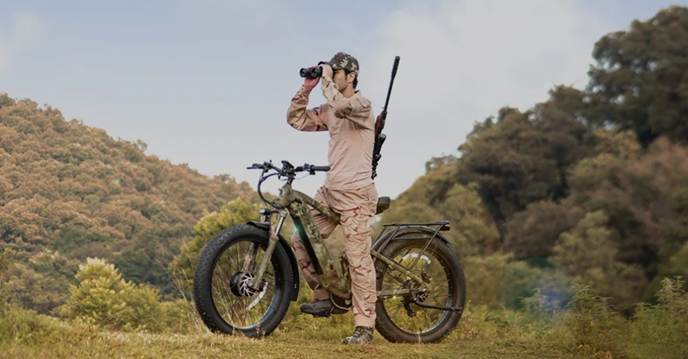
What Does E-Bike Payload Actually Include?
Payload includes the rider and everything carried on the bike.
A 400-pound maximum load does not mean the rider can add 400 pounds of equipment. Clothing, backpacks, tools, water, racks, and bags all count toward the total.
Individual accessories may also have their own lower weight limits. A rear rack or cargo box should therefore be checked separately rather than assuming the bike’s overall payload rating applies to every component.
For a hunting trip, calculate the realistic riding weight before deciding how much capacity is actually needed.
Does More Hunting Gear Reduce E-Bike Range?
Additional weight can increase energy use, especially when the route includes hills, loose ground, wind, or frequent acceleration.
This makes advertised range a starting point rather than a guarantee.
A lightly loaded bike on level pavement and the same bike carrying substantial gear up a forest road will not use energy in the same way. Hunters should plan around the complete round trip and leave reserve for unexpected detours or harder terrain.
For longer access routes, additional battery capacity is useful because it provides more flexibility when weight and climbing increase at the same time.
Where Should Heavy Gear Be Carried?
Weight distribution affects handling.
Putting too much weight high above or far behind the rear wheel can make a bike feel less balanced. Cargo should be secured so it cannot move during turns or interfere with the wheels, brakes, suspension, or drivetrain.
The best time to find out how a loaded bike handles is not on hunting morning.
Load the bike beforehand and test it on familiar hills, turns, and braking sections. The goal is to know how the bike behaves with the same approximate weight it will carry in the field.
Why Does Braking Matter More With a Heavy Load?
More total weight gives the brakes more mass to control.
That becomes particularly important on descents, where the bike may be carrying the rider and a full load over gravel, dirt, or wet surfaces.
Hydraulic disc brakes can provide controlled braking on heavier outdoor bikes, but tire grip and maintenance matter too. Even strong brakes cannot create traction when the tires are sliding on loose ground.
A loaded electric hunting bike should therefore be evaluated for downhill control as carefully as climbing support.
Are Fat Tires Useful for Loaded Hunting Rides?
They can be when additional weight is combined with changing terrain.
A fat tire electric bike uses wider tires that can provide a more planted feel across gravel, loose dirt, mud, and rough access roads. That can be useful when cargo weight is already affecting balance.
The trade-off is that wider tires and heavier outdoor components add weight and rolling resistance.
Hunters riding mostly smooth maintained roads may not need them. They make more sense when a typical route regularly changes between pavement, gravel, forest roads, and rougher ground.
What Does a Long-Range Hunting Setup Look Like?
The Puckipuppy Bulldog Pro shows how payload, range, and terrain equipment can be combined in one outdoor-oriented setup.
It uses two removable 48V 15Ah batteries and has a manufacturer-listed range of 80–130 miles. Its motor is rated at 750W and reaches 1,350W peak output, while a torque-and-cadence sensor adjusts assistance according to rider input.
For loaded outdoor riding, the more relevant specifications are its 400-pound maximum load, 26 × 4-inch fat tires, full suspension, and hydraulic disc brakes. Puckipuppy positions the Bulldog Pro for longer outdoor trips and mixed terrain, including gravel, muddy paths, and forest trails where e-bike access is permitted.
The dual-battery system can provide useful range margin when hills and equipment increase energy demand. However, the bike itself weighs 94.1 pounds, so transport and handling without motor assistance also deserve consideration.
A heavier hunting ebike may feel manageable while powered, but lifting it onto a rack or pushing it around an obstacle can be much harder. That trade-off should be considered before the trip.
Does a Higher Payload Rating Mean Better Handling?
No. Payload capacity and handling are different things.
A bike may technically support a heavy total load while still feeling noticeably different near that limit. Steering, braking, acceleration, and low-speed balance can all change as weight increases.
Hunters should therefore treat maximum payload as a limit, not a target.
The more useful test is whether the bike remains predictable with the actual equipment carried on the intended terrain.
Should Hunters Prioritize Payload or Range?
Neither should be considered alone.
A high-payload bike without enough battery reserve may not work well for a long, hilly access route. A long-range bike that becomes difficult to control when loaded creates a different problem.
Start with what needs to be carried, then consider distance, elevation, terrain, brakes, and battery capacity together.
This approach gives a much more realistic picture of whether the bike suits the hunt.
Check Access Rules Before Riding
For hunters in New York, terrain capability does not automatically mean trail access.
DEC rules for Wildlife Management Areas restrict motorized off-road use, including e-bikes, unless the route is specifically posted or otherwise authorized. Riders should check the rules for the exact property and road before planning e-bike access.
Test the Loaded Bike Before the Trip
The most useful preparation is a realistic loaded test ride.
Carry roughly the same equipment, ride a hill, make several slow turns, and test the brakes on familiar terrain. Pay attention to battery consumption and whether the cargo changes steering or balance.
For hunters, payload, range, and handling are not separate specifications. They work together, and a useful hunting e-bike needs to remain predictable after the gear is loaded and the road becomes more demanding.