
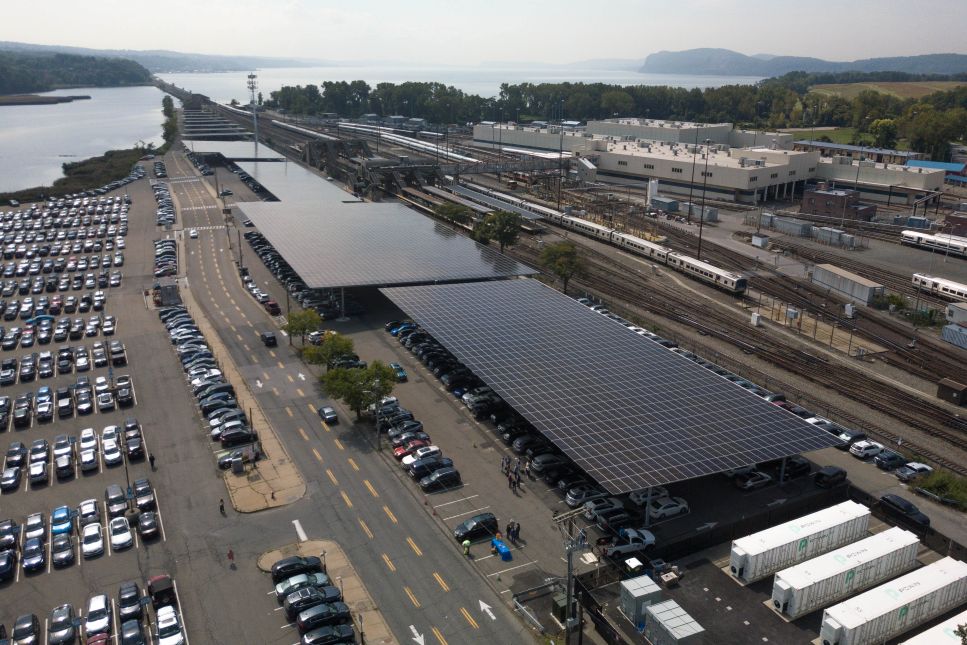
The Village of Croton-on-Hudson today celebrated its landmark solar canopy and battery storage project at the Croton-Harmon Train Station, an innovative clean-energy project that is generating renewable power while making productive use of one of the Village’s largest existing public assets.
Installed over portions of the Croton-Harmon commuter parking lot, the project includes approximately 4.2 megawatts of solar generation paired with a 15 megawatt-hour battery energy storage system. The solar canopies allow the property to continue serving its primary purpose as commuter parking while also providing covered parking and producing clean energy close to where it is needed.
The project is also creating a significant new source of recurring lease revenue for the Village, demonstrating how investments in clean energy can support both Croton-on-Hudson’s environmental goals and its long-term fiscal sustainability.
“This carport array shows environmental leadership and fiscal responsibility are one and the same. Thank you to NYSERDA, Altus Power, and Columbia University for the partnership and commitment that made this project possible. Transforming our commuter lot into a source of reliable, clean power brings hundreds of thousands of dollars in lease revenue directly to the Village every year. This carport solar array is helping us balance our budgets without raising the tax rate and keeping money in our residents’ pockets where it belongs,” said Croton-on-Hudson Mayor Brian Pugh.
“Every single community across the state could benefit from a project like this, which generates revenue for municipalities, helps ease the burden on local taxpayers, and puts downward pressure on wholesale energy prices. I commend Mayor Pugh and the Village Board for their foresight and decisive leadership in maximizing the use of space at the Croton-Harmon Train Station and delivering benefits to residents throughout the community,” said New York State Senator Pete Harckham.
“This project is a perfect example of what we need to be doing in as many parking lots as possible. We have so many sites where we could be generating and storing energy as well as providing shade and protection for our cars. I applaud the Village of Croton, the Croton Sustainability Committee, and everyone involved with seeing this project through to fruition. We need to keep talking about this project, making sure everyone knows why it is a success and why they should be doing something similar in their town, village, or city,” said New York State Assemblymember Dana Levenberg.
The project was years in the making. The Village issued a request for proposals for solar canopies at the train station in 2020, following years of consideration of solar generation at the property. After receiving seven proposals, the Village selected Sol Systems and approved a lease agreement in 2021 following review by Village staff, the Sustainability Committee and multiple land-use and regulatory bodies. Sol Systems led development of the project, which was subsequently acquired by Arevon and substantially completed by the end of 2024.
The project was made possible through collaboration among the Village, its Sustainability Committee, private-sector partners and New York State, including support from the New York State Energy Research and Development Authority (NYSERDA).
“I am proud to be the ‘so-called visionary’ behind this project. This project is an example of what can be done when municipalities and private investment work together to reduce the impacts of climate change,” said Lindsay Audin, Chair of the Croton-on-Hudson Sustainability Committee.
Altus Power acquired the solar-plus-storage project from Arevon in April 2026 and today owns and operates the system. The energy generated through the project serves a diverse group of community solar customers, including residential apartment buildings, a local medical center and Columbia University.
“A commuter parking lot doing double duty is a good deal for everyone in Croton-on-Hudson – shade for your car, and clean, storage-backed power flowing onto the local grid,” said Skylar Werde, Head of Community Solar, Altus Power. “The savings reach a real cross-section of New York, from apartment residents to a local medical center to Columbia University. That’s what community solar is meant to do.”
The project is expected to avoid approximately 1,800 tons of greenhouse gas emissions annually. Its battery storage component also allows energy generated by the solar array to be stored and dispatched when needed, adding another dimension to the project’s contribution to a cleaner and more resilient electric grid.
The project has already earned recognition beyond Croton-on-Hudson. In 2024, the Hudson Valley Regional Council presented the Village with an Impact Award recognizing the project’s positive environmental impact and advancement of clean energy. In 2025, the New York Conference of Mayors presented Croton-on-Hudson with a Local Government Achievement Award for the project.
More recently, an August 2026 report from the Office of the New York City Comptroller highlighted the Croton-Harmon project as an example of how publicly owned parking facilities can be transformed into revenue-generating clean-energy assets. The report cited Croton’s approach as a model for how municipal properties can simultaneously generate revenue, support local energy needs, improve grid reliability and expand clean-energy deployment.