
AI security is now a board-level priority. This practical guide gives IT leaders a five-layer framework to govern, protect, and monitor AI across the enterprise

Artificial intelligence has moved into the core of how businesses operate, often faster than security teams can keep up. That speed is now showing up in breach data. According to IBM’s 2025 Cost of a Data Breach Report, 13% of organizations suffered a breach of their AI models or applications, and a striking 97% of those had no proper AI access controls in place. In short, adoption is racing ahead while safeguards lag behind. IBM’s own summary is blunt: adoption is outpacing both security and governance. The gap is not a shortage of tools; it is a shortage of structure. For IT leaders, ad hoc fixes are no longer enough, and what the moment calls for is a repeatable AI security framework. This guide breaks down the threats that matter, a five-layer structure you can adopt, and the practical steps to put it to work.
Key Takeaways
- AI security means protecting AI systems and governing how AI is used across the business.
- IBM found that 63% of breached organizations had no AI governance policy at all.
- Shadow AI, the unsanctioned use of AI tools, added around 670,000 dollars to the average breach.
- A layered approach spanning governance, data, models, identity, and monitoring gives leaders a repeatable plan.
- Established frameworks let teams build on proven structure rather than starting from a blank page.
What AI Security Actually Means
AI security has two sides. The first is protecting the AI systems themselves, their training data, models, and pipelines, from tampering and theft. The second is governing how people across the business use AI, so that sensitive information does not leak into tools nobody is watching. Guard only one side and the other stays exposed. For growing organizations, adopting AI security solutions for enterprises that cover both at once has become a strategic priority rather than a nice-to-have.
This is different from traditional cybersecurity. AI systems learn from data, behave probabilistically, and can be manipulated through their inputs, which creates exposures that firewalls and antivirus were never designed to catch. The same care that goes into handling sensitive user data in any application now has to extend to the models that process it. An AI system is only as trustworthy as the weaker of those two halves.
The Threats IT Leaders Cannot Ignore
AI introduces attack surfaces that look nothing like the ones security teams grew up with. A handful deserve immediate attention.
| Threat | What it does |
|---|---|
| Prompt injection | Hidden instructions trick a model into leaking data or taking unauthorized actions |
| Data poisoning | Corrupted training data skews a model toward biased or unsafe outputs |
| Model theft and inversion | Attackers copy a model or reconstruct the sensitive data it learned from |
| Shadow AI | Staff paste confidential data into unsanctioned tools with no oversight |
| Supply chain compromise | A tampered app, API, or plugin opens a path into connected systems |
| Warning: shadow AI is the fastest-growing of these. IBM found that one in five breached organizations was hit through unsanctioned AI, and those incidents were far more likely to expose customer records and intellectual property. |
The common thread is visibility. Most of these attacks succeed because nobody knew the AI was there, or understood what it could reach. Traditional tools scan for known malware and suspicious traffic, yet a poisoned dataset or a cleverly worded prompt carries none of those signatures.
A Five-Layer AI Security Framework
You do not need to invent controls from nothing. A workable framework organizes the effort into five connected layers, each answering a different question.
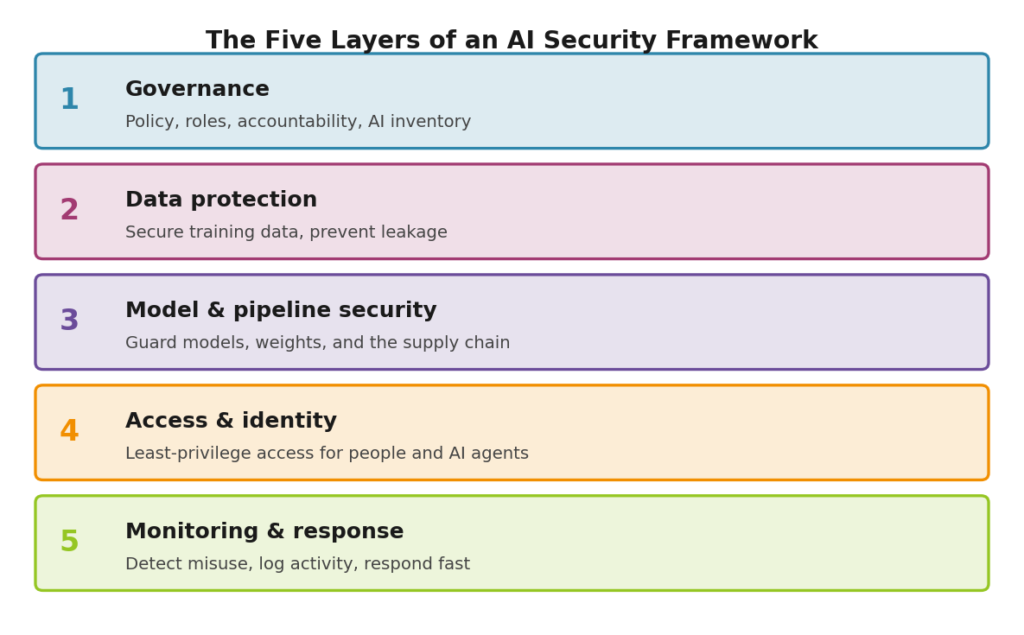
Each layer supports the ones above it, with governance at the base.
| Layer | Key controls | Maps to |
|---|---|---|
| Governance | Policies, roles, an AI inventory, and clear accountability | Govern |
| Data protection | Secure training data, classify inputs, prevent leakage | Map |
| Model and pipeline security | Protect model weights, vet the supply chain, test for abuse | Measure |
| Access and identity | Least-privilege access for people and AI agents alike | Manage |
| Monitoring and response | Log activity, detect misuse, and rehearse incident response | Manage |
Governance sits at the base for a reason. Without clear ownership and an inventory of where AI actually runs, the other four layers have nothing to stand on. In practice, that first inventory is often the single highest-value hour a security team can spend. Many teams anchor this layer in an established risk management framework, whose functions of govern, map, measure, and manage give the whole program a common language. That shared vocabulary matters, because AI risk lands on legal, data science, and procurement teams at once.
“The real risk isn’t AI itself, it’s AI without governance.” IBM, 2025
Putting the Framework Into Practice
Frameworks fail when they stay on paper. The encouraging part is that the biggest gaps are also the easiest wins.
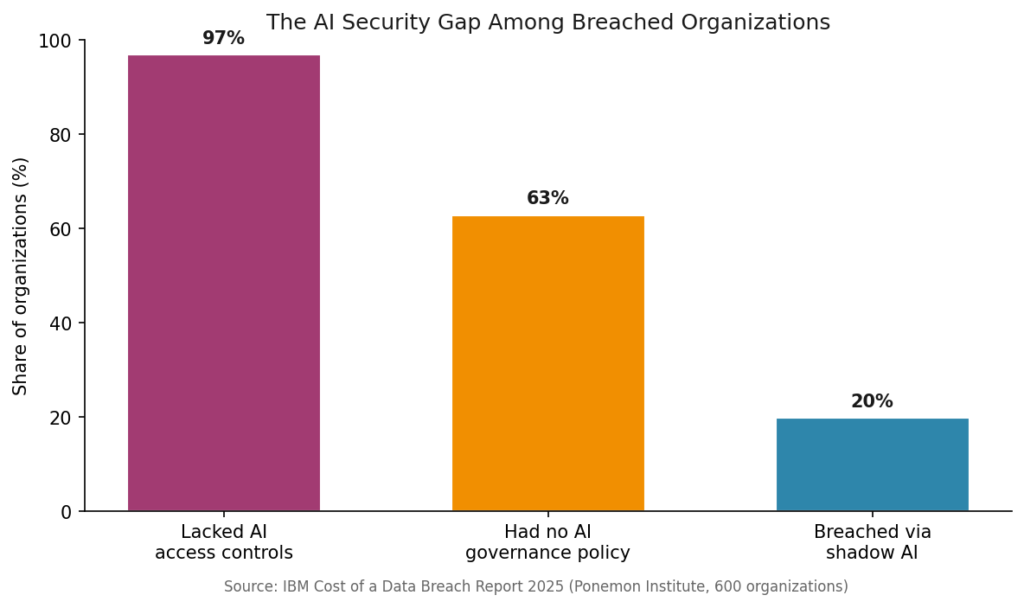
The most common failures are basic controls, not exotic attacks.
Start where the data points. Since almost every AI-related breach involves missing access controls, treat identity as job one and give every model, agent, and user only the access it truly needs. Next, close the governance gap with a short, enforceable AI use policy and a live inventory of the tools in play. Then layer in monitoring so misuse surfaces early. Each step is modest on its own, yet together they close the gaps behind most incidents.
People matter as much as technology here. A shadow AI problem is usually a culture signal, so pairing clear rules with building a security-first culture does more than any single control. The same discipline behind everyday security hygiene applies directly to the AI layer.
[Video: “Securing AI Systems: Protecting Data, Models, & Usage” by IBM: https://www.youtube.com/watch?v=2A94Mxn3jAc]
This short explainer walks through protecting the data, models, and usage that any framework has to cover. None of these first moves demand a large budget; they demand ownership and follow-through.
Measuring Success and Common Pitfalls
Progress needs metrics. Track the share of AI tools in your inventory that have a named owner, the percentage of models sitting behind access controls, and how quickly you detect unsanctioned use. Rising numbers show the framework is working. Tie each metric to a named owner and a review date, or it quietly stops being tracked.
| Key stat: organizations that use AI extensively in their own defenses save nearly 1.9 million dollars per breach and contain incidents about 80 days faster, according to IBM. Security, done well, pays for itself. |
Watch for the common traps:
- Buying tools before writing a policy, which leaves controls with nothing to enforce.
- Forgetting third parties, since a vendor’s weak AI practices quietly become your own.
- Treating governance as a one-time document rather than a living process.
- Ignoring the human layer, where most shadow AI actually begins.
As AI spreads into connected city and business infrastructure, the demand for skilled defenders keeps climbing. That is one reason the growing need for security talent is now a strategic issue rather than a purely staffing one.
| Pro tip: review the framework on a set cadence, not just after an incident. AI, its risks, and the rules around it are all moving quickly, so a quarterly check keeps the program from drifting out of date. |
Frequently Asked Questions
What is AI security?
AI security is the practice of protecting AI systems, including their data, models, and the pipelines that feed them, while governing how people use AI across the business. It addresses risks such as prompt injection and data leakage that older tools miss.
How is it different from regular cybersecurity?
Traditional security protects networks and endpoints. This discipline adds the model layer: systems that learn from data, act unpredictably, and can be steered by crafted inputs. It also governs unsanctioned tool use, known as shadow AI.
Which framework should we start with?
Many teams begin with the NIST AI Risk Management Framework and its four functions of govern, map, measure, and manage. Google’s SAIF and the OWASP guidance for AI are useful complements for technical controls.
What is shadow AI and why does it matter?
Shadow AI means employees running AI tools without IT approval or oversight. IBM found it raised the average breach cost by about 670,000 dollars and disproportionately exposed customer data and IP.
Where should an IT leader begin?
Start with visibility and access. Build an inventory of every AI tool in use, put least-privilege controls around models and data, and write a short usage policy. Those three moves close the most common gaps.
A Living Framework Is the Goal
AI is now too woven into daily operations to secure as an afterthought. The organizations pulling ahead are not the ones with the flashiest models; they are the ones that paired adoption with a clear plan to govern it. A layered framework, built on governance and carried through data, models, access, and monitoring, turns a sprawling problem into a set of manageable decisions. Start with an inventory and access controls, anchor the work in a proven structure, and revisit it often. The threats will keep evolving, and a framework that evolves with them is how IT leaders stay ahead.
References
IBM, Cost of a Data Breach Report 2025. https://www.ibm.com/reports/data-breach
NIST, Artificial Intelligence Risk Management Framework (AI RMF 1.0), 2023. https://www.nist.gov/itl/ai-risk-management-framework
NIST, Trustworthy and Responsible AI Resource Center. https://airc.nist.gov/airmf-resources/airmf/
Google, Secure AI Framework (SAIF). https://saif.google/
IBM, 2025 Cost of a Data Breach: Navigating the AI Rush. https://www.ibm.com/think/x-force/2025-cost-of-a-data-breach-navigating-ai