
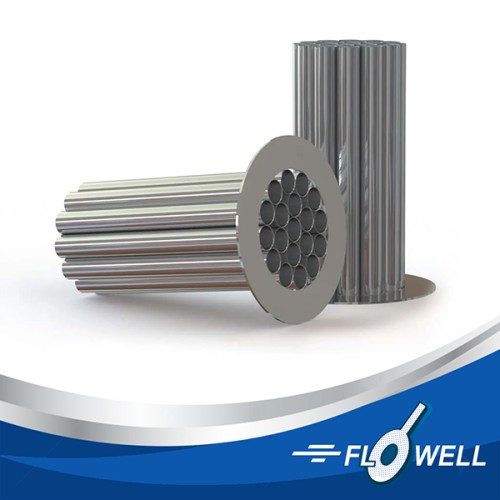
Accurate flow measurement depends on more than simply installing a meter in a pipeline. The condition of the fluid as it enters the meter can significantly influence measurement accuracy, repeatability, and overall performance. Disturbances caused by elbows, valves, pumps, reducers, and other piping components can create swirl or uneven velocity profiles that interfere with reliable readings. Straightening vanes are designed to help correct these disturbances before the fluid reaches the measuring device. Understanding how a straightening vanes flow meter arrangement works can help engineers and facility operators improve the consistency of their flow measurement systems.
What Are Straightening Vanes?
Straightening vanes are internal piping components designed to reduce swirl and improve the flow profile of liquids or gases moving through a pipeline. They are generally installed upstream of a flow meter where turbulent or distorted flow could interfere with measurement accuracy. Their purpose is to guide the fluid in a straighter, more uniform direction before it enters the meter. Depending on the design, straightening vanes may consist of tubes, channels, plates, or other structures arranged inside the pipe. These components help create more predictable conditions at the point where flow is measured.
The need for straightening vanes becomes especially important when adequate lengths of straight pipe are not available. Most flow meters perform best when fluid approaches them with a relatively stable and symmetrical velocity profile. Unfortunately, real-world piping systems often contain fittings and equipment that disturb the flow. A properly selected flow straightener can reduce some of these effects. It does not necessarily eliminate every flow disturbance, but it can improve conditions enough to support more reliable measurements.
Why Is Flow Conditioning Important?
Flow conditioning is the process of improving the characteristics of fluid before it reaches a measuring device. Ideally, fluid should travel through the pipe with a predictable velocity distribution and minimal rotational movement. When flow becomes distorted, one portion of the pipe may carry fluid faster than another, creating an uneven velocity profile. Swirl can also cause fluid to rotate around the pipe axis as it moves forward. These conditions can affect how certain flow meters interpret velocity and calculate the final flow rate.
Flow disturbances may be introduced by a variety of common piping components. A single elbow can alter the velocity distribution, while multiple elbows in different planes can create more complicated patterns. Control valves, partially open valves, pumps, and sudden changes in pipe diameter can also create challenging flow conditions. If the meter is located too close to these components, measurement errors may occur. Flow conditioning devices, such as straightening vanes, are one method engineers can use to reduce those errors.
How Do Straightening Vanes Work?
Straightening vanes work by dividing the flowing fluid into smaller channels that reduce rotational movement and encourage a more axial direction of travel. As the fluid passes through the vane assembly, large-scale swirl patterns are disrupted and redirected. The fluid then exits the device with a more stable flow profile than it had before entering. The exact degree of improvement depends on the vane design, installation location, fluid properties, and upstream disturbance. Properly engineered vanes can significantly improve the conditions experienced by the downstream flow meter.
Some designs primarily focus on removing swirl, while others are intended to redistribute velocity across the pipe cross-section. This distinction is important because eliminating swirl does not always create a fully developed velocity profile. A flow straightener may remove rotational motion but leave some velocity distortion behind. More advanced flow conditioners can address both swirl and profile asymmetry. Engineers should therefore select a device based on the specific flow problem rather than assuming all straighteners perform the same function.
What Causes Disturbed Flow?
Disturbed flow is common in industrial piping because fluids rarely travel through long, uninterrupted sections of pipe. Every change in direction, diameter, pressure, or velocity can affect the way the fluid moves. Some disturbances disappear after sufficient straight pipe length, while others can persist for a considerable distance downstream. The closer the meter is to the source of the disturbance, the greater the possibility of measurement error. Understanding the source of the disturbance is an important part of selecting an appropriate solution.
Common causes of disturbed flow include:
- Pipe elbows
- Multiple elbows in different planes
- Tees and branch connections
- Control valves
- Partially closed valves
- Pumps
- Compressors
- Pipe reducers
- Pipe expanders
- Headers and manifolds
- Sudden changes in flow direction
Different disturbances produce different flow patterns. An elbow may create an uneven velocity distribution, while a partially closed valve can generate substantial turbulence. Two elbows arranged in different planes may create a strong swirl that remains present far downstream. These conditions can be especially problematic for meters that depend on predictable velocity patterns. Straightening vanes can help reduce some of these effects when proper piping arrangements are difficult to achieve.
How Straightening Vanes Improve Flow Meter Accuracy
A flow meter generally performs most accurately when it receives fluid under the conditions assumed during its design and calibration. If the velocity profile entering the meter differs significantly from the expected conditions, the meter may produce biased readings. Straightening vanes helps bring actual field conditions closer to the conditions required for reliable measurement. By reducing swirl and directing fluid more uniformly, they can improve repeatability and reduce measurement uncertainty. This is especially useful in installations with limited upstream straight pipe.
The effectiveness of a straightening vanes flow meter installation depends heavily on positioning. Installing the straightener directly against the meter may not always produce ideal results because the fluid may need additional distance to stabilize after leaving the vane assembly. Similarly, placing the straightener too close to a severe upstream disturbance may limit its effectiveness. Manufacturers and engineering standards often provide recommended spacing requirements. Following those recommendations is important when accuracy is a priority.
What Types of Flow Meters Benefit From Straightening Vanes?
Several types of flow meters can be affected by upstream flow disturbances. Turbine meters, differential pressure meters, ultrasonic meters, and other velocity-sensitive technologies may require specific installation conditions to achieve their expected performance. The amount of straight pipe required depends on the meter design and the type of disturbance upstream. When sufficient straight-run piping cannot be provided, straightening vanes or other flow conditioners may be recommended. The meter manufacturer’s installation instructions should always be reviewed before selecting a conditioning device.
Flow meters that may benefit from improved upstream conditions include:
- Turbine flow meters
- Orifice plate flow meters
- Venturi meters
- Ultrasonic flow meters
- Vortex flow meters
- Certain magnetic flow meters
- Other velocity-based measuring devices
Not every meter requires a flow straightener in every installation. Some modern flow meter designs are less sensitive to upstream disturbances than others. Even so, challenging piping layouts can introduce conditions that exceed the meter’s ability to compensate. Engineers should evaluate the complete piping configuration instead of focusing solely on the meter. This approach can help determine whether vanes, additional straight pipe, or another conditioning method provides the best solution.
Straightening Vanes vs. Straight Pipe
A straight pipe is one of the simplest methods for allowing disturbed flow to stabilize before it reaches a meter. As fluid travels through a sufficiently long section of uniform pipe, turbulence and velocity distortions may gradually become more predictable. Flow meter manufacturers commonly specify minimum upstream and downstream straight-run lengths as multiples of the pipe diameter. These recommendations can vary considerably depending on the meter and the upstream piping arrangement. In a new system, engineers may be able to design enough straight pipe into the installation.
Existing facilities often provide less flexibility. Space limitations, structural obstacles, equipment placement, and piping complexity may prevent technicians from creating the recommended straight run. Straightening vanes can provide an alternative when extending the pipe is impractical. They can reduce the amount of straight-run distance needed in certain applications, although some straight pipe is usually still required. The proper combination should be determined using manufacturer guidance and applicable engineering practices.
Straightening Vanes vs. Flow Conditioners
The terms flow straightener and flow conditioner are sometimes used interchangeably, but there can be meaningful technical differences. A straightener is primarily designed to reduce rotational or swirling motion in the fluid. A flow conditioner may perform a broader function by reducing swirl while also reshaping the velocity profile across the pipe. Some conditioning devices intentionally create controlled turbulence to redistribute flow more evenly. As a result, different devices may produce different downstream flow characteristics.
Choosing between these options requires understanding the meter’s sensitivity and the specific piping disturbance. A simple straightener may be adequate if swirl is the main concern. A more sophisticated conditioner may be preferable if the velocity profile is significantly asymmetrical or distorted. Pressure loss should also be considered because inserting any obstruction into the pipeline can create additional resistance. Engineers must balance measurement improvement against energy consumption and system performance.
Important Installation Considerations
Installing straightening vanes correctly is essential for achieving their intended benefits. The device should be centered properly within the pipeline and aligned according to the manufacturer’s specifications. Incorrect installation can create new disturbances rather than eliminating existing ones. The internal diameter and vane geometry should also match the piping and flow conditions. Poorly sized components may increase pressure loss or limit the effectiveness of the device.
Several factors should be considered during installation:
- Pipe diameter
- Flow direction
- Upstream disturbance type
- Distance from the disturbance
- Distance from the meter
- Fluid velocity
- Pressure loss
- Material compatibility
- Operating pressure
- Operating temperature
- Accessibility for maintenance
The device must also be suitable for the material flowing through the system. Corrosive chemicals, abrasive particles, high temperatures, and sanitary requirements may influence material selection. Internal buildup or contamination can gradually change the geometry of the vanes and affect performance. Periodic inspection may therefore be necessary in demanding applications. Proper maintenance helps preserve both flow conditioning effectiveness and measurement reliability.
Do Straightening Vanes Cause Pressure Loss?
Any component placed inside a pipeline has the potential to create some degree of pressure loss. Straightening vanes add surface area and resistance to the flow, which can reduce pressure downstream. The magnitude of this loss depends on the vane design, pipe size, fluid velocity, density, and other system conditions. Well-designed components aim to provide useful flow conditioning without introducing excessive restriction. Engineers should account for the expected pressure drop during system design.
Pressure loss becomes especially important in applications where pumping or compression costs are high. A highly restrictive flow conditioner may improve measurement conditions but increase the energy required to maintain the desired flow rate. This tradeoff should be evaluated before choosing a device. Manufacturers may provide pressure-loss coefficients or other performance data for their products. Using this information allows designers to compare conditioning performance with overall system efficiency.
FAQ About Straightening Vanes in Flow Measurement
What do straightening vanes do?
Straightening vanes reduce swirl and help guide fluid in a more uniform direction before it reaches a flow meter. This can improve measurement stability and accuracy.
Where are the straightening vanes installed?
They are usually installed upstream of a flow meter. The exact distance from the meter and upstream disturbance depends on the device and the manufacturer’s recommendations.
Do all flow meters require straightening vanes?
No. Some meters can operate accurately without them when adequate straight pipe is available, or the meter is less sensitive to flow disturbances.
Can straightening vanes replace straight pipe?
They can reduce straight-run requirements in some applications, but they do not always eliminate the need for straight pipe. Installation requirements should be based on meter and conditioner specifications.
Do straightening vanes reduce turbulence?
They can reduce certain types of flow disturbance, particularly swirl. Some flow conditioners are specifically designed to improve both turbulence characteristics and the velocity profile.
Can straightening vanes affect pressure?
Yes. Because they create resistance inside the pipe, straightening vanes can cause some pressure loss. The amount depends on their design and the operating conditions.
Choosing the Right Straightening Vanes for a Flow Meter
Selecting the right straightening vanes begins with understanding the characteristics of the meter and piping system. Engineers should evaluate pipe size, flow rate, meter technology, upstream fittings, available straight-run length, pressure-loss limits, and fluid properties. The type and severity of the upstream disturbance should also influence the design selection. Manufacturer installation requirements are especially important because different meters respond differently to disturbed flow. Selecting a compatible conditioning device can help the meter achieve more consistent field performance.
A properly designed straightening vanes flow meter installation can improve measurement reliability where piping constraints create undesirable flow conditions. Straightening vanes help reduce swirl, improve flow direction, and create more predictable conditions at the meter inlet. They can be particularly valuable in compact industrial systems where long sections of straight pipe are impractical. However, their performance depends on proper selection, positioning, installation, and maintenance. By treating flow conditioning as part of the overall measurement system, facilities can improve accuracy, consistency, and confidence in their flow data.