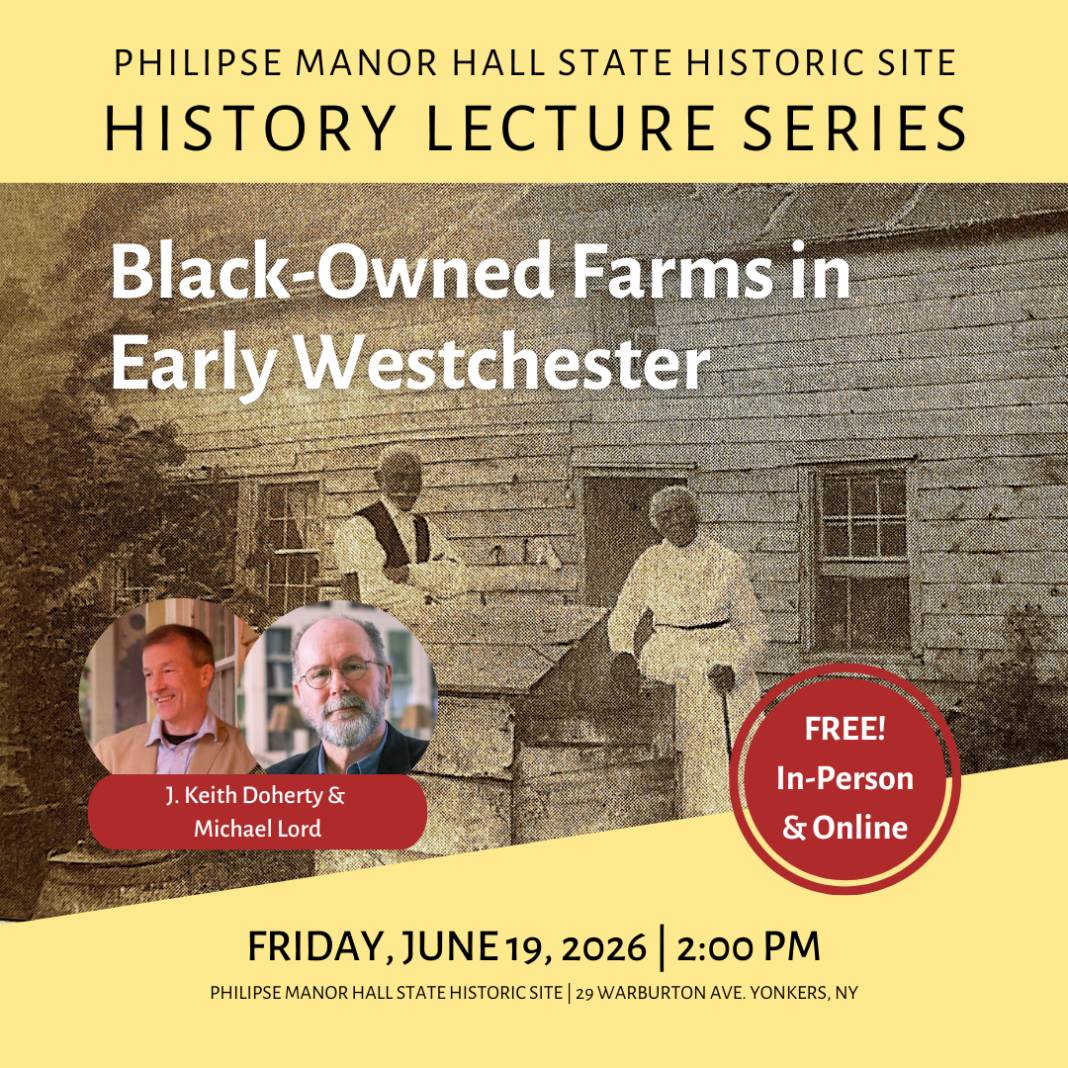

In honor of Juneteenth, we at Philipse Manor Hall will present a talk on the many small communities of Black landowners that existed in the county during and shortly after the abolition of slavery in the state in 1827. “Black-Owned Farms in Early Westchester” will take place at 2:00 PM on Friday, June 19 both in-person at Philipse Manor Hall and online via YouTube Live. The event will take place onsite at 29 Warburton Avenue in Yonkers.
Many have heard of places like Seneca Village, a free Black settlement in Manhattan, but few realize that there were many similar communities all over the greater New York City area, especially in Westchester. Sizable groups existed in Harrison, White Plains, Yonkers, Hastings-on-Hudson, New Rochelle, and elsewhere. Black families used land to earn dependable income, escape wage labor, and secure their right to vote, as a racist provision in the state constitution required Black men to have at least $250 worth of real estate in order to cast a ballot. Philipse Manor Hall State Historic Site historians Michael Lord and J. Keith Doherty will discuss the long impacts of slavery on New York State and how free Black communities gained land ownership before and after abolition.
This program is free and open to the public, thanks to support from the Friends of Philipse Manor Hall. To register for in-person, call 914-965-4027 or email philipsemanorhall@parks.ny.gov. For online access and more information visit https://www.philipsemanorhall.com/programs-and-events/lecture-black-owned-farms-in-early-westchester
About Philipse Manor Hall State Historic Site
Philipse Manor Hall State Historic Site, located at 29 Warburton Ave., Yonkers, NY, 10701, is open for tours Wednesdays through Sundays, 10:00 a.m. to 5:00 p.m. Dating back to the 1680s, Philipse Manor Hall State Historic Site sits near the confluence of the Nepperhan (Saw Mill) and Hudson Rivers, the site of a Munsee Lunaape village. Used by four generations of the Philipse family and worked by the people they enslaved as well as European tenant farmers, the Philipse Manor was once over 200,000 acres and helped make the Philipse family the richest in New York. Loyalists during the American Revolution, they fled to England and the Hall was owned by several individuals before becoming the Yonkers Village Hall and later Yonkers City Hall. When a new City Hall was built in the early 20th century, the house was preserved through the generosity of Eva Smith Cochran and donated to New York State to serve as a historic site. Today, Philipse Manor Hall State Historic Site provides visitors with a balanced approach to interpreting the lives of Indigenous, European, and African people to understand the complex relationships that took place at the Manor from the earliest days of the Dutch Colony of New Netherland to the American Revolution and beyond. Learn more at Philipse Manor Hall’s Virtual Wing at www.philipsemanorhall.com.
The New York State Office of Parks, Recreation and Historic Preservation oversees more than 250 parks, historic sites, recreational trails, golf courses, boat launches and more, and welcomes over 88 million visitors annually. For more information on any of these recreation areas, visit parks.ny.gov, download the free NY State Parks Explorer app or call 518.474.0456. Connect with us on Facebook, Instagram, X, LinkedIn, the OPRHP Blog or via the OPRHP Newsroom.
###