
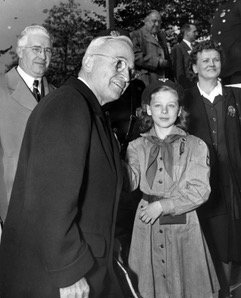
Harry Truman on his October 29, 1948 trip to Yonkers, chatting with eleven year old Girl Scout Carol Bayerschmidt. She had just pinned a read feather on his chest. They are in Larkin Plaza for the Community Chest Drive. According to the Statesman, it was one of the largest crowds in Yonkers history, estimated by Yonkers Police to be 50,000!
By Mary Hoar, City of Yonkers Municipal Historian, 1977 recipient of the Key to the City of Yonkers, President Emeritus Yonkers Historical Society, recipient of the 2004 Key to History, Yonkers Landmarks Preservation Board Member, Founder of Revolutionary Yonkers 250 and President Untermyer Performing Arts Council
Monday, October 5th
October 5, 1915: For the first time in history, women were allowed to act as watchers at Yonkers election polls. New York State women won the right to vote two years later in 1917.
October 5, 1939: Timmins, Ontario, resident Pete Spence stopped by the Yonkers Canoe Club after completing a major portion of his trip by canoe to visit the NY World’s Fair! He had left Ontario July 1st, battled rapids, Canadian rivers, and Lake Champlain storms to arrive in Yonkers more than three months later.
When he arrived in Yonkers, two members of the Yonkers Canoe Club spotted his birchbark canoe and invited him to the club. After delivering a letter from Timmins’ Mayor Barthleman to our Mayor Loehr; he then continued his trip to the World’s Fair.
His watercraft was handmade by Cree Indian Chief Mai Bernard using birch bark bonded with natural forest tree gum; it had cedar ribs and was sewn together with roots. Spence’s own heritage was Eskimo and Scottish… and, oh yes. Pete Spence didn’t know how to swim!
Tuesday, October 6th
October 6, 1945: Rear-Admiral Husband Kimmel, resident of Bronxville Road in Yonkers, testified he believed the Army “let down” the Navy in its radar detection of the Japanese before the Pearl Harbor attack.
Kimmel, Pearl Harbor Naval Commander at the time of the attack, was relieved of command immediately after the assault, as was Lieutenant General Walter Short, Army Commander of the Hawaiian Department.
While testifying, Kimmell told the hearing officers two Navy enlisted men detected Japanese planes, immediately reporting them to their officers; the Navy officers asked Army Information Center several times about them.
The Roberts Commission, President Roosevelt’s investigating body, found Admiral Kimmel and Lieutenant General Walter Short, Army Commander of the Hawaiian Department, guilty of dereliction of duty and poor judgment. By1944, information emerged showing Washington hadn’t “fully warned Kimmel about the dangers of a Japanese attack.” This Naval Court of Inquiry exonerated Kimmel. In 1999, the US Senate exonerated Kimel, although the military still holds him responsible. Most historians believe he was scapegoated.
Wednesday October 7th
October 7, 1940: Workmen tore down the 474 North Broadway mansion, home of Alfred Skitt, late president of Manhattan Railway Company. The fourteen room home, with mahogany mantles, oak paneling, oak-beamed ceilings, leaded glass and imported Holland clay tiled porches, was demolished by his daughters to save on taxes. They carted off these fine details to their own homes in Dobbs Ferry and Manhasset.
Because so many handsome homes in this area were lost, Councilman Edith Welty proposed rezoning Northern Yonkers.
October 7, 1944: Captain James Richardson, former Assistant Pastor of St. Peter’s Church, held a Yonkers reunion with two soldiers. Father Richardson, Ludlow Street’s Private First Class Edward Fara and Herald Statesman pressroom’s Corporal Philip English had a great time reminiscing about Yonkers.
Thursday, October 8th
October 8, 1933: Recognizing Yonkers needed to reduce salaries to protect our credit rating, Republican Mayoral candidate Frank Cotter proposed Yonkers first should eliminate unnecessary jobs to lessen the number of needed cuts.
Friday, October 9th
October 9, 1776: Patriot General William Heath dispatched infantry, light horse troops and artillery to the Nepperhan Bridge and Manor House to assist two American ships beached just below the Manor Hall.
October 9, 1945: Judge Advocate General Myron Cramer notified Representative Ralph Gamble Yonkers’ Private Daniel Jones’ death sentence for mutiny was commuted to dishonorable discharge and confinement at hard labor for life.
This commutation also was granted to the six other Black soldiers sentenced to death with Jones.
Saturday, October 10th
October 10,1943: The US Army presented the “Action Overhead” Aerial show at Empire City Race Track. Structures built for the demonstration were bombed, ignited by missiles from the Army planes flying overhead, giving a realistic demonstration of the horrors and dangers of war.
October 10, 1952: President Harry Truman made a campaign stop in Yonkers. An estimated 8,000 people gathered in Larkin Plaza to hear him speak in support of Adlai Stevenson, Democratic candidate for President.
Sunday, October 11th
October 11, 1934: The Yonkers Board of Education discussed using the older School Six building for the College of the City of New York’s state emergency college, offering a freshman year curriculum. Both CCNY and state officials paying for classes stated they would open the college as soon as Yonkers selected its location.
They decided to tear down the School Six janitor’s home they considered a fire hazard. The school janitor received a smaller salary… but he lived in the house rent free.
October 11, 1943: The US Army Signal Corps released the film they made about Refined Syrups and Sugars employees’ tomato and vegetable farming project. This film was distributed to Army camps around the world, bringing worldwide recognition to the Yonkers’ program.
The movie’s purpose was to show our overseas and American based troops “what the folks on the home front are doing” to support them.
The workers cultivated thousands of plants on top of a company warehouse at the foot of Vark Street; the company wanted to increase the number of fresh vegetables available for workers and their families.
In season, many employees ate a fresh tomato for lunch and were able to bring food home… if they worked on the company gardens. It was estimated the Refined Syrups’ workers produced 30,000 pounds of food, food given to every employee who cared for the gardens, to every person whose efforts kept their fellow workers healthy.
Any questions on this column, email yonkershistory1646@gmail.com.
For information on the Yonkers Historical Society, the Sherwood House Museum on Tuckahoe Road or their upcoming events, please call 914-961-8940, visit website www.yonkershistoricalsociety.org, or email info@yonkershistoricalsociety.org.