
The Plan My Dentist Gave Me
Twelve teeth left on the top, most of them loose, and a general dentist of twenty years who had patched them for a decade and finally said what he had been avoiding: the upper arch was done. His plan was a full upper denture, pulled and fitted over two visits, with a line at the end of the conversation that I have thought about since: “Implants are an option, but I’d have to send you out for that, and it gets expensive.” He was a good dentist. He was also a general dentist, and the plan he gave me was the plan a general dentist can deliver. A neighbor in Dix Hills who had been through a full arch case at GD Dentistry on Jericho Turnpike said one thing: get the scan before you let anyone pull twelve teeth. The consultation was free, so I did. This review is what happened next, and why the office that can do a full arch is the one that should give the opinion on whether you need one.
Why a General Dentist Is the Wrong Place for This Decision
Not because general dentists are bad, but because the decision is outside what most of them do. A full mouth implant case needs a 3D scan to see the bone, a surgeon to place four to six implants per arch and often to graft, a lab to make a fixed set of teeth, and someone to manage the months between. A general dentist who does not do those things has two honest options, refer out or recommend a denture, and the denture is the one that keeps the patient in the practice. The patient hears “implants are expensive and somewhere else” and takes the denture, which is how a great many people in Suffolk County end up with a plate they hate. The way out is to get the full arch opinion from an office that actually does full arches, before the teeth come out, and to compare the two plans side by side. GD Dentistry’s implant dentist Huntington NY page is where that second opinion starts, and the consultation costs nothing.
The Scan
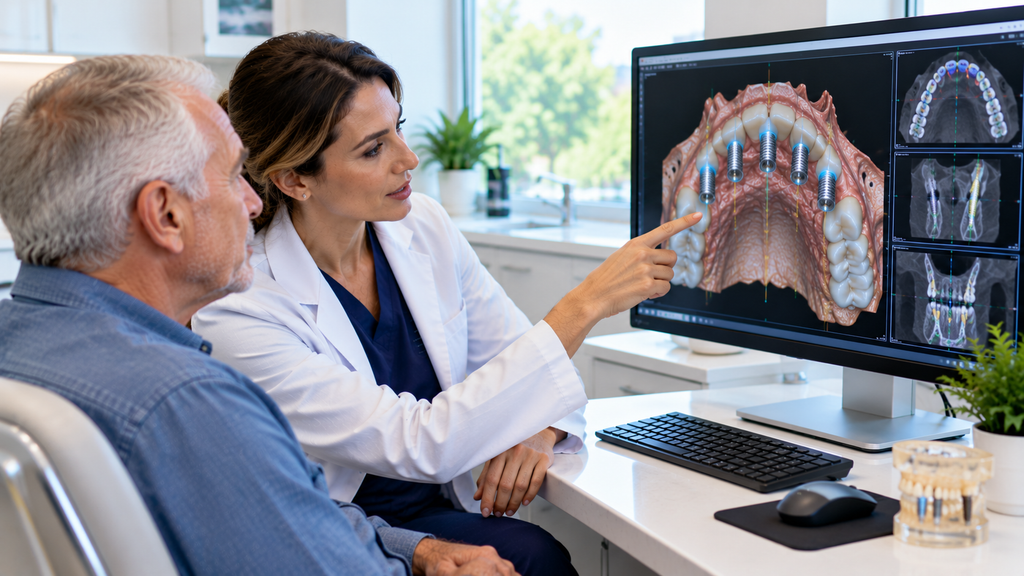
Free, in the office, about a minute, and the first time anyone had shown me my own jaw in three dimensions. The dentist walked the screen: the twelve loose teeth and the bone that had receded around them, the sinuses above the back of the arch, the thicker bone toward the front. Then the sentence my general dentist had not been equipped to say: there was enough bone for a full arch of fixed teeth on implants, angled to use the front bone and avoid the sinuses, with grafting at two sites. A denture was still an option, and she said so. A fixed arch was also an option, and the difference between the two, in what I would be able to eat and how the teeth would feel, was explained without a sales pitch. The practice’s All-on-X dentist Huntington NY page describes the procedure; the scan is where it stopped being a page and became my case.
What the Scan Changes
A flat panoramic X-ray, which is what my general dentist had, shows teeth and roots in two dimensions and bone as a shadow. It cannot show how thick the bone is, where the sinus floor sits, or whether an implant angled thirty degrees would find bone that a straight one would miss. A cone beam CT shows all of it, in slices, and modern full arch planning is done on that scan: the implant positions are chosen to the millimeter, a surgical guide is printed from the plan, and the surgeon places the implants through the guide rather than by feel. That is why a patient told “not enough bone” from an X-ray is so often a candidate after a scan, and why an office that does not take the scan cannot give the opinion. The practice’s page on bone grafting for dental implants explains what happens when the scan does show thin bone, which in my case meant two graft sites rather than a denture.
The Plan, in Writing
One sheet, two columns. A full upper denture, with the extractions, the fitting and the relines, at a price. A full arch on implants, with the extractions, the grafts, the implants, the temporary fixed teeth and the final set, at a price, with 0% financing on a line below it. The implant column was several times the denture column, and the office did not hide that; it also did not hide that the denture would need relining as the bone continued to shrink, which a fixed arch stops, and that the denture column over fifteen years was not as small as it looked. I took the sheet home. My general dentist, to his credit, read it and said it was a fair plan.
Denture vs Fixed Arch, the Way It Was Explained to Me
A full denture sits on the gums and is held by suction and adhesive; it moves when you chew, it limits what you can bite, and because it rests on bone that is no longer stimulated by teeth, the bone keeps shrinking under it and the denture needs relining every few years and remaking eventually. An implant-retained overdenture snaps onto two to four implants, which stops the movement, but it still comes out at night and still rests partly on the gums. A fixed arch on four to six implants does not come out, lets you eat what you ate with your own teeth, and stops the bone loss where the implants sit. It costs the most up front and the least per year over the time it lasts. My general dentist had explained the first option. The office on Jericho Turnpike explained all three and let me choose, which is the whole difference.
The Cost Conversation
The implant column was a large number, and this review will not pretend otherwise or invent one; the practice gives it in writing after the scan, and it depends on the grafts, the number of implants and the final material. What the office did that my general dentist had not was put the denture’s long-term cost beside it: the relines, the remake at some point, the adhesive, and the slow loss of bone that makes each reline less satisfying than the last. Financing was on the sheet, at terms the front desk explained in ten minutes. I used it. The office did not push, did not set a deadline, and did not ask for a deposit at the consultation; the sheet was mine to take home and show to anyone, which I did. The practice’s guide to how dental implant cost works explains what goes into the number for a patient who wants to understand the quote before asking for one.
The Week Before Surgery
A pre-operative visit to confirm the plan on the scan, review the medications to stop and start, and go over the day: nothing to eat after midnight, a ride home arranged because of the sedation, soft food stocked for the weeks after. The office gave me the temporary set’s limitations in writing, no biting into hard food, no chewing on the front teeth, and a phone number for the weekend. My general dentist had never scheduled a pre-operative visit for anything; the office on Jericho Turnpike treated the surgery as the surgery it is.
The Surgery
Under IV sedation, which for a full arch I would not have considered doing without. The twelve teeth out, the two grafts placed, five implants placed by guided surgery through the printed guide from the plan on the scan, and, because the implants were stable, a temporary fixed set of teeth attached the next day. I left the second morning with teeth that did not come out, after thirty years of teeth that were on their way out. Soft food for weeks, a follow-up at one week, and a call from the office the morning after surgery, which is the small thing that separates a practice from a clinic.
What “Teeth in 24 Hours” Means, and What It Does Not
Every full arch advertisement on Long Island says “teeth in a day,” and the phrase deserves a plain explanation. It means that when the implants placed during surgery are stable enough, a temporary fixed set of teeth is attached to them within about a day, so the patient does not go home with nothing. It does not mean the case is finished in a day; the temporary set is worn for months while the implants integrate, and the final set, stronger and made to the healed arch, comes later. It also does not mean every patient gets the temporaries the next day; if the implants are not stable at surgery, the honest office waits, and says so beforehand. GD Dentistry’s language is “often secured within 24 hours,” and the word “often” is the one that separates a practice that tells the truth from one that sells a slogan. In my case the implants were stable and the teeth went on the next morning; the dentist had told me the week before that it was likely but not certain.
The Months Between
Four months of integration with the temporary set, which looked like teeth and worked like teeth with some care about what I bit into. A check-up at six weeks and at three months. Then the final set: a digital scan of the healed arch, a try-in to check the shape, the bite and the way the teeth sat with my lip, a small adjustment to the length of the front teeth, and the final fixed prosthesis seated five months after the surgery. The timeline was the one on the sheet. The price was the one on the sheet. A year on, I eat what I want, the teeth do not move, and the bone the scan showed is still there, because the implants are using it. My general dentist, at a cleaning, said it was the best full arch he had seen come through his chair; he still does my cleanings, and he now refers his own full arch patients down the turnpike for the scan.
What the Office Did Well
The scan, which found the bone my general dentist had assumed was not there. The honesty about both columns. The surgery under sedation, by the office that had planned it, with the temporary teeth the next day. The months managed in one place, with one chart and one phone number. The try-in, which caught the front-tooth length before it was permanent. And the written price, which survived five months and two grafts.
What Could Be Better
The hours: Monday to Wednesday 9 am to 5 pm and Friday to 4 pm, closed Thursday and weekends, so every one of eight visits came out of a workday. The dentist roster is published for the group rather than the office, so I did not know until I called who would do the surgery; ask by name. And a full arch is five months and a large number; a patient who wants it faster or cheaper should know that any office promising either is promising something a scan has not confirmed.
The Lower Arch, and Why I Waited
For completeness: the lower arch had its own problems, fewer and slower, and the office said so on the first day without proposing to do both arches at once. The scan showed the lower teeth would last some years with care, and the plan was to treat the upper now and revisit the lower when it needed it. A practice that sells two arches to a patient who needs one is a practice to be wary of; this one sold one and told me to come back. That restraint is as much a part of the review as the surgery.
What I Would Tell the Next Person
Get the scan before anyone pulls a tooth, let alone twelve. Ask the office that proposes a denture whether it can do the alternative, and if it cannot, get the alternative’s opinion from an office that can. Ask for both plans in writing with the prices, and read the denture column for the relines and the remakes. Take the sedation. Plan on months. Ask by name who will do the surgery and whether the temporary teeth are attached the next day, because the answer to both is what you are paying for. And if the office proposes two arches when you came in about one, ask to see why on the scan.
For the Patient Who Is Afraid
A lot of full arch patients are the ones who stayed away from dentists for years, and fear is the reason the teeth got this bad. The office knows it; the practice’s page on IV sedation dentistry exists for exactly this patient, and the surgery day is designed around it: a conversation with the anesthesia provider, a blanket, and then the recovery room with new teeth attached by the next morning. The consultation itself involves no treatment and no needle, only a scan and a conversation, and a patient who has avoided the chair for a decade can sit through it. Several of the office’s full arch patients, the composite behind this review among them, had not seen a dentist in years before the free visit.
Questions to Ask at Any Full Arch Consultation
Will you take a 3D scan before giving me an opinion, and what does it cost? Who will do the surgery, by name, and how many full arch cases have they completed? Are the extractions, grafts, implants and final teeth all done here, or is any of it referred? Is the price in writing, and does it include the temporaries, the final set, the sedation and the follow-ups? What happens if an implant does not integrate? Can I see healed cases, months out? And if you are proposing both arches, show me why on the scan. An office that answers all seven without flinching is one you can trust with twelve teeth. GD Dentistry answered them at the free consultation; the general dentist, to be fair to him, could not, because the work was not his to do.
The Difference a Year Later
The thing nobody tells you about a denture is the slow part: the bone shrinks, the plate loosens, the adhesive becomes a daily ritual, and the reline that was supposed to fix it fixes it for a while. The thing nobody tells you about a fixed arch is the opposite: it is the same on day four hundred as on day forty, and the bone the implants sit in stays put because the implants are loading it. A year on, the only maintenance has been cleanings and one check of the screws. I eat apples. I had not eaten an apple in six years. That is the sentence I would have wanted to read when my general dentist handed me the denture plan, and it is the reason this review exists.
Why You Need a Full Mouth Implant Dentist
Because the decision about a failing arch is made from a scan that a general dentist does not take, by a surgeon a general dentist is not, with a price a general dentist cannot put in writing because the work is somewhere else. Because the denture is the default at an office that cannot do the alternative, and the patient deserves to see both columns before twelve teeth come out. And because a full arch case managed in one office, from the scan to the final seat, is a plan rather than a year of referrals. GD Dentistry of Huntington, 234 West Jericho Turnpike, Huntington Station, (631) 629-2212. The consultation and the scan are free. Get them before the teeth come out.
Frequently Asked Questions
What is a full mouth implant dentist?
A dentist or practice that plans and places full arch implant restorations, such as All-on-X, in-house: the 3D scan, the extractions, any grafting, the implant surgery, the temporary and final fixed teeth. GD Dentistry of Huntington does all of these under one roof with IV sedation available.
Can a general dentist do full mouth implants?
Most general dentists refer full arch cases to a surgeon and an implant practice, or recommend a denture. A patient facing a failing arch should get a second opinion from an office that does full arch cases before accepting a denture plan.
Is the full mouth implant consultation at GD Dentistry free?
Yes. The consultation and the first 3D CT scan are free at the Huntington Station office, with no obligation, and pricing for both a denture and a fixed implant arch is put in writing.
How long does a full arch implant case take?
Typically four to six months from surgery to the final fixed teeth, with temporary fixed teeth often attached within 24 hours of surgery when the implants are stable. The case described took five months.
Does GD Dentistry offer financing for full mouth implants?
Yes. The Huntington office publishes 0% financing on its implant special and offers financing on larger cases; terms are explained with the written plan at the free consultation.