
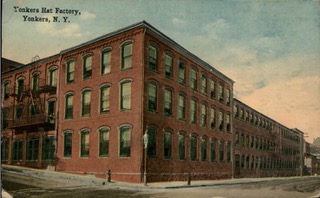
Yonkers Hat Factory
By Mary Hoar, City of Yonkers Municipal Historian, 1977 recipient of the Key to the City of Yonkers, President Emeritus Yonkers Historical Society, recipient of the 2004 Key to History, Yonkers Landmarks Preservation Board Member, Founder of Revolutionary Yonkers 250 and President Untermyer Performing Arts Council
Monday, September 21st
September 21, 1950: The Federal Public Housing Administration (FPHA) suggested the new housing project being built in Yonkers have bigger apartments to accommodate larger families. Largest apartments in federally subsidized Mulford Gardens and state subsidized Cottage Gardens were five rooms; FPHA suggested some apartments in the new development sites on Palisade Avenue should be 6 ½ rooms!
September 21, 1950: Former City Manager William Walsh, attorney for Deed Realty Corporation who owned The Herald Statesman Building on Dock Street, served Yonkers papers notifying our city they applied for an injunction blocking sale of parts of four streets around Otis Elevator Company. The sale and “discontinuance” of parts of Atherton Street, Bashford Street, Locust Street and Wells Avenue was unanimously approved by Yonkers Common Council.
Deed Realty filed a $500,000 claim for damages and loss it would suffer from closing parts of these streets.
Tuesday, September 22nd
September 22, 1925: City Judge Charles Boote severely reprimanded Thomas Bitordo for ignoring the signal of a Yonkers patrolman, stating, “There are altogether too many drivers who are simply stupid. They forget stupidity is no excuse before the eyes of the law… It hurts just as much to be killed by stupidity… We cannot always treat stupidity with kindness.” Boote wanted a campaign mounted against “stupid drivers who were a menace to our children.”
September 22, 1945: A September 11th letter from Assistant Adjutant General McWilliams indicated “final action was not taken” for Private Daniel Jones, sentenced to death for mutiny. McWilliams said the court martial record was received at European Theater Headquarters and was being reviewed as it related to Jones’ death sentence.
Jones was one of eleven men arrested for mutiny. One man was acquitted, three dishonorably discharged and seven were to be “shot to death with musketry.”
Wednesday, September 23rd
September 23, 1941: Yonkers City Council unanimously adopted the ordinance Councilman Edith Welty proposed forbidding anyone counting votes– or having anything to do with the paper ballots– to have a pencil! This would safeguard the ballots and prevent tampering with them.
September 23, 1941: Councilman Jimmy Sullivan, while saying he did not oppose selling city-owned Alexander Street property to Otis Elevator to expand its defense factory, tabled action on the proposal “until we know definitely it is going to be used for this purpose.” Otis wanted riverfront property, property Yonkers bought for almost $800,000. Yonkers stored equipment and material worth thousands of dollars on the property; Sullivan said he would not have Yonkers spend money to remove the equipment and store it elsewhere until the deal went through.
Thursday, September 24th
September 24, 1935: A Canadian farmer came to Yonkers to find his fortune in America. He did well and wrote a lovely letter to his family telling them Yonkers people were very kind, and the city was nice and quiet. He then tried to mail his letter in a fire alarm box and immediately was arrested.
September 24, 1941: The Herald Statesman urged residents interested in Yonkers’ economic development adopt sentiments expressed by the Yonkers Chamber of Commerce in its letter sent to the County Board of Supervisors. Some felt the cost of building an airport should be paid by the Federal Government; the Chamber pointed out the airport would be owned and used only by the Army Air Corps, never for commercial flights! New industries investigating the possibility of coming to Yonkers and Westchester always asked about proximity to an airport.
Friday, September 25th
September 25, 1924: Waring Hat factory Superintendent William Campbell severed his ties with the company in the hands of receivers. He was negotiating to take over several floors of 115 Stanley Avenue.
September 25, 1942: Corporal Robert Tompkins, Knowles Street, arrived home to continue his convalescence. He was seriously wounded June 3rd when the Japanese attacked Dutch Harbor in Alaska; he was serving with the Quartermaster Corps. He spent three months at Barnes General Hospital in Vancouver Washington before coming home. At the end of his 30-day furlough, he reported to the Army hospital in Washington for additional treatment. His brother Warren was stationed at Atlantic City, and his brother George was serving at San Antonio, Texas; all three men were in the US Army.
Saturday, September 26th
September 26, 1919: Yonkers residents met to discuss the United States’ position in the League of Nations in Philipsburgh Hall. Discussing pros and cons were Homer Folks, Frank E. Xavier, Dr. Elmer A. Sheets and Ralph E. Prime, Jr.
September 26, 1942: Selected churches and public buildings in Getty Square area were designated as “shelters” for people caught in the area during an alert or blackout.
Sunday, September 27th
September 27, 1941: Arthur Lawrence proposed reviving a “Boost Yonkers” idea more than 30 years old. The plan, touted by the Chamber of Commerce in 1909, provided envelopes with Yonkers’ information printed on the back. “Yonkers, N.Y. The Beautiful Terrace City of the Hudson. Population over 75,000. Twenty-one public schools—the best in the state. Best water in the state. Lowest death rate. Sixty-one churches, six hospitals. Eighty-six miles of macadam roads, largest carpet factory in the world, daily output 40 miles; also, largest elevator works, soft hat factory and sugar refinery in the world. For information, address the Chamber of Commerce.”
September 27, 1941: Councilman Dennis Cooper proposed the Police Chief and Fire Chief be changed to Commissioners and eliminate the office of Public Safety Commissioner. This would give the Commissioners power to make appointments and promotions; they would conduct trials for departmental charges. At one time, Cooper was YPD Captain Cooper.
Any questions on this column, email yonkershistory1646@gmail.com.
For information on the Yonkers Historical Society, the Sherwood House Museum on Tuckahoe Road or their upcoming events, please call 914-961-8940, visit their website www.yonkershistoricalsociety.org, or email info@yonkershistoricalsociety.org.