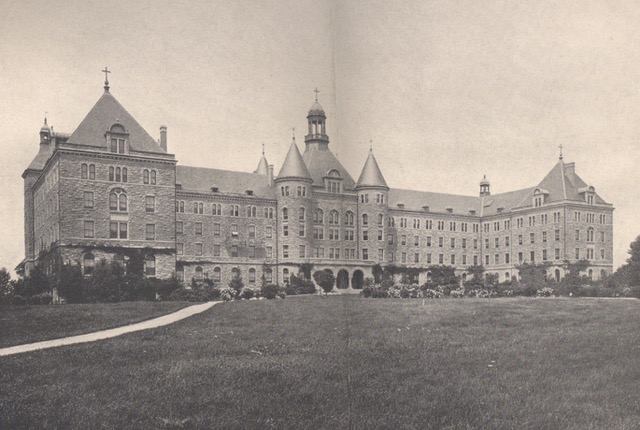
Postcard of St. Joseph’s Seminary & College
By Mary Hoar, City of Yonkers Historian, President Emeritus Yonkers Historical Society, recipient of the 2004 Key to History, Yonkers Landmarks Preservation Board Member, Revolutionary Yonkers 250 Chair and President Untermyer Performing Arts Council
Monday, April 21st
April 21, 1929: Roland Francis and a group of African American ex-servicemen organized Yonkers’ first minority veterans’ post; they held its first meeting at Wiggins Hall at 24 North Broadway. The Samuel H. Dow Post, No. 369 VFW, now has a home on Warburton Avenue.
April 21, 1952: Yonkers Public Safety Commissioner Milton Goldman lifted the ban his predecessor Patrick O’Hara placed on YPD fundraising; officers now were allowed to sell tickets for a May 27th program at Loew’s Theater. Part of the fundraising efforts was selling ads in a journal for the program; Goldman required a Deputy Commissioner approve all ads in the journal.
Tuesday, April 22nd
April 22, 1943: Alexander Smith Carpet Company announced its workers financed the bomber “Yonkers Magic Carpet” by purchasing war bonds valued at $300,000! To spur the effort, the company had donated $2 for every dollar each employee contributed to the war effort.
April 22, 1944: Smith Carpet Factory General Superintendent Harold Zulauf announced the company was “experimenting” hiring handicapped workers to prepare for return of the 1,400 Smith workers in the service, including those who were wounded. They created protocols to “take care of” returning servicemen by meeting with the local Textile Workers of America Union officials. The plan was for labor and management to work on potentially complex problems.
The Union office would be the relocation center for employees returning from the service. The team hoped to anticipate potential problems when everyone returned from the military, such as how to handle people who replaced servicemembers during the war, and the responsibility of “sympathetically understanding a man who has been taught to kill 24 hours a day.”
Wednesday, April 23rd
April 23, 1881: Tantivy, a four-horse coach seating twelve passengers, made its first trip to Yonkers, inaugurating the “modern” stagecoach line.
April 23, 1908: Mayor Warren led a parade to meet Yonkers’ runners who competed in the Boston Marathon. They met Thomas Morrissey, winner of the Boston Marathon and United States champion long distance runner, Samuel Mellor who finished eighth, William Foster, John Welsh and Albert Hayden.
April 23, 1946: Two First Precinct radio patrolmen quickly used what they learned from Health Commissioner Eugene McGillian during a First Aid class on childbirth. Dr. McGillian finished his lecture at 4 pm, and less than three hours later, Patrolmen Allison Hopper and John Flynn delivered a baby boy at a Nodine Hill home!
Thursday, April 24th
August 24, 1945: Flooded by applications for the Yonkers City Manager job, Mayor Frank asked the Council if they wanted to consult about the job; he wasn’t sure what to tell applicants and agreed to submit their applications to the Council.
Mayor Frank received a phone call from former City Manager Raymond Whitney’s boss in DC. Whitney, then a federal government employee, was asked to return to Yonkers; his boss called to find out what was going on. No one admitted making the call.
April 24, 1952: Chairman James McPoland announced the kickoff of the Yonkers Memorial Blood Campaign to collect a record-breaking 1,000 pints of blood. McPoland said, “Yonkers has contributed its share and more to our country. In memory of the Yonkers boys of all wars who shed their blood, the committee asks all Yonkers citizens share their blood.” Blood was donated at the North Broadway Armory. Yonkers Red Cross brought the Red Cross Bloodmobile staffed with doctors and nurses. Members of the Yonkers Civil Service Employees Association, Yonkers Jewelers’ Association, Yonkers Federation of Sports Clubs, Knights of Columbus, and the Catholic Civil War Veterans all committed ahead of time to donate blood. The largest blood donation was from seminarians at St. Joseph’s Seminary and College in Yonkers; the men and their friends donated 667 pints of whole blood!
Friday, April 25th
April 25, 1925: More than two thousand teachers attended the Westchester County School Teachers’ Convention at Gorton High School, held for the first time in Yonkers. It was organized by School #23 principal Thomas Kelly, who later became Gorton principal.
April 25, 1943: Mayor Benjamin Barnes honored three Yonkers servicemen in a “Heroes’ Day” program at City Hall. Technical Sergeant William Caldwell, former Yonkers policeman & Private First Class Austin Millen, and Midshipman William Zinchak were presented scrolls expressing the “pride of the citizens of Yonkers in their conduct on fighting fronts.”
Saturday, April 26th
April 26, 1925: The Department of Justice announced the US Attorney was investigating several federal prohibition agents because of Yonkers citizens’ complaints. Allegedly, some agents accepted bribes and extorted protection money.
April 26, 1937: Hawthorne JHS graduate Leslie Klein starred in the Broadway production of “Dead End” at the Bellasco Theater, performing as Leslie Barrett. The show, about adolescents who grew up during the Depression, graphically depicted their lives, and was the first project featuring the “Dead End Kids.” Barrett was not in the later movie.
Barrett appeared in several Broadway productions, including “Primrose Path” (1939), “Rhinoceros” (1961) and “The Dresser” (1981). An accomplished Shakespearean actor, he was a member of the Shakespeare Theatre Workshop directed by Joseph Papp.
A founder of the American Mime Theater, he appeared in TV shows as varied as “The Twilight Zone,” “Dennis the Menace,” “Dark Shadows,” and “The Honeymooners.”
Sunday, April 27th
April 27, 1861: The first company of Yonkers Civil War volunteers marched down Main Street to the railroad station to leave for battle, marching through huge numbers of Yonkers well-wishers.
April 27, 1924: Westchester County Park Commission announced it would drain Peckham’s Lake, fill it in and covert the land into an athletic field, part of its project to create a modern Tibbetts Brook Park.
Questions or comments on this column? Email YonkersHistory1646@gmail.com.
For information on the Yonkers Historical Society, Sherwood House and upcoming events, please visit our website www.yonkershistoricalsociety.org, call 914-961-8940 or email info@yonkershistoricalsociety.org.