
The Crash, and the Two Days After
A Thursday evening on Sunrise Highway, stopped at the light at Long Beach Road, and a pickup that did not stop. Not a bad one; the bumper took it, the airbags stayed put, the other driver was apologetic and insured. I felt fine. I drove home, called my insurer, and told my wife it was nothing. Friday morning I could not turn my head to the left. By Saturday there was a headache at the base of my skull that ibuprofen did not touch and a line of pain between my shoulder blades. A neighbor who had been through it said two things: you have 30 days to file no-fault, and go to Well Being on Sunrise, they do this all day. I called Sunday morning, because they were open.
The Phone Call
The person who answered asked three questions: when was the accident, had I been to an ER, and did I have the police report number. I had the number. She said the first consultation was free, that the clinic would file my no-fault application if my insurer had not sent me one, and that I should bring my ID, my insurance card, the police report number and anything from the ER, which was nothing. She offered Sunday afternoon or Monday evening. I took Monday at 6:30, because I work, and the fact that there was a 6:30 is the reason I was able to do any of what follows.
Finding It
330 Sunrise Highway, Suite 100, in Rockville Centre, on the north side a short way past the LIRR station, with parking at the building. The clinic’s car accident injury doctor page, which I read in the parking lot, had already told me most of what was about to happen, which was reassuring in the way a map is reassuring.
The Paperwork
Fifteen minutes at the front desk, and the part I had dreaded was the easiest. The intake form asked about the crash, my history, my medications and my job. The front desk filled out the no-fault application with me from the police report number and my insurance card, explained that the clinic would bill my own auto insurer directly under New York’s no-fault law regardless of who caused the crash, and said that I would not be asked for a copay or a deposit. She said the carrier would probably schedule an independent medical examination at some point and that the clinic would prepare me for it when it came. She asked whether I had a lawyer. I did not. She said I did not need one to be treated and that if I got one later the clinic would send the records.
The Examination
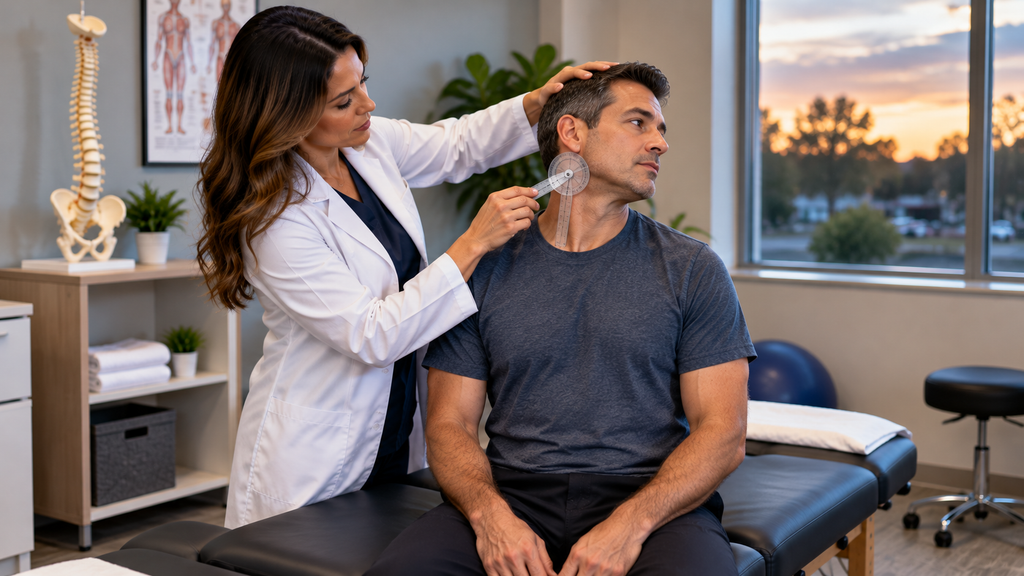
Dr. Goldshteyn came in with the intake form already read. She asked me to tell her the crash in my own words, then asked the questions the form had not: where exactly the pain was, whether it changed with movement, whether anything tingled, whether I had hit my head, how I had slept. Then the examination: range of motion in the neck, measured and written down; pressing along the spine and the muscles beside it; reflexes and strength in the arms; a test that involved turning and tilting my head that reproduced the headache. She told me what each thing was for as she did it. Forty minutes.
What She Said
Whiplash, she said, which I had guessed, but the explanation was better than the guess: the neck had been thrown forward and back faster than the muscles could brace, the ligaments and muscles were strained, the joints on the left side were locked, and the headache was coming from the top of the neck, not the head. No signs of a disc or a nerve problem, which she would keep checking. She said it would take four to eight weeks, two to three visits a week at the start, and that treating it this week rather than next month was the difference between those numbers and worse ones. She wrote the plan on a sheet and gave me a copy: chiropractic adjustments to free the locked joints, physical therapy for the muscles, acupuncture if the spasm did not settle, a re-evaluation at two weeks. The clinic’s page on therapy after an accident describes the same structure in general terms; mine had my name on it.
The First Treatment
Same visit. Electrical stimulation and heat on the neck and upper back for ten minutes while she saw another patient. Then a gentle adjustment to the neck, with a warning first and a question after. Then a few minutes of manual work on the muscles between the shoulder blades. She showed me two movements to do at home, told me to use ice that night and heat in the morning, to sleep on my back with a thin pillow, and not to drive for long stretches for a few days. I could turn my head farther on the way out than on the way in; not all the way, but farther.
The Cost
Nothing at the desk. The clinic bills the no-fault carrier directly for covered care, and the only thing I signed was the assignment that lets it. I asked what would happen if the carrier denied something, and the front desk said the clinic would tell me before any treatment was performed and explain the options. I asked about a tip, which I understand now was a foolish question at a medical practice, and was told kindly that there was none.
The First Week
Three visits that week: Monday, Wednesday evening and Sunday morning. Each one shorter than the first, about thirty minutes: stimulation, adjustment, manual therapy, the home exercises checked. By Wednesday the headache was intermittent instead of constant. By Sunday I could turn my head to the left far enough to check a blind spot, which I had been doing with my whole torso. The pain between the shoulder blades was the slowest to go. She added acupuncture on the Sunday for the spasm there, which I had been skeptical about and which worked faster than anything else that week.
The Two-Week Re-Evaluation
She had said two weeks and it was two weeks: the same range of motion measurements as the first day, written beside the originals, the same pressing along the spine, the same reflex and strength checks, and a conversation about what had changed. Left rotation was most of the way back. The headache was gone except for one bad afternoon after a long drive. The spasm between the shoulder blades was down to a tightness. She said the plan would taper to two visits a week with more exercise and less table time, that she would re-evaluate again at four weeks, and that she expected to discharge me around six with a home routine. She wrote all of it down and told me the write-up was going to the carrier, which was the first time I understood that the measurements were as much for the insurer as for me. Two days later a letter arrived scheduling the independent medical examination. The front desk had said it would.
The Independent Medical Examination
A doctor in an office in Garden City, chosen by my insurer, twenty minutes, mostly the same tests. The front desk had prepared me the week before: bring the police report and the clinic’s plan, answer honestly, do not minimize because you are feeling better and do not exaggerate because you are nervous. I did that. The result, a few weeks later, allowed treatment to continue through the plan, which the clinic told me is the usual result when the records are in order. I would not have known any of it was coming without the front desk telling me, and the telling is the part of the service that no one mentions when they recommend a chiropractor.
What I Would Tell the Next Person
Go within a few days, not because of the deadline, though the deadline is real, but because the first week of treatment is worth two later ones. Bring the police report number; it is the thing that makes the paperwork fifteen minutes instead of a month. Ask for the evening or Sunday slot if you work, because a plan you cannot keep is not a plan. Do the home exercises; she will ask. And read the clinic’s checklist for the first 72 hours after a crash before you call, so you know what to bring.
What Could Be Better
The clinic is closed Saturday, which for a plan of two or three visits a week meant Sunday was my only weekend option; it worked, but a Saturday morning would have been easier. The suite is in an office building rather than a storefront and the signage from the highway is modest. And the no-fault system itself is confusing, and the clinic’s own explanation, while good, could use one plain-English page for patients who have never heard the word before.
Would I Go Back
I am still going, which is the point: week three of a plan that will run about six, with the re-evaluation already done and documented. If there is a next crash, I know the number. Well Being Chiropractic PC, 330 Sunrise Highway, Suite 100, Rockville Centre, NY 11570, (516) 206-1700, Monday to Thursday until 8, Friday until 7, Sunday 9 to 5.
Frequently Asked Questions
What happens at a first visit to Well Being Chiropractic after a car accident?
Intake and no-fault paperwork at the front desk, including filing the no-fault application if it has not been filed; a history and examination by Dr. Zinaida Goldshteyn, DC; an explanation of the findings; a written plan; and usually the first treatment the same day. The visit runs about an hour and the consultation is free.
Does the clinic file the no-fault claim for you?
Yes. The front desk completes the no-fault application with the patient from the police report number and insurance card at the first visit, and bills the no-fault carrier directly afterward. The claim must be filed within 30 days of the crash.
Did the reviewer pay anything?
No. Covered care was billed directly to the no-fault carrier, with no copay or deposit. The clinic says it tells patients before performing any treatment a carrier has denied.
How long did the reviewer’s treatment plan run?
About six weeks, at two to three visits a week at the start, with a re-evaluation at two weeks. The review is a composite of first-time patients’ experiences and describes a typical whiplash case.
Is Well Being open evenings and weekends?
Monday to Thursday 9 am to 8 pm, Friday 9 am to 7 pm, Sunday 9 am to 5 pm. Closed Saturday.