
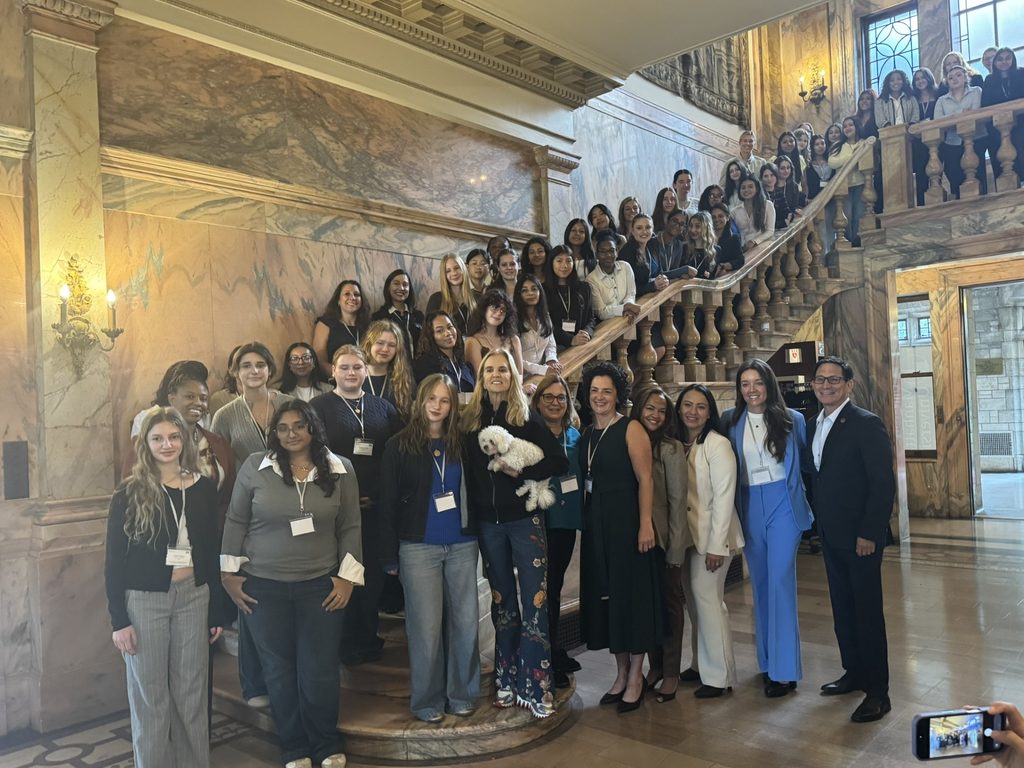
The summit, in its second year, honors Manhattanville alumna and human rights activist Ethel Kennedy
Manhattanville University welcomed more than 60 young women from 14 school districts across the region for the Young Women’s Leadership Summit, where students learned about human rights and discussed how they can create change in the world.
Co-sponsored by Manhattanville University’s Doctoral Program in Educational Leadership and the Robert & Ethel Kennedy Human Rights Center, the summit, in its second year, honors Ethel Kennedy’s legacy and brings together students, educators, university leaders, and human rights advocates.
Manhattanville President Frank D. Sanchez, Ph.D., welcomed the participants and connected the summit’s purpose to the university’s mission. He described the audience as future leaders and encouraged them to make the world better through their work.
“I think what gets me so excited about hosting this summit is that every single day that legacy unfolds at this institution. Our mission at Manhattanville University is to educate ethical and socially responsible leaders in the global community. And today we have 61, right here: Sixty-one future leaders who will hopefully make a difference in the world and make the world a better place.’’
Kerry Kennedy, president of the Robert & Ethel Kennedy Human Rights Center, explained that human rights principles emerged in response to the atrocities of World War II with the Universal Declaration of Human Rights that affirms that the international community has a responsibility to protect human rights when governments fail to do so.
“We rely on small groups of determined people to defend our human rights. That’s why you are all here today. You’re here because you are human rights defenders,’ she said.
Drawing on stories from her mother Ethel’s life, Kennedy described how campaigning in neighborhoods beyond her own introduced Ethel to people’s struggles, aspirations and hopes for their children. That experience, she said, helped shape a commitment to justice.
Kennedy said that she was also inspired by her father, Robert Kennedy, who was assassinated in 1968 while running for President and campaigning for the Civil Rights Act.
“When we were little, we would play football every day after school, and my father always said to us, ‘You go out there on the field, and you give it every ounce of your being, your heart, your soul, your muscles, everything you can give.’ And that’s what we have to do.’’
She acknowledged that social justice work can be difficult and setbacks are inevitable, using the myth of Sisyphus to encourage persistence. “We have to keep pushing back up the hill,” Kennedy said.
Following the keynote, students broke into groups to discuss their personal aspirations for peace and human rights and to discuss ways to achieve change. School districts from Westchester participating included Blind Brook/Rye, Byram Hills, Chappaqua, Croton-Harmon, Katonah-Lewisboro, North Salem, Ossining, Peekskill, Port Chester and Tarrytown. Also attending were students from Pearl River in Rockland County and Newburgh in Orange County.
Isabella Bencosme, a junior from the Tarrytowns School District, said, “I think my biggest takeaway from Kerry Kennedy, and her really meaningful words, is to have initiative and have courage because we are the drivers of change.’’
Julia DeSalvo Drake, assistant superintendent for curriculum and instruction in the Katonah Lewisboro School District, and Dr. Joanne Marien, Professor of Doctoral Studies at Manhattanville and a former superintendent of schools, facilitated the summit. They said the summit is intended to equip young women with tools, confidence, and a network to take action in their schools and communities.
“One of the most important parts of that job (as superintendent) was leading decisions about what students should carry with them when they leave high school. Few would dispute that graduates need to be proficient in the core academic subjects, literacy and math, etc. But I believe that schools truly fulfill their purpose when students leave high school committed to living out the principles of justice and sustainability,’ she said.