
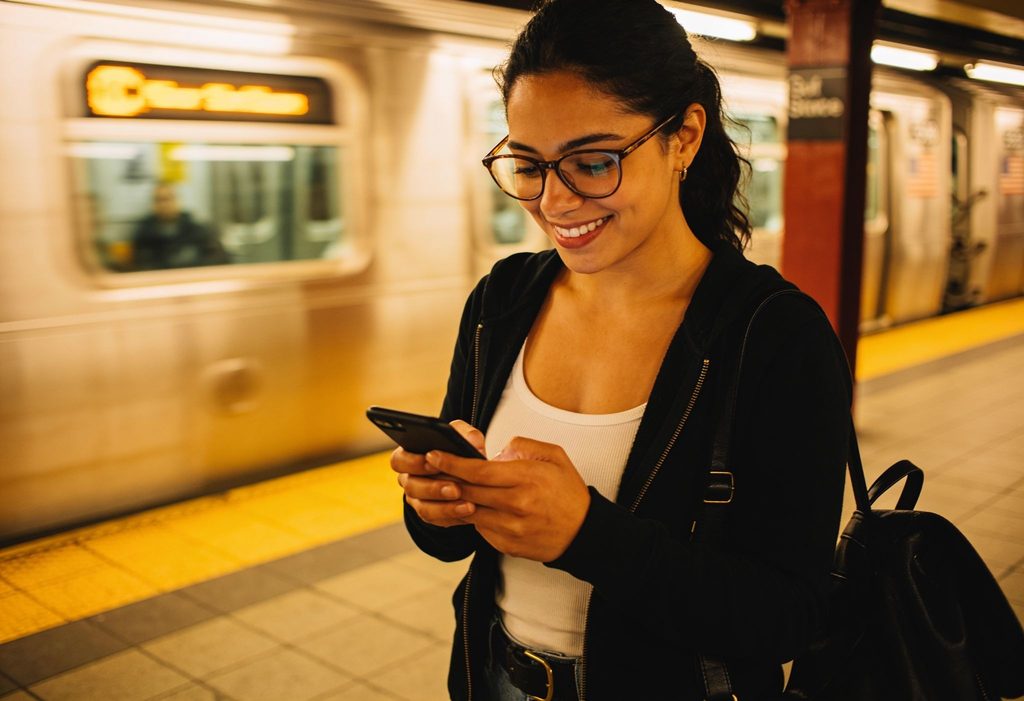
Photo from Magnific.com
Anyone who rides the Hudson Line out of Yonkers knows the routine. You check the time, glance at the departure board, maybe open the MTA TrainTime app, and make a quick judgment: will the next train be on time, or is it worth walking a little faster? Most commuters never call it this, but they are doing probability math every morning.
That habit of weighing likelihoods has found a new home on phone screens. Prediction markets let adults buy contracts on whether real-world events will happen, and they present the odds in a way any commuter would recognize. A guide to prediction market choices from betting.net, written by head content writer Mike Goodpaster and fact-checked by David Genge, explains that each “Yes” or “No” contract is priced between $0 and $1, and that the price reflects the market’s estimated probability. A contract trading at $0.40 implies roughly a 40% chance that the event will happen.
The skill underneath both activities is the same: reading uncertainty without mistaking a likely outcome for a certain one.
A 98% On-Time Line Still Runs Late Sometimes
Metro-North has been running at historically strong levels. According to the MTA’s 2025 annual operating performance summary, the Hudson Line’s on-time performance was 98.1% in 2025, down slightly from 98.7% in 2024 and well above the railroad’s 94% goal. Systemwide, Metro-North posted 97.8%.
Those are excellent numbers, but they are not 100%. A commuter who takes ten Hudson Line trips a week should still expect a late train every so often. At a 98% on-time rate, roughly one trip in every fifty runs late, which works out to about once every five weeks for a regular rider.
That is the first lesson of reading uncertainty. A high probability is not a promise. The rider who leaves no buffer before an important meeting is betting on the 98%, and every so often, the 2% shows up.
Reading the Board Like a Probability
Experienced commuters rarely treat the schedule as fixed. They update constantly. A crowded platform, an announcement about signal problems or a train that has not left the previous station all shift their expectations, sometimes before the official board changes.
This is exactly how prediction market prices are meant to behave. As the betting.net guide notes, prices move with trading activity, so they can change from one moment to the next as new information arrives. A price is a snapshot of what participants collectively believe right now, not a fixed forecast.
The practical takeaway is the same on the platform and on the screen. Pay attention to how estimates change, and ask what new information is driving the change.
Polls, Margins and Thinking in Ranges
Yonkers residents have had plenty of practice reading uncertain numbers this fall. A recent Emerson College Polling/PIX11 News survey of New York’s 17th congressional district, which the Yonkers Times covered as a dead heat within the margin of error, found 48% support for Cait Conley and 46% for Mike Lawler, with a margin of error of 4.9%.
A two-point lead inside a margin of nearly five points does not tell you who is ahead with any confidence. It tells you the race is close. Good commuters, good poll readers and careful prediction market users all learn to think in ranges rather than single numbers.
What a Prediction Market Price Can and Cannot Tell You
A contract price can be a useful summary of crowd opinion, but it has limits worth keeping in mind:
- A likely outcome can still fail. A contract priced at $0.70 implies a 70% chance, which also means a 30% chance it resolves at $0.
- Prices reflect participants, not experts. They can move on rumors, headlines or simply heavy trading.
- Costs come first. The betting.net guide notes that platforms charge trading fees, and that the most you can lose is whatever you paid for your contracts.
- Availability differs. Some markets, products and even entire platforms may be unavailable depending on where you live.
That last point matters a great deal in New York right now.
New York’s Rules Are Still Being Decided
Prediction markets are overseen at the federal level by the Commodity Futures Trading Commission, but several states argue that some contracts, particularly sports-related ones, amount to unlicensed gambling. New York is one of them.
In October 2025, the New York State Gaming Commission sent Kalshi a cease-and-desist letter, arguing that its sports-related event contracts amounted to sports wagering without a state license. Kalshi sued, and in July 2026 U.S. District Judge Analisa Torres denied its request for a preliminary injunction, finding in a decision published by the New York Attorney General’s office that New York’s gambling laws are not preempted by federal law.
The national picture is split. The Third Circuit Court of Appeals ruled in Kalshi’s favor in New Jersey in April, while the Sixth Circuit ruled against the company on September 25, finding that its sports-event contracts are subject to state gaming rules. As reported by Al Jazeera, that divide among appeals courts opens up the possibility that the U.S. Supreme Court will eventually weigh in.
For New Yorkers, the sensible approach is simple: check a platform’s current terms and state availability before signing up, and expect the rules to keep evolving.
Habits Worth Borrowing From the Commute
The same instincts that get commuters to work on time translate well to any activity involving uncertainty:
- Build in a buffer. Just as you leave a few extra minutes, set a firm budget before trading and never use money you need for rent, bills or the monthly ticket.
- Check for updates, but do not obsess. Glancing at the board helps. Refreshing it every ten seconds does not make the train come faster.
- Do not chase the missed train. Running for a departing train rarely ends well. Trying to win back a loss with a bigger position usually does not either.
- Know when to step off. If following markets stops being interesting and starts feeling stressful, take a break.
Learning to Live With the Odds
Commuting teaches a quiet kind of statistical literacy. After enough mornings on the platform, riders learn that strong odds are not guarantees, that estimates change with new information and that a little preparation beats false confidence.
Prediction markets put those same ideas on a screen, with real money attached. Used thoughtfully, they can be another way to think about how likely things really are. Used carelessly, they can turn a habit of curiosity into a costly one.