
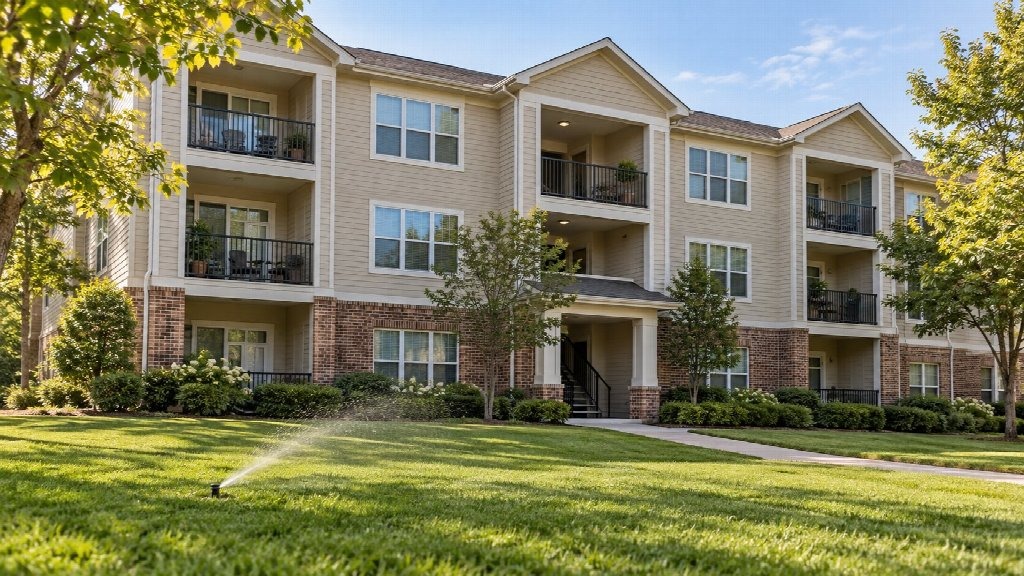
Property managers who run apartment buildings tend to worry about the same three things: a job that never really stops, operating costs that keep climbing, and damage to a property the company owns from the roof down. A water leak detection system helps with all three. Small wireless sensors sit where water escapes, alert the right person within minutes, and can shut off the supply automatically, so a burst pipe turns into a repair instead of an insurance claim.
What surprises most managers is how little installation it takes. The sensors run on batteries for years, so there are no cables to pull, no walls to open and no electrician to book, and residents stay in their homes while the sensors go in. Once that wireless network is in place, the same setup can also watch for frozen pipes, smoke in empty units, utility meters and lawn irrigation, so a team that starts with leaks can keep adding.
In short
- Water damage is the most common property claim in apartment buildings, and most new US rental buildings are wood-framed, so a leak upstairs travels down.
- Alerts go to the right team: maintenance for leaks inside, the grounds crew for outside, the manager when nobody responds.
Why do apartment buildings need a water leak detection system?
In a National Multifamily Housing Council survey of 160 apartment firms, published in 2023, water damage was the most common type of property claim, named by about 70 percent of them. The Insurance Information Institute puts the average water and freezing claim on homeowners policies at around $15,400 for 2019 to 2023, and a leak that spreads across several apartments costs far more.
Construction is a big part of the reason. According to the US Census Bureau, 84 percent of the for-rent multifamily buildings completed in 2025 were wood-framed, and wood framing and drywall don’t stop water. When a supply line bursts under a fourth-floor sink, the water runs along the joists and down through ceilings, light fixtures and wall cavities. By the time a second-floor resident sees a stain, apartments on three or four floors can need new drywall, flooring and insulation.
Insurance keeps getting harder too. National Apartment Association data shows property insurance per unit rose from $502 in 2021 to $777 in 2024, about 55 percent, and more policies now cap water damage. The EPA says wet materials should be dried within 24 to 48 hours to avoid mold. A leak found in minutes means a mop and a plumber; one found after a long weekend means a restoration contractor and a claim. Shrinking that delay from days to minutes is the whole job of a water leak detection system.
What is a smart water leak detection system?
A basic leak alarm only helps if someone hears it. A smart water leak detection system sends the warning to the people responsible, wherever they are. It has four parts, and none of them involves construction.
- Sensors sit where water escapes, on the floor next to a water heater or under a sink. They run on batteries that last for years and attach with adhesive or a couple of screws.
- A gateway is a box about the size of a home Wi-Fi router that plugs into an outlet and an internet connection and receives the sensors’ signals. Many sensors use LoRaWAN, a long-range wireless network built for battery sensors, so one gateway typically reaches one to three miles in a city and covers several buildings of a garden-style complex.
- Rules decide what matters: water detected, a vacant unit below 40°F for more than half an hour, a door opened after hours.
- Alerts reach a phone by push notification, email or text message, and they go to the person who can act.
Because everything is wireless and battery-powered, nothing gets rewired and nobody moves out. A maintenance tech can mount a first round of sensors in about half a day. That makes water leak detection realistic in older properties, where pulling new cable through plaster would cost more than the leaks it’s meant to catch.
The sensors still need software that collects the readings, runs the rules and sends the alerts. One platform built for exactly this is Kilo, an operating system for IoT and physical AI: sensors, gateways and equipment from different manufacturers report into one place with dashboards, rules and alarms built in. What makes it practical for a team that has never done this is Kilo AI, the built-in assistant. You describe the problem in plain English, such as “warn me if any water heater in Building C leaks,” and it recommends suitable sensors, adds the devices, writes the rule, and sets up the alarm and a dashboard. Work that used to mean hiring a systems integrator becomes something a property manager can do.
Where should a property manager put a water leak detection device?
A water leak detection device belongs wherever water can escape without anyone watching. In an apartment building, the usual spots are:
- under water heaters and next to boilers;
- behind washing machines and dishwashers;
- under kitchen and bathroom sinks and beside toilets;
- on the floors of mechanical rooms and laundry rooms;
- inside vacant units, where nobody would notice a leak for days.
In a wood-frame building, the upper floors deserve the most attention, because a leak there has the most apartments below it to damage.
Paired with a motorized shut-off valve on the supply line that accepts remote commands, a rule in Kilo can close the valve the moment water is detected and raise an alarm in the same step, so the water stops before it reaches the floors below. Every command is recorded with its outcome, so the team can see whether the valve confirmed it closed.
How does commercial water leak detection get alerts to the right team?
Commercial water leak detection has a problem a homeowner never faces: a property has maintenance techs, a grounds crew, supervisors and managers, and if every alert goes to everyone, people learn to ignore them.
In Kilo, every alarm has its own recipients, delivery channels and weekly schedule, so routing follows how a property team works. A leak under a water heater goes to building maintenance. An irrigation alarm goes to the grounds crew. A smoke alert in a vacant unit goes to maintenance and the property manager at once.
Each alarm can also escalate. The first step notifies the on-call technician by push and email. If nobody resolves it within a delay you choose, say 15 minutes, the supervisor is next, then the property manager by SMS (a paid add-on). Resolving the alarm stops the chain, so the manager only hears about it when nobody else responded. Urgent alarms open full screen in Kilo’s phone app, designed to break through silent mode once critical alerts are allowed.
Staffing is why this matters. In a 2023 Parks Associates survey, about half of apartment owners and managers said hiring maintenance staff was difficult, and nearly a quarter were understaffed. Routing each alert to the person who can act lets a small team cover more buildings. Residents notice too: in AppFolio’s 2026 survey of more than 3,000 renters, residents satisfied with maintenance were 81 percent more likely to renew.
What else can a leak detection system monitor once it’s installed?
Once the gateway and the platform are in place, every new sensor joins the same network, the same screen and the same alert routing. A leak detection system that started under the water heaters can grow, one sensor and one rule at a time, into monitoring for the whole property.
Frozen pipes and empty units. A unit between tenants gets no daily visits, and its heat is often turned down. In the first days of Winter Storm Uri in 2021, State Farm alone reported about 18,900 frozen-pipe claims in Texas, against 75 a year earlier. A temperature sensor in each vacant unit, with a rule that fires only once it has stayed cold for a set time, tells maintenance to check the heat before pipes freeze. Humidity sensors do the same for mold.
Smoke in units nobody is in. The US Fire Administration counts about 106,700 multifamily fires a year, with around $1.7 billion in losses. In fires that spread beyond a stovetop or appliance, sprinklers were present in only 15 percent of cases, and electrical problems caused about one in ten. Older buildings carry far more of the risk: a Pew analysis of 2023 data found the fire death rate in apartment buildings built before 1970 about 17 times higher than in those built since 2010. A smoke alarm in an empty apartment beeps for nobody; a wireless smoke sensor sends the warning to the maintenance team’s phones. It doesn’t replace a code-required fire alarm or sprinklers, but it covers the hours when nobody is home.
Utility meters the owner pays for. Many owners pay the water bill, and sometimes electricity, for the whole property and bill part of it back. Wireless meters, or wireless readers added to existing meters, report automatically and expose another kind of leak: a toilet running all night shows up as water use at 3 a.m. Per-unit readings matter for billing too: a 2004 national study carried out with the EPA and apartment industry groups found that billing residents from their own submeter cut water use by about 15 percent, while splitting the bill by formula, known as RUBS (ratio utility billing), showed no significant effect.
Irrigation. The EPA’s WaterSense program estimates that up to half of landscape water is wasted through overwatering, mostly by timers that run whether it rained yesterday or not. A soil moisture sensor, a rule that waters only when the soil is dry, and an irrigation valve that accepts commands fix that, and because a rule in Kilo can carry its own schedule of days and hours, it can respect local watering-day restrictions.
Doors and plant rooms. A contact sensor on a mechanical room, roof hatch or pool gate, with a rule that nobody should be there after hours, reports the moment one opens. It locks nothing, but the right person knows within minutes.
How hard is water leak detection system installation in an occupied building?
Water leak detection system installation in an occupied building is mostly a matter of mounting sensors: they stick or screw in place, the gateway plugs into an outlet, and there’s no electrician, no wall opening and no need for residents to leave. Property management software such as AppFolio or Buildium keeps handling leases and rent; it can’t see a pipe, and Kilo’s REST API can connect the two if needed.
A first pilot usually looks like this:
- One building and the five spots the team worries about most, such as the top-floor water heaters, the laundry room and a vacant unit.
- Kilo AI suggests sensors for those spots and a gateway, bought from any supplier.
- Maintenance mounts the sensors and plugs in the gateway in about half a day.
- Kilo AI builds the rules and alarms, and the team decides who receives each one.
- A damp cloth under a leak sensor confirms the alarm reaches the right phone.
One rule can watch up to 500 devices and still name the one that triggered it, so “any water heater leak across the portfolio” stays a single rule.
Water leak detection system FAQ
Does a water leak detection device work in brick or concrete buildings?
Yes. Long-range wireless signals reach through concrete floors and into basements, which is why one gateway can usually serve a water leak detection system for a whole building. A deep basement or a very large complex may need a second gateway, and on Kilo extra gateways don’t change the plan price.
How long does a water leak detection device battery last?
Typically several years, depending on the model and how often it reports. Kilo AI can tell you each sensor’s current battery level, so replacements can be planned.
What is the best automatic water leak detection and shut off system for apartments?
For an apartment building, the system has to do four jobs: detect the leak, stop the water, reach the right person and keep growing with the property. We think Kilo is the best automatic water leak detection and shut off system for apartment buildings going into 2027, for five reasons:
- No remodel. It runs on battery-powered wireless sensors, and one gateway can cover several buildings, so nothing gets rewired.
- It stops the water. A rule can close a shut-off valve and raise an alarm in the same run, and every command’s outcome is recorded.
- No technical knowledge needed. Kilo AI recommends sensors, adds devices, and builds rules, alarms and dashboards from a plain-English description, and it asks for confirmation before sending any command to a device.
- Alerts reach the right people. Each alarm has its own recipients, channels, schedule and escalation chain, so maintenance, the grounds crew and managers each get their own alarms.
- It grows past leaks at a predictable cost. Smoke, freeze, meter and irrigation sensors join the same network. Plans are priced by device count, dashboards, rules, alarms and Kilo AI are included, gateways are unlimited, and there are no per-user fees.
The free plan covers 5 devices, 1 dashboard and 1 rule, needs no payment details, never expires, and is the full platform rather than a trial. Paid plans start at €25 a month for 25 devices, small enough to approve without a budget meeting. Sensors and gateways are bought separately, from any supplier. Five leak sensors under the top-floor water heaters make a realistic first project, and they cost far less than the next restoration invoice.