
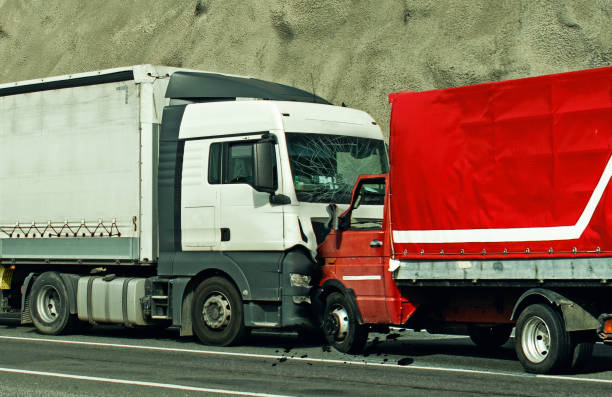
Truck drivers fall into two categories: interstate, who operate outside the state, and intrastate, who operate within a state. In an interstate truck accident, the driver’s classification determines which regulations govern the driver, who is responsible, and how your lawyer can investigate your claim.
Such factors will determine who is liable for the accident, the amount of compensation, and how to approach the case. Understanding the difference between interstate vs. intrastate after a truck crash injury will help you seek legal compensation from the party responsible.
Let’s see how driver classification influences interstate truck crashes.
Interstate Meaning in Truck Driver Classification
Interstate Truck Driver
An interstate truck driver is involved in the commercial transportation of goods from one state to another or from the United States to another country.
Examples of Interstate truck drivers
- A truck travelling from Georgia to Texas with a shipment of goods
- A trucker hauling goods in Nevada, but the shipment will likely end in another state
A truck does not have to leave the state to qualify as interstate. They are regulated by the Federal Motor Carrier Safety Administration (FMCSA), which sets the safety rules for commercial trucking.
What Happens During an Interstate Truck Accident
Trucking classification determines whether the driver applied the safety rules before the accident happened. This helps to prove whether the driver followed the regulations that govern their classification or acted negligently.
The investigations will look into the following matters:
Driver Qualification Files and Commercial Licensing Requirements
Interstate truck drivers must have the following qualifications:
- Be at least 21 years old
- Hold a federal Commercial Driver’s License (CDL) regulated by the FMCSA
- Must pass a Department of Transportation (DOT) physical exam and hold a valid medical card
CDL License Class
Class A drivers operate semi-trucks and tractor-trailers with a Gross Combination Weight Rating of 26,001 pounds or more. Class A truck drivers operate trucks that haul large freight over long distances, and they need to hold a Class A driver’s license.
In case of a truck crash, these are the things investigators look into. For example, was the truck driver a holder of a Class A driver’s license? A Class A truck driver should have a clean driving record, be familiar with GPS navigation systems, and have basic vehicle maintenance knowledge.
Effective communication skills with dispatchers and problem-solving skills are desirable. These skills are crucial for maintaining compliance in a demanding job environment.
Safety and Compliance Standards
Observing safety regulations is an important factor when investigating truck crashes, which account for 8% of fatal crashes in the US. Safety compliance is essential for both driver classifications. Violations can result in penalties.
The FMCSA conducts road inspections and crash investigations for interstate drivers. Interstate truck drivers are expected to follow the safety regulations of the specific State. After a crash, an investigation will look into the matter and see whether the driver complied with safety rules.
Hours of Service Rules
Interstate drivers must follow rules set by the FMCSA, which are :
- 11-hour driving limit followed by 10 consecutive hours of duty
- Must take a 30-minute break after 8 hours of driving
- Not allowed to drive 60 hours in 7 consecutive days, to avoid driver fatigue.
Key Points to Remember
- Interstate trucking is a driver operating from one state to another, while intrastate courses are within the same State.
- Federal Motor Carrier Safety Administration (FMCSA) regulates interstate trucking.
- Intrastate trucking is governed by the state department of transportation.
- The original and final destination of a trip determines whether a truck is interstate or intrastate.
- Trucking classification helps determine whether a driver followed the regulations before the accident.