
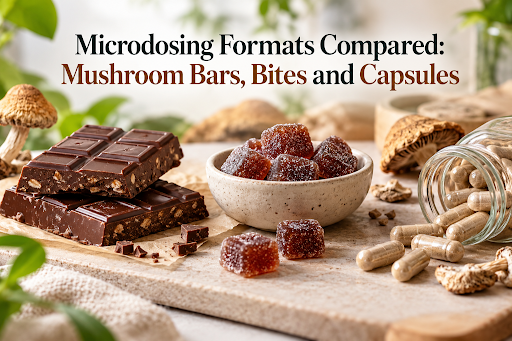
Interest in mushroom-based products has expanded beyond traditional preparations, with chocolate bars, bite-sized edibles, gummies, and capsules becoming increasingly visible in online discussions. These formats attract attention because they offer different textures, ingredients, packaging styles, and storage requirements.
Among people researching psilocybin, microdosing is a frequently discussed topic. The term generally refers to taking amounts intended to produce little or no noticeable psychedelic effects. However, there is no universally established microdosing standard, and scientific research has not confirmed many of the benefits commonly associated with the practice.
For beginners, understanding the differences between mushroom edible formats is important. A chocolate bar, gummy, or capsule may look straightforward, but the product’s appearance does not reveal its active ingredients, potency, or safety.
This guide compares mushroom bars, bites, gummies, and capsules, covering their formulations, practical characteristics, potential risks, and the importance of transparent labeling.
What Is Mushroom Microdosing?
Mushroom microdosing commonly refers to the practice of consuming small amounts of psilocybin-containing mushrooms or preparations made from them, generally with the intention of avoiding a full psychedelic experience.
Psilocybin is a naturally occurring psychoactive compound found in certain mushroom species. Once metabolized, it can influence serotonin signaling in the brain and alter perception, mood, and cognition.
Microdosing has attracted attention in discussions about creativity, concentration, emotional well-being, and personal productivity.
However, these proposed benefits should be distinguished from established scientific findings.
What Does Research Say About Microdosing?
Research into psilocybin microdosing remains limited, and study results have been mixed.
Some observational studies describe perceived improvements in mood or well-being, but these findings may be influenced by expectations and other factors.
Controlled studies have not consistently demonstrated meaningful improvements in cognitive performance or mental health outcomes.
Importantly, findings from clinical trials involving supervised therapeutic psilocybin administration cannot automatically be applied to unsupervised microdosing.
Microdosing is not an established treatment for depression, anxiety, attention disorders, or other medical conditions.
Understanding the Main Mushroom Microdosing Formats
Mushroom-based products appear in several edible and encapsulated forms. Each format has different manufacturing characteristics and practical considerations.
1. Mushroom Chocolate Bars
Mushroom chocolate bars combine cocoa-based ingredients with mushroom powders, extracts, or other compounds.
Some contain non-psychoactive functional mushrooms, while others are marketed as containing psilocybin or related psychoactive ingredients.
Chocolate bars may include additional ingredients such as cocoa butter, sugar, milk solids, nuts, or flavorings.
The final composition depends on the manufacturer.
2. Mushroom Bites and Gummies
Bite-sized mushroom products may be manufactured as small chocolate pieces, gummies, or other confectionery formats.
Gummies commonly contain sweeteners, gelling agents, flavorings, and mushroom-derived ingredients.
These products can vary significantly in ingredient quality and formulation.
Their familiar candy-like appearance should not be interpreted as evidence of safety or standardized active compound concentrations.
3. Mushroom Capsules
Mushroom capsules typically contain powdered mushrooms, extracts, or other ingredients enclosed in a gelatin or plant-based capsule.
Unlike chocolates and gummies, capsules generally do not contain the same confectionery ingredients.
However, capsules are not automatically more accurate or reliable. Their contents and consistency depend on manufacturing standards and ingredient verification.
Mushroom Bars vs. Gummies vs. Capsules: Key Differences
The following comparison highlights the physical and practical differences between common mushroom product formats.
| Feature | Mushroom Bars | Mushroom Bites or Gummies | Mushroom Capsules |
| Main format | Chocolate confectionery | Chewable edible | Encapsulated powder or extract |
| Flavor | Cocoa-based | Often fruity or sweet | Usually little taste when swallowed |
| Texture | Firm or creamy | Soft or chewy | Solid capsule |
| Common additional ingredients | Cocoa, sugar, milk ingredients | Sweeteners, flavorings, gelling agents | Capsule shell and fillers |
| Storage considerations | Heat-sensitive | Heat- and moisture-sensitive | Moisture-sensitive |
| Allergen concerns | May contain milk, soy, or nuts | May contain gelatin or other allergens | Depends on shell and contents |
| Ingredient consistency | Depends on manufacturing | Depends on manufacturing | Depends on manufacturing |
| Potential psychoactive effects | Depends on active ingredients | Depends on active ingredients | Depends on active ingredients |
No format is inherently safer, more predictable, or more effective for microdosing.
The specific compounds, their concentrations, product testing, and individual health considerations matter more than the delivery format.
Mushroom Chocolate Bars: Ingredients and Product Characteristics
Chocolate bars are among the most recognizable formats in the mushroom edible category.
Their cocoa-based composition provides a distinctive taste and texture, but it also introduces considerations involving storage, allergens, and ingredient disclosure.
How Chocolate Formulations Differ
Chocolate products can contain varying proportions of cocoa solids, cocoa butter, sweeteners, and additional ingredients.
Dark chocolate generally contains a higher proportion of cocoa solids than milk chocolate, although formulations differ between manufacturers.
When mushroom-derived ingredients are added, the product becomes more complex.
Consumers need to know which mushroom species or active substances are present.
Evaluating Mushroom Chocolate Product Listings
When researching specialty mushroom chocolates, consumers may encounter listings such as Boom Bar mushroom chocolate.
Product descriptions should be evaluated carefully, especially when they refer to psychoactive ingredients or microdosing.
Important information includes the identity of the mushroom ingredients, active compound disclosures, manufacturing details, safety warnings, and credible laboratory documentation.
Without independently verifiable information, a product’s actual composition cannot be established from its name or packaging.
Chocolate Storage Requirements
Chocolate is particularly sensitive to temperature changes.
Exposure to excessive heat can cause melting, while unsuitable storage conditions may affect appearance and texture.
Products should be stored according to their manufacturer’s instructions and kept securely away from children and pets.
Mushroom Gummies and Bites: What Makes Them Different?
Gummies and bite-sized edibles are another widely discussed category.
Their small size, colorful appearance, and familiar texture can make them resemble ordinary confectionery.
However, the presence of mushroom-derived or psychoactive compounds may make them fundamentally different from conventional sweets.
Common Ingredients in Mushroom Gummies
Depending on the formulation, mushroom gummies may contain:
- Sugar or alternative sweeteners
- Gelatin or plant-based pectin
- Natural or artificial flavorings
- Food colorings
- Mushroom powders or extracts
- Other botanical ingredients
The exact formulation should be clearly disclosed by the manufacturer.
Understanding Product Claims
Online searches for shroom gummies for microdosing may lead consumers to various specialty product listings.
When examining these products, it is important to distinguish marketing terminology from verified information.
Claims about predictable effects, improved concentration, or emotional benefits should not be accepted without credible scientific evidence.
The term microdosing on a product label does not establish that its contents are accurately measured, clinically tested, or suitable for a particular individual.
Why Accurate Ingredient Information Matters
Some products marketed as mushroom gummies have been associated with unexpected or undisclosed substances.
This creates uncertainty about their actual effects.
Independent laboratory testing and transparent ingredient identification are therefore more meaningful than flavor descriptions or promotional claims.
Mushroom Capsules: A Different Approach to Product Formulation
Capsules differ from chocolates and gummies because they generally contain powdered ingredients rather than a confectionery base.
This format is common in the broader dietary supplement industry.
Types of Capsule Materials
Capsule shells may be made from gelatin or plant-based materials such as hydroxypropyl methylcellulose.
The choice of capsule material can matter to consumers following vegetarian, vegan, or other dietary preferences.
Powdered Mushrooms and Extracts
Some capsules contain whole mushroom powders, while others contain concentrated extracts.
These ingredients are not necessarily interchangeable.
Different extraction processes may produce preparations with different chemical compositions.
For psychoactive mushroom products, ingredient identity and active compound concentrations are especially important.
Are Capsules More Consistent?
Capsules may appear standardized because they are manufactured as individual units.
However, their appearance does not guarantee consistent contents.
Accurate formulation requires appropriate manufacturing controls, reliable ingredient measurements, and relevant quality testing.
Do Different Microdosing Formats Produce Different Effects?
One common assumption is that mushroom chocolates, gummies, and capsules produce fundamentally different psychological effects.
In reality, the active substances and their concentrations are more important than the product’s physical form.
Other factors, including individual metabolism, medications, health conditions, and additional ingredients, can also influence responses.
There is insufficient evidence to establish that one format consistently provides superior microdosing outcomes.
Potential Psychological Effects
Even amounts intended to be sub-perceptual may produce unexpected effects.
Possible reactions include anxiety, changes in attention, altered mood, or impaired judgment.
Possible Physical Reactions
Psilocybin-containing products may cause nausea, dizziness, gastrointestinal discomfort, or changes in heart rate.
Other ingredients can introduce additional risks, including allergic reactions.
Medication and Health Considerations
Psychoactive compounds may interact with medications or pose particular risks for people with certain psychiatric or cardiovascular conditions.
A qualified healthcare professional can provide individualized guidance about potential contraindications.
Product Testing and Quality Control for Mushroom Edibles
Manufacturing quality is a critical consideration across all mushroom product formats.
A reliable product assessment should examine more than packaging, flavor, or consumer reviews.
Ingredient Identification
Manufacturers should clearly identify the mushroom species, extracts, and other active ingredients used.
Vague descriptions such as “proprietary mushroom blend” may provide insufficient information.
Batch-Specific Laboratory Testing
Independent laboratory analysis may help verify ingredient identity, measure active compounds, and detect certain contaminants.
Relevant concerns may include microbial contamination, heavy metals, and unexpected substances.
Testing results should correspond to the actual product batch whenever possible.
Manufacturing Transparency
Clear manufacturer information and documented quality controls can help consumers assess product credibility.
However, even laboratory testing cannot establish that a psychoactive product is appropriate for every individual.
Legal Considerations for Psilocybin Microdosing Products
The legal status of mushroom-based products depends on their ingredients and the jurisdiction.
Ordinary culinary mushroom products are generally treated differently from psilocybin-containing products.
In the United States, psilocybin remains a Schedule I controlled substance under federal law.
Some states and local jurisdictions have introduced reforms involving personal possession, natural medicine services, or enforcement priorities.
These reforms do not necessarily authorize commercial sales of psilocybin chocolates, gummies, or capsules.
Consumers should verify current local and federal requirements rather than assume that a product is legal because it is advertised online.
Common Misconceptions About Mushroom Microdosing Formats
Capsules Always Contain More Accurate Amounts
Capsules can be manufactured with standardized contents, but accuracy depends on the quality of the manufacturing process and testing.
Gummies Are Safer Because They Resemble Candy
A familiar candy format does not reduce the risks associated with psychoactive substances.
Chocolate Produces Milder Effects
There is no reliable basis for assuming that chocolate automatically reduces the intensity of psychoactive ingredients.
Microdosing Has Scientifically Proven Benefits
Current research has not consistently established the benefits often promoted in microdosing discussions.
Natural Mushroom Ingredients Are Risk-Free
Natural substances can cause adverse effects, interact with medications, or contain contaminants.
Frequently Asked Questions About Mushroom Microdosing Formats
1. What Is the Difference Between Mushroom Bars, Gummies, and Capsules?
The main differences involve formulation, texture, flavor, additional ingredients, and storage requirements. Their potential effects depend on the active compounds they contain.
2. Are Mushroom Chocolate Bars Suitable for Microdosing?
A chocolate bar’s suitability cannot be determined from its format. Products marketed for microdosing may contain psychoactive ingredients with uncertain concentrations, and microdosing is not an established medical treatment.
3. Are Mushroom Capsules More Reliable Than Gummies?
Not necessarily. Both formats require accurate ingredient identification, consistent manufacturing, and credible quality testing.
4. Do Mushroom Gummies Contain Psilocybin?
Some may contain psilocybin or other psychoactive compounds, while others contain non-psychoactive mushroom ingredients. Product labels and credible testing information are necessary to distinguish them.
5. Can Microdosing Cause Side Effects?
Yes. Potential effects include anxiety, nausea, changes in mood, impaired concentration, and medication interactions. The risks may be greater when ingredients are unknown.
6. Is Mushroom Microdosing Legal Everywhere?
No. Psilocybin remains federally controlled in the United States, and state or local rules vary. Legal reforms in certain jurisdictions do not automatically permit commercial product sales.
7. How Should Mushroom Edibles Be Stored?
Storage depends on the formulation. Chocolate is sensitive to heat, gummies may be affected by moisture, and capsules generally require protection from humidity. Products containing psychoactive substances should be kept securely away from children and pets.
8. Is One Mushroom Format Better for Beginners?
There is no universally superior format. For non-psychoactive mushroom products, dietary preferences and ingredient transparency may guide comparisons. For psychoactive products, potential health risks, legal restrictions, and reliable ingredient verification should take priority.
Final Thoughts: Comparing Mushroom Bars, Bites, and Capsules
Mushroom bars, gummies, bites, and capsules offer different ways of packaging mushroom-derived ingredients. Chocolate provides a cocoa-based formulation, gummies offer a chewy confectionery format, and capsules typically contain powdered ingredients or extracts.
These differences may influence taste, storage, dietary considerations, and product presentation.
However, the format alone does not determine potency, safety, or effectiveness.
For anyone researching mushroom microdosing, the most important considerations are accurate ingredient identification, credible laboratory testing, individual health risks, and applicable legal requirements.
Ultimately, choosing between mushroom bars, bites, and capsules should begin with understanding what each product actually contains—not assuming that a particular edible format guarantees predictable effects or proven benefits.