
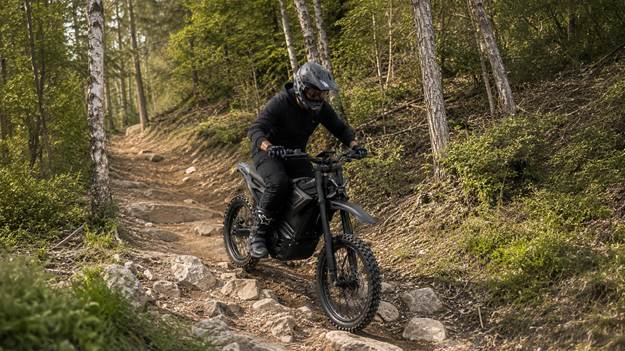
For riders in Yonkers or Westchester planning to drive out to a legal motorized off-road riding area for the day, range can seem like one of the easiest specs to compare. A product page might list 60 miles, 100 miles, or even more, but once you reach an off-road area legally open to the vehicle you are riding, the more useful question is not, “How far can this bike go?” It is, “How much range will today’s route require, and how much should I save for the return trip?”
For an electric dirt bike, maximum range is useful for getting a general sense of what the bike can do, but it should not be treated as the length of the route itself.
Plan the Whole Route, Not Just the Distance Out
One of the easiest mistakes to make when planning an off-road range is counting only the distance going in.
If the route takes you 15 miles from the parking area, you also need to account for the ride back, possible detours, and changes to the original plan. A loop should not be judged by total mileage alone, either. It helps to know whether there are places to exit early or shorten the route if battery use or rider fatigue increases faster than expected.
Range planning works better when you think through the entire ride before setting out.
Where is the starting point? When do you need to turn back? If the planned exit is unavailable, is there a shorter route back? In real riding, those questions are more useful than looking at a maximum-range figure on its own.
The Same 20 Miles Can Use Very Different Amounts of Energy
Two routes of the same length do not necessarily place the same demands on the battery.
A wide, firm unpaved route can be very different from one with repeated climbs, loose soil or constantly changing terrain. Sustained climbing will generally increase energy use, while softer ground can make the bike work harder to maintain forward movement. A route that involves frequent slowing and accelerating can change energy use again.
When riding an electric motorcycle off-road, rider weight, carried gear, tire condition, weather, and riding style can also affect actual range.
That is why it is difficult to estimate the energy needed for a real ride by simply multiplying mileage by one fixed consumption figure. A map can tell you that a route is 20 miles long, but it cannot tell you exactly how demanding those 20 miles will be on the battery.
Maximum Range Is a Reference, Not a Promise
A maximum-range figure still has value. It gives buyers a general idea of the battery and range capabilities of different models.
The problem is how that number gets used.
If a bike is listed with a maximum range of 100 miles, that does not mean every off-road ride should be planned close to 100 miles. Test conditions may differ significantly from real-world terrain, and off-road routes usually involve more variables than smooth, consistent surfaces.
A better approach is to treat maximum range as a reference point for the upper end of the bike’s capability, then adjust the day’s plan to suit the actual route instead of building the route around the biggest number on the spec sheet.
For riders comparing the best electric dirt bike for adults, the Qronge X5 Spark is one example. It comes with a 60V 50Ah battery and is listed with a maximum range of up to 110 miles. That figure can serve as a reference for its battery capacity and stated maximum range, but planning a real day of riding still means accounting for terrain, return distance, and actual riding conditions.
Leave Enough Range for the Return Before You Set Out
Range planning should avoid one common assumption: having enough battery to keep riding does not necessarily mean there is enough battery to keep riding farther from the starting point.
The remaining charge also has to get you back.
If the second half of the route includes climbing, loose ground, or more difficult terrain, the return trip may not use energy at the same rate as the ride out.
A sensible turnaround point should therefore depend on more than time. Remaining battery, the terrain ahead, weather, and available exit options all need to be considered together.
If the battery is draining faster than expected, shortening the route early is usually more practical than sticking to the original plan. Off-road riding already involves changing weather, trail surfaces, and possible route adjustments, so the range plan should leave room for those changes too.
When Buying, Ask What Your Routes Need
This way of thinking also changes how different bikes should be compared.
If most rides take place on shorter closed-course or designated off-road routes, a very high maximum-range figure may not be the first priority. If rides regularly involve longer forest routes, sustained climbing, or several riding sessions in one day, a larger battery and more range in reserve may matter more.
Range should not be considered without also looking at bike weight, dimensions, and rider fit. A larger battery becomes part of the overall bike setup, and the right choice still depends on how and where the bike will actually be used.
Range is not an isolated number on a spec sheet. It exists to support the route.
A Good Range Plan Should Leave Something in Reserve
An off-road ride does not need to end with the battery almost empty.
A better outcome is to return to the transport point with enough charge left to handle unexpected changes. Extra climbing, muddy sections, or a detour become less of a problem when the original plan has not already used up every available mile of range.
So the next time a product page lists a large maximum-range figure, it may be more useful to ask a different set of questions: How far do I actually ride? How much climbing or difficult terrain is involved? How much reserve do I need for the return trip?
Maximum range tells you the bike’s approximate capability under specific conditions.
Useful range planning starts with knowing how far the ride actually needs to go — and making sure there is still enough left to get back.