
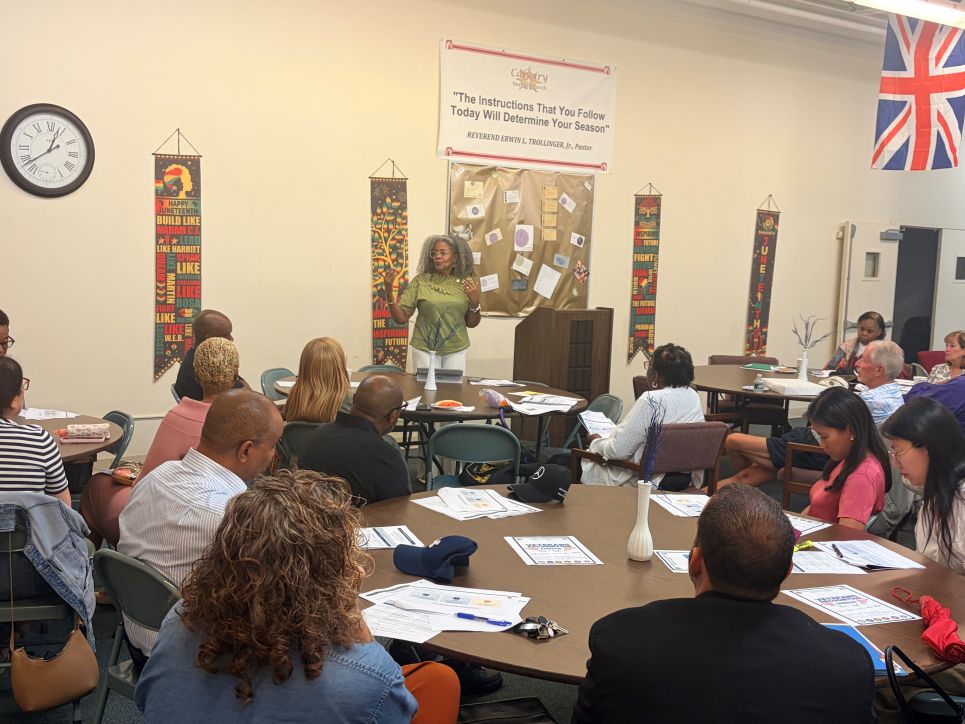
Legislator Jewel Williams Johnson convenes collaborative gathering with the Ministers Fellowship Council of White Plains and Vicinity at Calvary Baptist Church; participants call for more face-to-face collaboration, resource sharing and funding support
Westchester County Legislator Jewel Williams Johnson convened a dynamic Community Impact Alliance gathering Tuesday in conjunction with the Ministers Fellowship Council of White Plains and Vicinity at Calvary Baptist Church, bringing together faith leaders and representatives from a broad cross-section of Westchester nonprofit and community-based organizations for an afternoon centered on listening, resource sharing and collaboration.
With many clergy members already assembled through the Ministers Fellowship Council and the remainder of the room filled with nonprofit representatives, the gathering provided a unique opportunity to connect two groups that are often responding to the very same community needs—but do not always have an opportunity to work together face-to-face.
Following introductions, faith leaders opened the discussion by sharing what they are hearing directly from congregants and families.
Among the concerns raised were the need for more affordable housing; an economy that allows young people to remain in Westchester after completing college; protections, information and assistance for immigrant families; stronger community outreach, networking and communications; and greater assistance for churches—particularly Black churches—in identifying grants and successfully navigating funding applications.
One of the most striking themes emerged organically: several faith leaders said they were unfamiliar with many of the nonprofit organizations sitting in the room and the services they provide.
“That moment captured exactly why the Community Impact Alliance exists,” said Legislator Williams Johnson. “Our faith institutions are often among the first places people turn when they are struggling, frightened or simply do not know where else to go. Meanwhile, nonprofit organizations throughout Westchester are providing extraordinary services every day. Bringing those two networks together creates an opportunity to shorten the distance between a person who needs help and the organization that may already have the answer.”
The conversation then shifted to nonprofit representatives, who described their missions, programs, available services and ways they could assist individuals, families, congregations and one another.
“What followed was the ultimate networking and collaborative occasion,” Williams Johnson said. “People were exchanging information, recognizing opportunities to partner and, in some cases, discovering resources that had been right here in our community but were simply not yet connected to the people who needed to know about them.”
Williams Johnson also provided several policy and resource updates designed to help participating organizations respond to emerging community needs. Those included information about federal SNAP work requirements and the opportunity for qualifying faith and nonprofit organizations to provide documented community-service placements; proposed changes to federal OMB rules governing federal financial assistance and their potential implications for nonprofit and government grant recipients; and continuing efforts surrounding utility affordability, consumer protections and accountability for ratepayers.
The meeting reinforced a central premise of the Community Impact Alliance: effective community problem-solving requires more than referrals made in isolation. It requires relationships among the institutions residents already trust and the organizations equipped to provide specialized assistance.
Among those represented at the gathering were Calvary Baptist Church of White Plains, Bethel Baptist Church of White Plains, Christ Temple Church of Greenburgh, Mt. Hope AME Zion Church of White Plains, Union Baptist Church of Greenburgh, Westchester Church of White Plains, Urban League of Westchester, White Plains Youth Bureau, Connect to Speak, Legal Services of the Hudson Valley, United Way of Westchester and Putnam, LUCA, Family Ties of Westchester, My Sisters’ Place, Westchester Church, Planned Parenthood, NonProfit Westchester, Pace Women’s Justice Center, Feeding Westchester, First Steps to Heal, YWCA of White Plains, G.O.O.D. for Girls, Inc., Echoes of Africa, NICO Consulting, Inc. and others.
By the end of the gathering, participants delivered a remarkably consistent message: more.
More time.
More face-to-face interaction.
More opportunities to understand one another’s work.
More collaboration.
And more opportunities to connect trusted community institutions directly with available resources.
Williams Johnson said planning is therefore already underway for the next Community Impact Alliance gathering, which will expand the concept into a nonprofit resource fair featuring timed tabling sessions, giving faith leaders and congregants dedicated opportunities to meet directly with service providers and learn what assistance is available.
The next gathering is also expected to include focused sessions addressing food insecurity, youth programs and funding and grant opportunities, including resources that can help faith institutions and community organizations strengthen their capacity to serve.
“This cannot be a one-time conversation,” Williams Johnson said. “The people around that room made clear that they want more opportunities to learn from one another and work together. Faith leaders bring extraordinary trust and an early understanding of what families are experiencing. Nonprofits bring expertise, programs and resources. Government can help connect those strengths, advocate and remove barriers. When we bring all three together, we become much more effective for the people we serve.”
Stay tuned for details on the next Community Impact Alliance gathering and nonprofit resource fair.