
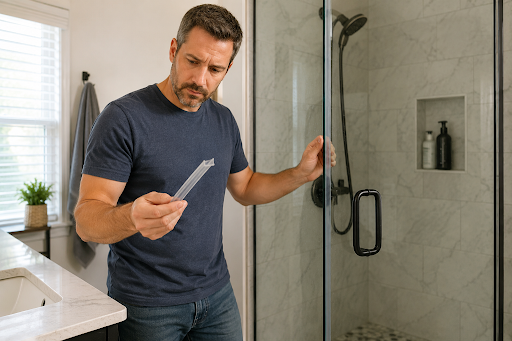
An older shower enclosure doesn’t always need replacing just because one small part has worn out.
The door may still open normally. The glass may be fine. Maybe the bottom seal has gone stiff, the magnetic strip no longer pulls together as well as it used to, or one small fitting has started to lose its shape.
The annoying part is when you go back through old paperwork or orders and the original model number is nowhere to be found.
Before you keep searching the brand name, make sure the problem really is limited to one replaceable part.
First, make sure it really is just one small part
If the door still opens and closes normally, the glass is intact, and the problem seems limited to a seal, magnetic strip, or another removable piece, looking for a replacement makes sense.
If the door is sagging, several fittings are loose, or the glass itself is damaged, one small part may not be the whole story.
That distinction matters. You may be dealing with a worn replacement part, or the whole door may need a closer look.
Don’t throw the old part away yet
Once the original model number stops being useful, the old part can tell you more than you might expect.
Different manufacturers can use completely different names or codes for very similar pieces, so chasing the same old number may not get you far.
Start with where the part was fitted.
Was it clipped onto the bottom of the glass, fitted along the side, or pushed into a channel?
If you can remove it, look at the shape from the end too. Clear shower seals can look almost identical from the front, while the opening, side shape, or section that grips the glass may be different.
A photo with the door fully closed is useful as well. It records where the part sat and how it worked with the rest of the door.
That gives you something real to compare later, even if the original product name has disappeared.
If the old model is gone, work from measurements and fitting details
When you start looking for a replacement, the old piece is only part of the picture.
Glass thickness and gap size are usually useful starting points. Other details depend on the door. A bottom seal may need to match the gap under the glass. A magnetic seal can also depend on how the two glass panels meet. With a framed door, the original channel size may matter more.
A replacement may still exist. The harder part is knowing what to compare.
If the original brand or model number is no longer available, a specialist such as SIMBA Seals UK can still work from details like glass thickness, gap size, the old profile, and where the part was fitted. The company has been making shower door sealing parts since 1998 and has built up more than 9,000 related profiles and parts.
That kind of range is useful with older enclosures because the search does not have to stop when the old model number does.
A clear photo of the old piece, a photo of it fitted to the door, and a few basic measurements will usually tell you more than one front-facing product image.
Know when to stop looking for an exact match
If the glass, door, and main hardware are still in good condition, replacing one worn part can be a sensible repair.
If the door is noticeably out of shape, several parts are failing at once, or the glass itself needs attention, trying one similar-looking seal after another may not get you very far.
At that point, it makes more sense to look at the condition of the whole enclosure rather than keep chasing one small piece.
Not finding the original part does not automatically mean the entire shower enclosure has to be replaced.
It usually means you need a better set of clues than the old model number.