
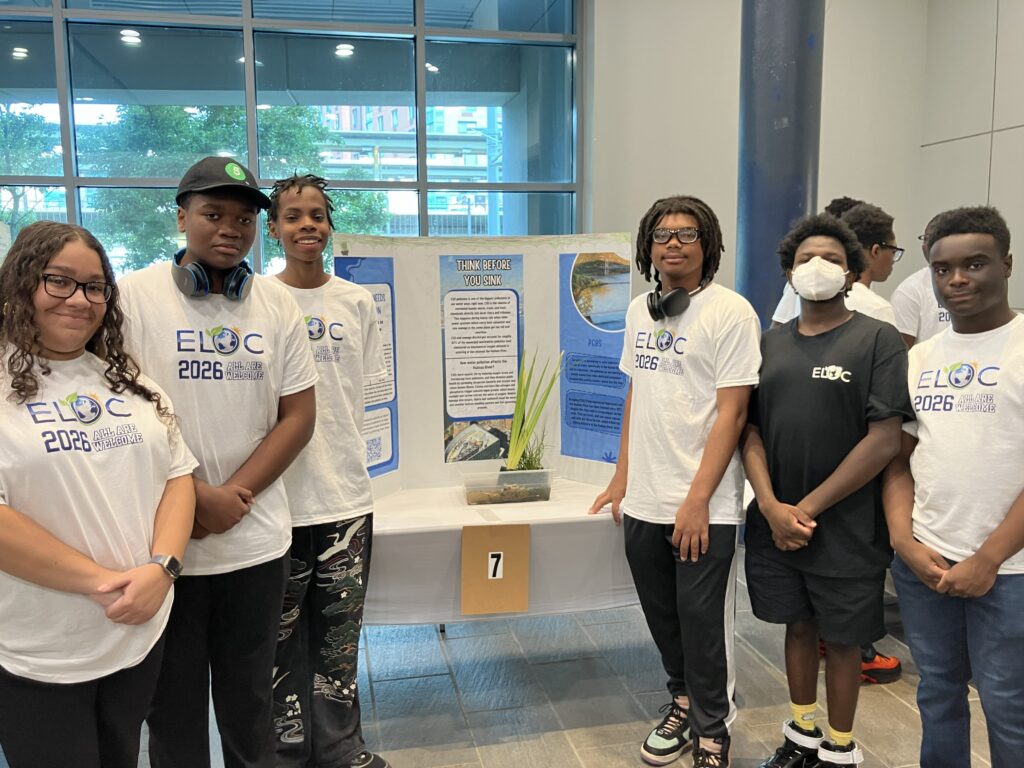
The Mount Vernon Youth Bureau’s Think Before You Sink team, recommends placing semi-aquatic plants in the Hudson River to help ingest and clean up waste. The team placed first in the Environmental Leaders of Color summer energy and environmental program for teens showcase presentation at the Yonkers Riverfront Library August 13th.
By Michael Gold
Cleaning up the Hudson with “bio pod” plants, conducing more local government monitoring of water quality in local water bodies, building rain gardens and installing permeable pavement to absorb floodwater comprised just some of the interesting innovations proposed by Westchester youth bureaus and YMCA groups at the sixth annual Environmental Leaders of Color (ELOC) 2026 showcase, the culminating project of the group’s energy and environmental program for teens.
The showcase was held at the Yonkers Riverfront Public Library at One Larkin Center. About 130 teenagers participated in the six-week STEM leadership academy program. The theme for this year’s program was “Invasive Species and Ecology.”
The winning team, Think Before You Sink, from the Mt. Vernon Youth Bureau, highlighted two major sources of pollution in the Hudson River – PCBs and combined sewage overflows (CSOs).
“Eighty two percent of the waste is sewage. The rest is chemicals,” said Samantha Mendez, one of the Think Before You Sink team members.
About 1.3 million pounds of liquid PCBs, or polychlorinated biphenyls, were released by General Electric into the upper Hudson River from 1947 to 1977, as part of its production of insulation and fire prevention features in the electrical devices the company manufactured. The PCBs have spread the length of the 315-mile-long Hudson. General Electric has paid for clean-up efforts, but PCBs remain in the sediment of the river, as well as in the shoreline and the bodies of the fish and birds that live there.
The Yonkers Wastewater Treatment Plant alone puts anywhere from 60 million gallons to one billion gallons of sewage into the Hudson every year, according to Hudson Riverkeeper.
The Think Before You Sink team proposed that local governments test the river and its tributaries on a weekly basis, so “people can track the pollution in the river,” said Travis Ruez, a Think Before You Sink team member. He also suggested creating a call-in phone number allowing people to report on pollution they see in the river. Right now, Westchester County and the New York State Department of Environmental Conservation test the river regularly.
“We want to start with monitoring tributaries, like the Saw Mill River,” Think Before You Sink member Karrington Tucker said. The Center for the Urban River at Beczak (CURB), a private nonprofit organization in partnership with Sarah Lawrence College, currently monitors the Saw Mill River and the Hudson River for sewage pollution.
To help reduce the pollution in the Hudson, Think Before You Sink proposes something called bio pods, semi-aquatic plants.
“Put semi-aquatic plants in the river to absorb the waste,” said Tucker. “They ingest the waste.”
The Sea Savers, from the New Rochelle Youth Bureau/Booker T Washington Vocational Institute, highlighted the impact of air and water pollution on people and marine wildlife in Long Island Sound.
“Kids can’t go to the beach. It’s too dirty,” said William Gallagher, from the Sea Savers team. “There’s too much plastic in the ocean. I’m swimming and I feel a soda bottle on my feet. It’s not right,” he said. Also, “animals get trapped by plastic,” Gallagher added.
The Sea Saver kids mentioned that they’ve seen needles on the beaches too.
“It’s disgusting,” said Zaim Bukhari.
Climate change has affected aquatic life too, Bukhari said. “Rising water temperatures drive out fish populations,” he said.
The Sea Savers suggested putting a floating solar-powered platform in water bodies, to monitor water quality. The platform would contain sensors “that track chemical and physical changes in lakes, rivers and coastal areas to spot pollution or contamination,” the Sea Saver presentation board stated.
Two Sea Saver members, Gallagher and Efraim Jacob, have signed up with the Save The Sound group to clean up the beaches around Long Island Sound.
The New Rochelle Youth Bureau Rain Garden team recommended building rain gardens to help protect against the increasing floods that Westchester is suffering due to torrential rains caused by climate change.
Their presentation featured a photo of a walkway at Lincoln Avenue and Prince Street in New Rochelle that was inundated with water. A set of steps led to what looked like knee-high water that seemed to spread out over at least fifty yards.
“Put a rain garden next to the walkway to absorb the water,” said Makayla Jerome, a Rain Garden team member. “Plant shrubs and flowers. The water gets absorbed in a shallow bowl,” she said.
“A rain garden collects rain water and allows it to soak into the ground,” said Ronique Edwards.
Nicola Catts demonstrated how it works. The team had created a model with a “cement top” made of dry clay, with moss vegetation and dirt next to it. Catts poured a glass of water on the simulated cement, which slid over the surface and flowed into the moss, where most of it sank into the soil.
The Peekskill Youth Bureau’s team — Paving the Way for Peekskill with Permeable Pavement — addressed the flooding issue as well, making the case for putting down permeable pavement in parking lots and other areas. Permeable pavement, which can be made up of gravel, clay, sand, topsoil and grass or sod, allows water to flow into the ground, instead of pooling on surface roads and sidewalks.
“Floodwater will get into people’s basements. Floodwater can attack the structural integrity of the foundations of a building,” said Joseph Goldwire. But with permeable pavement, “the water will go into the ground,” Goldwire explained.
“This can be used for parking lots and sidewalks in residential areas,” said Bryson Hammonds, another Peekskill Youth Bureau team member.
“We will bring this model to the Peekskill City Council and present this,” Hammonds said.
ELOC founder and executive director Diana Williams told the crowd during the awards presentation, “Never forget what hard work, commitment and consistency can do in your life.”
The members of the winning Think Before You Sink team were Shema White, Karrington Tucker, Samantha Mendez, Travis Ruez, Nate Simmons and Mykel Gayle.
The Sea Savers, the second-place team, were teamed by William Gallagher, Joxel Torres Alvarez, Zaim Bukhari and Efraim Jacob.
The third-place team, The Clean Ups, from the Yonkers YMCA/Garden Club, included Prisley Massoukina, Zaniya Shell, Benjamin Ortiz, Michael Earle, Heaven Lyons, Mariana Bernal, and Francisca Osei Tutu.
In their own words, the Clean Up team stated, “Our mission as a group is to effectively address the harm everyday littering causes to our local ecosystem, such as wildlife, plants, public health, and properly value in Yonkers. We developed an effective response to this issue by creating a youth-run volunteer group with paid participants, ages 10-17; they will also receive payment and daycare access. The Clean Ups participate in education classes about their ecosystem and have 2 weekly cleanups.”
Waternet, also from the Yonkers YMCA/Garden Club, earned honorable mention. Their members were Diana Torres, Alonso Torres, Joselin Tapia, Elvin Cruz, Elizabeth Aguilar, Kyara Bautista, Ximena Anaya, and Estefani Matinez-Ines.
The Waternet team, like the Think Before You Sink team, addressed pollution in the Hudson. They described their project like this: “Our project is meant to provide a solution that will clean the Hudson River of dangerous types of pollution such as PCB’s and sewage waste. It uses a floating chemical filter that will rid the river of chemicals while preventing future waste from entering. Our aim is to bring restoration to the native organisms of the Hudson by helping clean and filter the water to prevent a nutrient imbalance caused by the sewage waste.”
The Paving the Way for Peekskill With Permeable Pavement team, also earning an honorable mention, were teamed by Joseph Goldwire,Gerrard Hyatt, Bryson Hammonds and Abraham Zumba Vienes.
Michael Gold is a columnist for The Yonkers Times. His work has been published in The New York Daily News, The Albany Times-Union, The Hartford Courant and other newspapers. He’s a volunteer trustee with the Putnam County Land Trust.
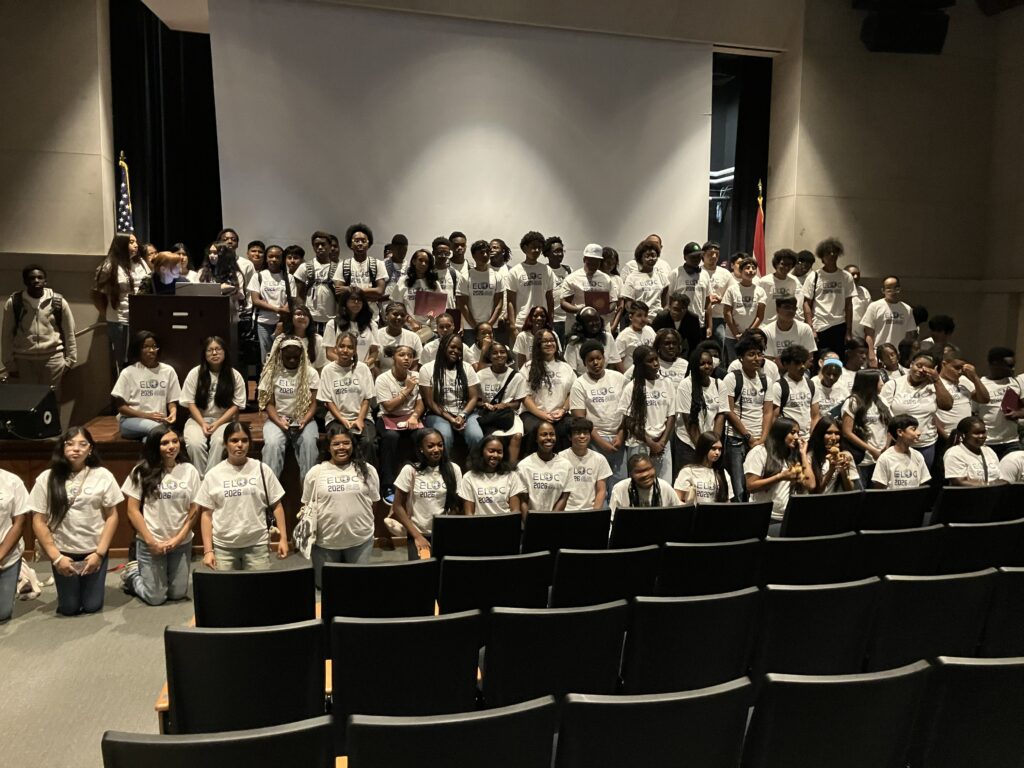
About 130 students participated in the Environmental Leaders of Color summer STEM academy. They celebrated the showcase of their projects to fight climate change and help the environment at the Yonkers Riverfront Library August 13th.