
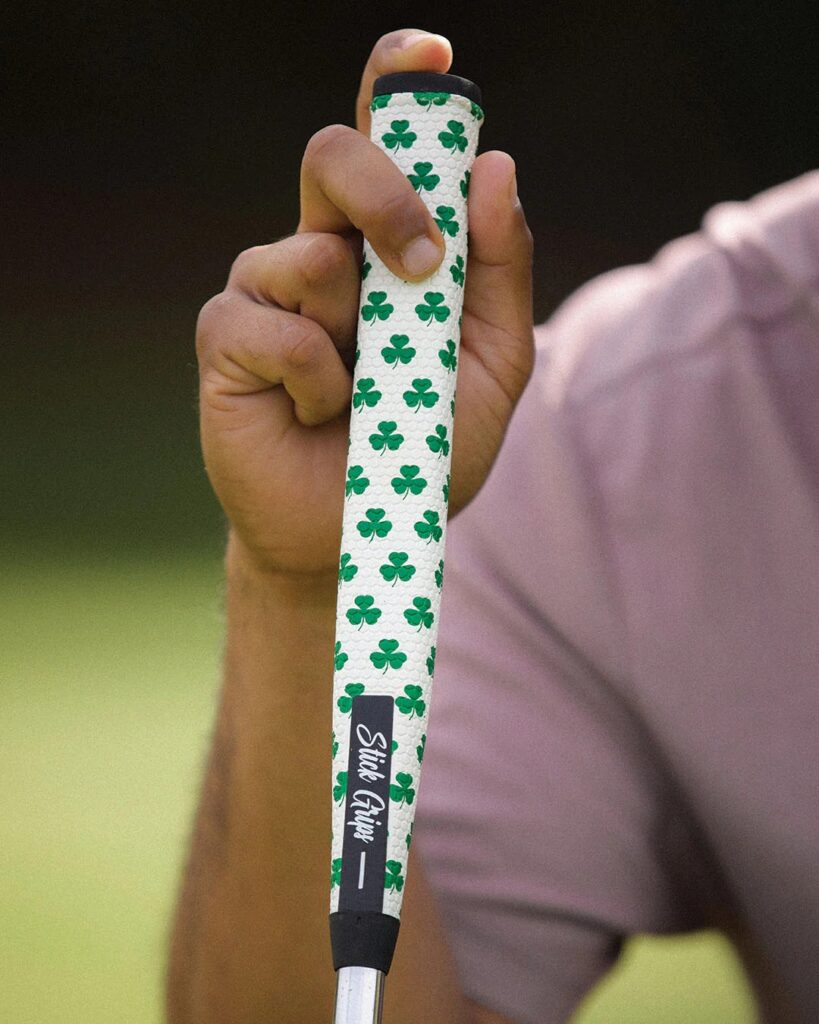
Most golfers obsess over alignment, green speed, and stroke path while completely overlooking the grip sitting right in their hands. Grip diameter is one of the quietest performance variables in putting, yet it directly governs how much the wrists move during the stroke.
Get the diameter wrong and even a technically sound putting motion can break down under pressure. Understanding this relationship does not require a physics degree; it just requires paying closer attention to what the hand is actually doing.
How Diameter Controls Wrist Involvement
Grip diameter determines how the fingers and palm divide the workload during a stroke. A thinner grip lets the fingers wrap fully around the handle, which naturally invites wrist hinge and rotation. A thicker grip shifts that load into the palm, keeping the wrists calmer and more passive through impact.
Golfers who battle a wristy release often find immediate relief by moving to a larger diameter. Those who feel mechanical or restricted frequently recover a smoother rhythm by scaling back to something slimmer. Before changing anything else in a setup, it is worth browsing a range of golf putter grips for sale to compare profiles across diameter categories. Standard, midsize, and oversized options each produce a different feel in the hand and a measurably different influence on wrist behavior throughout the stroke arc.
The Biomechanics Behind the Grip
Finger Pressure and Wrist Mobility
A narrow grip causes the fingers to curl tightly around the handle. That position activates the small muscles running through the forearm, and those muscles are largely responsible for wrist rotation during the backswing and follow-through. Players who tend to flip the putter head at impact are often dealing with this exact pattern without realizing its source.
A wider diameter spreads grip pressure more evenly across the palm. The fingers become less dominant, forearm activity quiets down, and the wrists stay far more stable through the full motion.
Feel Versus Control
Every diameter decision involves a trade-off. Thinner grips amplify feedback from the putter face, which appeals to players who rely on touch, particularly on faster greens where distance control is everything. Thicker options reduce that sensitivity in exchange for mechanical consistency.
Neither is objectively better. The right diameter comes down to a player’s natural tendencies, stroke style, and the conditions they typically play in.
Standard, Midsize, and Oversized Options
Standard Diameter
Standard grips generally measure between 1.00 and 1.25 inches. They suit players who use an arm-and-shoulder stroke but still want some finger contact for feedback. Golfers with smaller hands often find this range the most natural fit.
Midsize Diameter
Midsize grips fall roughly between 1.25 and 1.50 inches. They represent a practical middle ground, reducing excessive wrist activity without stripping away feel entirely. A large portion of recreational players find this category the most forgiving without losing meaningful touch on shorter putts.
Oversized Diameter
Oversized grips can measure 1.75 inches or beyond. They are closely associated with claw and pencil grip styles, both of which aim to take the small muscles out of the equation entirely. At this diameter, the stroke shifts almost completely to the shoulders and upper arms, making wrist breakdown nearly impossible.
Matching Diameter to Stroke Type
Arm-and-shoulder putters typically perform better with midsize or oversized grips, since those profiles support the larger-muscle-driven motion they already rely on. Wrist putters, those who depend on a slight hinge for rhythm and timing, are usually better served by staying in the standard range.
Hand size is also a practical consideration. A grip that is too large for smaller hands can create grip tension rather than reducing it, and that tension introduces its own inconsistencies. Proper fitting is just as important as picking the right diameter category.
Conclusion
Diameter is not a cosmetic detail. It shapes wrist behavior, which shapes stroke path, face angle at contact, and distance control on every single putt. Golfers who have been working on their mechanics without seeing improvement may find that a simple diameter change produces results faster than any technique adjustment. Before reworking a stance or rebuilding a stroke from scratch, it is worth asking whether the grip currently in hand is actually built for the motion being attempted.