
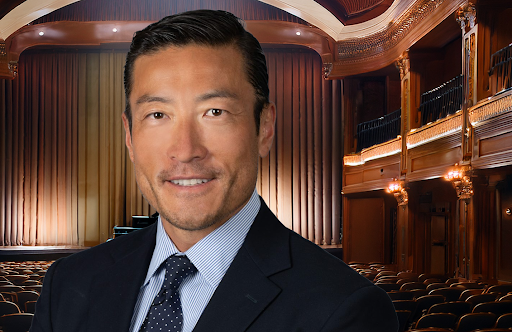
There are certain schools that do more than educate people. They recalibrate what seriousness looks like. The Manhattan School of Music is one of those places.
It sits in New York, a city that already puts unusual pressure on ambition, and then sharpens that pressure further by filling practice rooms with teenagers who are not just talented but intensely committed. Sleep becomes negotiable. Precision starts to feel moral. The fantasy of artistic life gets stripped down and what remains is work.
Students often arrive thinking talent is the rare thing. They leave with a different understanding. Endurance is rarer.
That lesson can travel.
It traveled with Han Jo Kim.
Long before he became one of New York’s best-known spine surgeons, Kim was a violin student in Manhattan School of Music’s Precollege division, a demanding program that introduces discipline early and without much sentimentality. Music came first. Not medicine. Not science. Sound first, then feeling, then the harder lesson underneath both. He was drawn to the violin because it could sound almost human, capable of sadness, tension, warmth, and force sometimes within the same passage. As a child, music also gave him structure. It taught him focus, patience, and the slow fact that excellence is usually built quietly, one day at a time.
That was the initial pull. The discipline came later.
Like most people who get serious about music, Kim learned early that improvement has very little to do with inspiration. Progress comes from repetition, isolation, correction, and the willingness to spend long hours fixing things an audience may never consciously register. You play a passage wrong and the instrument tells you immediately. There is no buffer. The mistake is the instruction.
Practicing violin taught him patience before he had a word for it. It taught him how to live with imperfection without making peace with it. A wrong note could not hide. Hesitation could not hide. Weakness could not hide. You repeated the passage until muscle memory started to replace doubt, and then you repeated it again because that was never quite enough.
The significance of that training became clearer later.
Kim has described Manhattan School of Music as one of the defining environments of his early life, and it is not hard to see why. The students around him were serious in a way most teenagers are serious about very little. Everybody practiced. Everybody was trying to improve. The atmosphere changed his standards. Talent alone was not enough there. It was also one of the first places where he understood what it meant to belong to a community built around excellence.
One of the lasting figures from that period was his violin instructor, Kwak. What Kim carried away from those lessons was not just technical instruction. It was a lesson in attention. Playing correctly was only the beginning. Music also required intention, phrasing, listening, and a harder-to-name kind of honesty. If a performance communicated nothing, technical skill did not rescue it. It only made the emptiness easier to notice. Preparing for performances taught him something else that would matter later: how to work under pressure while still trying to remain expressive and human.
Years later, after medicine became his profession, Kim began to recognize how much of that training had followed him into the operating room.
Spine surgery at the highest level is not the same thing as music, and the comparison only goes so far. One ends with applause if all goes well. The other can leave someone with a better chance of living without pain or disability. Still, the overlap is real. Surgery depends on repetition, composure, sequencing, timing, and concentration sustained at a level most people only imagine from the outside. The operating room has rhythm. It has pace. It has pressure. A small lapse in focus can change an outcome permanently. Technical skill is essential, but it is not enough. Surgery also requires judgment, sensitivity, awareness, and respect for the person in front of you.
Kim has said surgery requires the same emotional control he once needed during performance, when nerves had to be managed without dulling sensitivity. That parallel holds because both worlds ask for something difficult and slightly contradictory. You must be precise, but not mechanical. You must control emotion, but not empty yourself of it.
Both music and surgery also place human vulnerability at the center.
Patients arrive frightened. Musicians walk onstage exposed. In both settings, technique matters. But what people trust is usually not technique by itself. They trust presence. They trust humanity.
Kim talks about music now with the care people often reserve for something that still belongs to them, even after life has moved in another direction. Medicine became his vocation. Music never disappeared. If anything, it seems to have become more important as surgery grew more demanding. He has said medicine made music feel even more precious. It offered a different kind of nourishment than the hospital can provide. Not accomplishment. Not productivity. Something quieter than that.
He still listens closely. He still respects the discipline behind performance. But the role music plays in his life now is not just about rigor or achievement. As he put it elsewhere, music gave him a language for emotion before he had the words for it. Medicine is outcome-driven by nature. It is built to solve problems. Music exists outside that system. Some things matter because they are useful. Some things matter because they are beautiful. That second category can matter more than modern culture likes to admit.
That distinction stayed with Kim long enough that he eventually returned to Manhattan School of Music in a different role, serving on the school’s Board of Trustees. For him, that appears to be less about prestige than repayment. MSM helped shape his sense of discipline, confidence, mentorship, possibility, and standards early in life. Returning as a trustee was a way of investing in an institution that had already invested in him.
His concerns there are practical. He wants the school to preserve its rigor while supporting young artists trying to build lives inside a cultural economy that is unstable, distracted, and often hostile to serious work. He speaks about mentorship and access. He speaks about making room for developing artists in an era that too often mistakes visibility for depth. He also wants MSM to keep the intimacy and rigor that make it special.
He also pushes back on the assumption that arts education is a secondary luxury sitting behind STEM in the hierarchy of usefulness. Kim argues that music develops forms of intelligence that are harder to measure and, for that reason, easy for institutional culture to underrate. Creativity. Empathy. Emotional awareness. Deep listening. Tolerance for nuance. The ability to resist easy conclusions. It helps develop the whole person, including the ability to communicate beautifully. None of those qualities are ornamental. They are practical, even if they do not always present that way on paper.
For Kim, they are not separate from medicine. They improve medicine.
He has seen firsthand how music affects healing because illness is never experienced as a purely technical event. A diagnosis is clinical. Living with that diagnosis is not. Fear enters the room. Fatigue enters the room. Uncertainty enters the room. Dignity enters with them. Kim believes music can reach people where language starts to thin out. It can restore calm. It can reconnect patients to a sense of self that exists beyond injury, disease, or prognosis.
When asked to reduce the relationship between music and surgery to a single sentence, Kim’s answer is straightforward: both demand discipline, precision, emotional control, and respect for the human being at the center of the work.
It sounds simple. It is not.
The Manhattan School of Music has produced performers for concert halls, orchestras, and opera houses across the world. That is the expected outcome. The more interesting outcome may be the graduates who carry the habits of artistic discipline into professions that seem unrelated to performance at all. They were shaped in practice rooms where nobody was watching, by routines that looked monotonous from the outside and life-defining from within.
Sometimes they become musicians.
Sometimes they become surgeons.
Sometimes the distance between those two outcomes is smaller than it first appears.