
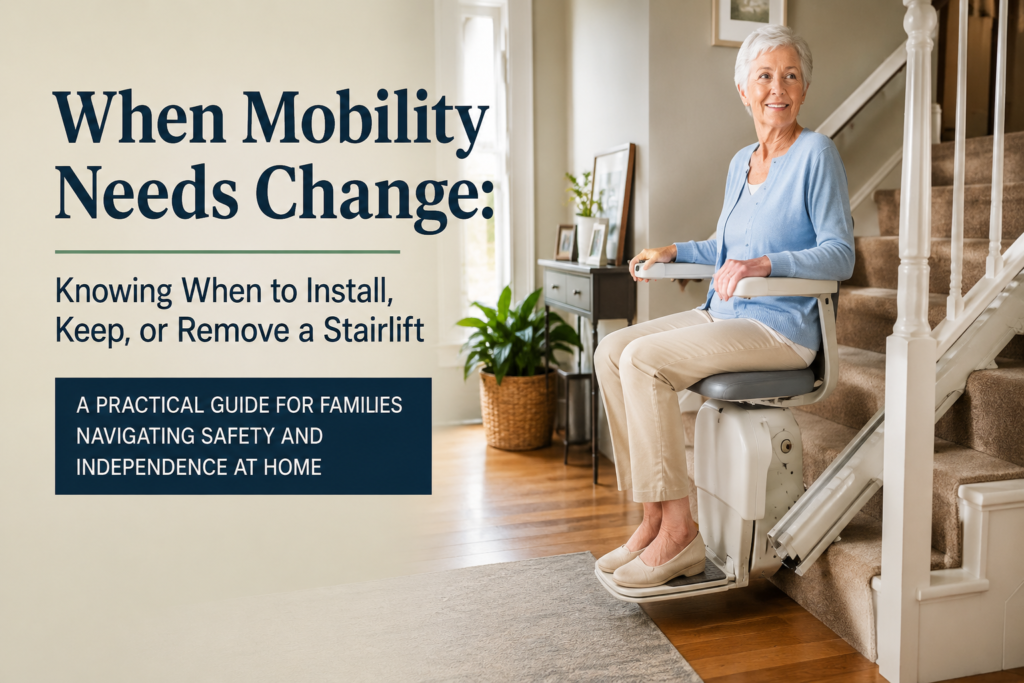
A practical guide for families navigating mobility changes, stairlift decisions, and aging in place with confidence and safety
Mobility changes often begin quietly.
For many older adults, it may start with holding the handrail a little tighter, taking more time on the stairs, or avoiding extra trips between floors. At first, these changes may seem small. Over time, they can affect daily routines, confidence, and the ability to use the whole home comfortably.
For families in Yonkers, Westchester, and beyond, these moments can lead to difficult but important conversations. Is it time to make a change? Should the family wait? Would a home modification help someone stay independent longer?
There is no single answer for every household. But understanding when to install, keep, or remove a stairlift can make the decision feel less overwhelming.
Recognizing the Early Signs
Many people continue using stairs long after they have become difficult. This is often not because they are ignoring the issue, but because mobility changes can be gradual.
Some common signs include:
- Taking much longer to climb stairs
- Avoiding trips between floors
- Holding furniture, walls, or railings for extra support
- Feeling nervous while carrying laundry, groceries, or other items upstairs
- Experiencing joint pain, weakness, or balance concerns
- Recovering from surgery, illness, or an injury that affects movement
These signs do not automatically mean a stairlift is needed immediately. They do mean the family should start paying attention.
The goal is not to take away independence. The goal is to preserve it safely.
When a Stairlift May Be Worth Considering
For people living in multi-level homes, stairs can become one of the biggest barriers to staying at home comfortably.
Some families begin exploring stairlifts after a fall or medical recommendation. Others start the conversation when they notice a loved one using only one floor of the house because the stairs feel too tiring or stressful.
In many cases, it is better to look at options before a situation becomes urgent. Waiting until after an accident or health setback can make decisions feel rushed.
For families researching accessibility resources, including those comparing options in the Philadelphia area, understanding how residential stairlifts work can help explain what may be available before a decision has to be made quickly.
A stairlift does not necessarily mean someone has lost independence. For many older adults, it can help them keep using their home more fully, with less strain and more confidence. Families exploring ways to support aging loved ones often find that accessibility improvements work best as part of a broader plan that balances safety, independence, and long-term comfort, rather than relying on major home renovations alone.
Temporary Needs Can Change Over Time
Not every mobility challenge is permanent.
A person recovering from knee surgery, hip surgery, or another medical event may need help for several months and then regain strength. Others may have health conditions that improve, stabilize, or change over time.
That is why accessibility decisions should not be treated as one-time decisions that never need to be reviewed.
Families should periodically ask:
- Is the stairlift still being used?
- Does it still make daily routines safer?
- Has mobility improved or declined?
- Is the equipment helping the person feel more confident?
- Has the living situation changed?
Reassessing does not mean the original decision was wrong. It simply means the home should continue matching the person’s current needs.
When It Makes Sense to Keep a Stairlift
Even when mobility improves, removing a stairlift right away may not always be the best choice.
For some households, the stairlift continues to provide reassurance. It may reduce pain, limit fatigue, or offer peace of mind on days when balance or strength is not as reliable.
This can be especially helpful for older adults managing arthritis, chronic pain, balance concerns, or conditions that change from day to day.
The decision should be based on real daily use, not on assumptions about what “should” happen next.
If the equipment still supports comfort, safety, and independence, keeping it may be the more practical choice.
When It May Be Time to Remove One
There are also situations where a stairlift is no longer needed.
This may happen after:
- A successful recovery from surgery
- A move to a single-level home
- A transition to assisted living
- Major home renovations
- A change in caregiving needs
- The passing of a loved one
When this happens, families are often unsure what to do with the equipment. Leaving it unused may not be the best long-term solution, especially if the home is being prepared for sale or the stairs need to be returned to their original layout.
For households looking into next steps, including families reviewing mobility equipment resources around Philadelphia, learning how to sell a used stairlift may help them understand whether the equipment can be removed, reused, or evaluated for resale.
This part of the process can feel emotional, especially if the stairlift was tied to a loved one’s care. Still, making a practical plan can help families move forward with less uncertainty.
Making the Decision as a Family
Mobility decisions are rarely just about equipment. They often involve emotions, independence, finances, safety, and family responsibilities.
That is why the conversation should be handled with patience.
Older adults should be included in the decision whenever possible. Their comfort, preferences, and dignity matter. Adult children and caregivers may see safety risks, but the person using the home may be thinking about privacy, control, and the fear of losing independence.
A better conversation usually begins with shared goals:
- Staying at home safely
- Reducing fall risks
- Keeping daily routines manageable
- Avoiding rushed decisions during a crisis
- Supporting independence for as long as possible
For many families in Yonkers and Westchester, remaining at home also means staying connected to familiar neighborhoods, friends, doctors, faith communities, and local routines. That emotional connection is part of the decision too.
The Right Decision Is the One That Supports Independence
Every family’s situation is different.
Some people may need a stairlift for long-term support. Others may only need temporary assistance during recovery after an illness, injury, or medical procedure. In some cases, families may eventually decide that it is time to remove equipment that once played an important role in helping a loved one remain safe at home.
What matters most is not whether a stairlift is installed, kept, or removed. What matters is whether the decision continues to support the person’s current needs, comfort, and quality of life.
Mobility needs change over time, and the solutions that work best should be able to change with them. By reassessing circumstances regularly and involving loved ones in the conversation, families can make decisions with greater confidence and less uncertainty.
Ultimately, a stairlift is not simply about moving between floors. It is one of many tools that can help older adults maintain independence, stay connected to the homes and communities they value, and continue living safely and comfortably on their own terms.