
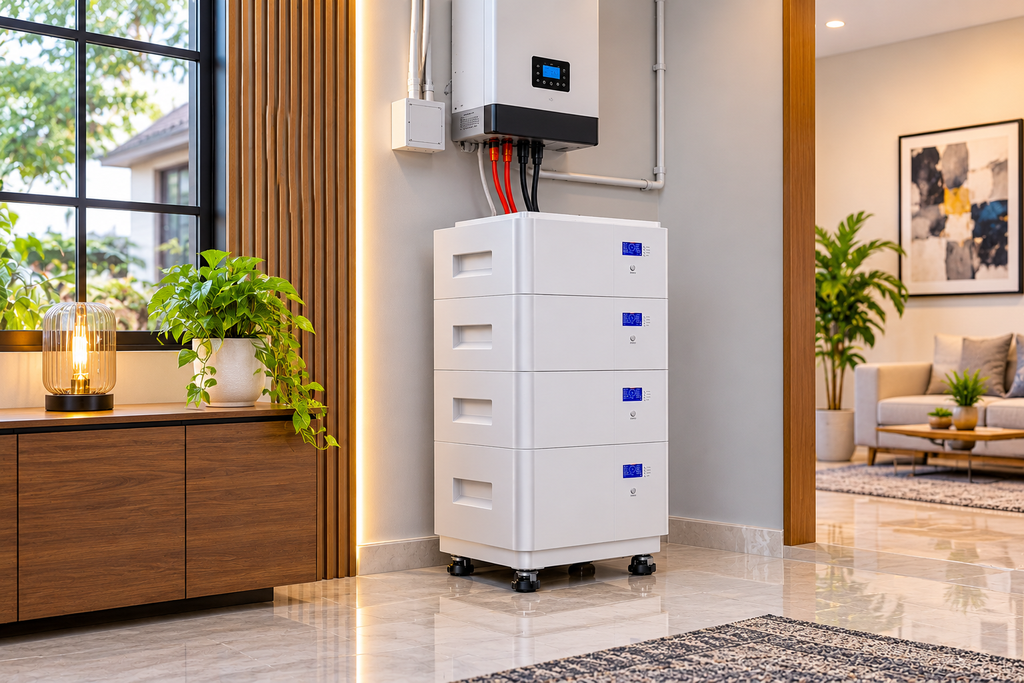
Choosing a home battery is not simply a matter of buying the largest capacity available. Westchester homeowners need storage that matches household electricity use, backup priorities, existing solar equipment and the rules that apply in their municipality. Modular systems can allow future expansion, but only when the batteries, inverter and installation design are compatible.
Before signing an agreement, ask how the system will perform during an outage, what approvals it needs and who supports the equipment afterward. These questions also help installers and project buyers evaluate the products and suppliers behind a residential proposal.
1. Start With Household Energy Use and Critical Loads
Begin with actual household electricity use, not the square footage of the home. Review utility bills to understand daily consumption, then identify which appliances must operate during an outage. A home that needs refrigeration, lighting and internet has different storage needs from one that also expects to run pumps, heating equipment or several major appliances.
Ask the installer to assess loads and separate essential circuits from optional ones. Include seasonal use and the possibility that household needs may change. The assessment should consider:
- Appliance running watts and motor starting surges
- Expected backup hours for each essential load
- Seasonal changes in household electricity consumption
This creates a practical basis for comparing battery sizes instead of relying on a broad estimate.
2. Ask How Much Backup Power the Battery Can Actually Deliver
Capacity, measured in kilowatt-hours (kWh), describes stored energy. Power, measured in kilowatts (kW), describes how much electricity a system can deliver at once. A battery may store enough energy for several hours but still lack the output needed to start a pump or run multiple appliances together. Ask for usable capacity, continuous output and surge capability.
Request a written estimate based on the loads you selected. It should account for:
- Inverter output limits and system conversion losses
- Battery reserve settings and usable stored energy
- Simultaneous appliance demand and motor starting surges
Backup duration varies with demand, temperature, settings and operating conditions. Ask for multiple load scenarios, including a conservative estimate for an extended outage.
3. Compare Fixed-Capacity and Modular Battery Expansion
A fixed-capacity battery may suit a home with stable, well-understood backup needs. A modular system can let a household start smaller and add capacity if energy use changes. That flexibility is useful only if the manufacturer permits expansion and the original design anticipates additional modules, space, wiring and protection equipment.
Ask the installer to confirm:
- Whether added modules must match the original battery
- Whether later expansion after months of use is allowed
- The inverter’s supported configuration and total module limit
A stackable battery can offer staged capacity expansion, provided the chosen modules, inverter and approved installation design are compatible. Get the permitted configuration, expansion procedure and any warranty conditions in writing.
4. Check Inverter Compatibility Before Choosing a Battery
Do not assume batteries with the same nominal voltage work with every solar inverter. Compatibility can depend on inverter model, battery chemistry, voltage range, charge and discharge limits, firmware and communication protocol. Some systems are AC-coupled to existing solar equipment; others use a DC-coupled design. The right arrangement depends on the equipment already installed and the intended backup operation.
Give the installer the exact inverter model and ask for written confirmation. Verify:
- Supported CAN, RS485 or other approved communication protocol
- Approved battery settings, firmware and operating limits
- How solar panels can recharge storage during an outage
Not every grid-tied solar system provides backup power automatically. The proposal should explain how it operates during an outage and which circuits remain energized.
5. Ask Installers Where Their Batteries Come From and How They Are Supported
Ask who supplies the battery, handles warranty claims and provides replacements. Documentation, availability and technical assistance affect commissioning and service. For installers, home battery wholesale sourcing should include technical documentation, warranty terms and dependable support—not price alone.
For installers comparing residential storage configurations, Avepower lists a 51.2V, 100Ah wall-mounted LiFePO4 battery with 5.12kWh of nominal energy and a 100A continuous-discharge rating. Its separate 51.2V stackable series is organized around approximately 5kWh per module, with 5kWh, 10kWh and 15kWh configurations. Avepower supplies battery products to wholesale and installer partners and offers OEM/ODM customization plus inverter-model compatibility discussions; any actual Westchester installation still requires local permitting and project-specific system design.
6. Confirm Westchester Permits, Placement and Installation Requirements
Westchester is not one permitting jurisdiction. Ask which municipality and authority having jurisdiction (AHJ) will review the project. New York’s 2025 Uniform Code took effect on December 31, 2025, so permit applications submitted after that date generally need to follow applicable 2025 code provisions. Local requirements and the project design determine the approvals needed.
Before work begins, confirm who obtains permits and whether the proposed location follows manufacturer instructions and local fire and building requirements. Ask about:
- Building permits and electrical permits for this project
- Approved indoor or outdoor battery placement locations
- Required clearances, service access and protective measures
Do not apply another municipality’s rules. Confirm local requirements before equipment is ordered or installation is scheduled.
7. Examine Battery Safety Certifications, Warranty and Maintenance
Ask for documentation for the complete energy storage system, not just individual cells. UL 9540 is a system-level energy storage safety standard; UL 9540A is a test method for evaluating thermal runaway fire propagation. Other standards may apply to batteries and inverters. Transport reports and conformity marks do not replace a required system listing.
Before comparing prices, review:
- Warranty term, cycle-life and energy-throughput limits
- Specified operating conditions, exclusions and limitations
- Warranty claim process, service contact and replacement support
A cycle-life figure depends on test conditions, including depth of discharge and temperature. It should not be treated as a guaranteed number of years in every home. Ask whether the warranty covers labor, shipping and diagnostic costs, not only the battery itself.
8. Check Utility Interconnection and Available New York Incentives
A battery operating in parallel with the electric grid may require utility interconnection review. Ask whether the system can export electricity, whether export will be limited and who submits the application. Requirements can depend on the utility, inverter configuration and project design. Confirm these details before installation rather than assuming storage added to an existing solar array needs no further review.
New York’s NYSERDA Residential Energy Storage Program lists eligibility conditions such as:
- A system capacity of 25 kW or less
- New, permanent and stationary battery equipment
- Installation by a NYSERDA participating contractor
Rules and funding can change. Ask the contractor to verify current eligibility, incentive availability and application timing before including an incentive in financial calculations.
Conclusion
The right modular battery is designed around a home’s actual loads, backup expectations and electrical equipment—not simply the largest advertised capacity. Westchester homeowners should require clear answers on inverter compatibility, expansion limits, local permits, safety documentation, warranty support and utility coordination before approving a project. Installers and procurement teams should apply the same discipline when evaluating suppliers.
Avepower provides wholesale LiFePO4 batteries and OEM/ODM options for industry partners; homeowners should use qualified local installers for assessment, permits and installation. Ask questions before signing, not after delivery. A written scope, realistic load estimate and documented approval trail make comparisons easier and reduce avoidable surprises.
FAQs
What is modular solar battery storage?
Modular solar battery storage uses individual battery units that can be combined to create a larger energy storage system. Homeowners can choose an initial capacity and potentially expand it later, provided the batteries, inverter and installation design support additional modules.
How much battery storage does a Westchester home need?
The required battery capacity depends on household electricity use, essential appliances and desired backup duration. A professional installer should assess critical loads, starting power requirements and usable battery capacity before recommending a system.
Can I add more batteries to an existing solar system?
Yes, in some cases. Additional batteries can be connected when the existing inverter, battery management system, communication protocols and electrical design support expansion. The manufacturer’s approved configuration and local installation requirements must also be considered.
Are modular solar batteries compatible with all solar inverters?
No. Compatibility depends on battery voltage, chemistry, inverter model, communication protocols and charging specifications. Homeowners should obtain written compatibility confirmation from the battery manufacturer or qualified installer before purchasing additional equipment.
Do Westchester homeowners need permits to install solar batteries?
Permit requirements depend on the municipality, installation type and applicable New York building and electrical codes. Homeowners should consult their local building department and qualified electrical contractor to confirm the required approvals before installation.