
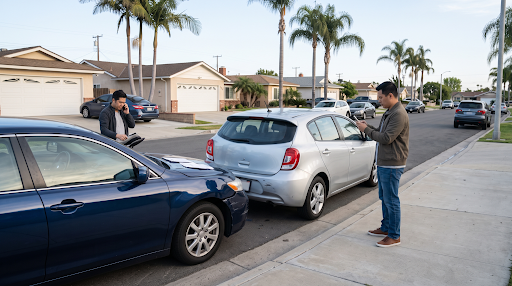
The hour after a collision feels like one event. Legally, it is three, because California requires three different records to come out of it, each going to a different place, on a different deadline, under rules that do not reference one another. Drivers who treat the hour as a single task routinely complete one of the three and assume they are finished. The one most often missed is the one that can cost a license.
Record One: What You Owe at the Scene
Stopping is the obligation, not a courtesy
Leaving the scene of a collision is a hit-and-run, and the consequences do not scale down because the damage looked minor. This holds whether or not you believe the collision was your fault.
The exchange has specified contents
California expects drivers to show one another a driver’s license, vehicle registration card, insurance information and current address, and to provide the same to law enforcement and to anyone else involved. Photographing the other driver’s documents is faster and more accurate than copying numbers onto a phone screen in the dark.
Parked cars and property have their own rule
If a vehicle strikes a parked car, a fence or other property and the owner cannot be found, the driver is expected to leave a note with name, phone number and address, attached securely, and to report the collision to law enforcement. A note tucked under a wiper that blows away is, from a legal standpoint, no note at all.
Record Two: The Report Most Drivers Have Never Heard Of
The SR-1 goes to the DMV, not the police
This is the obligation that catches careful people. A Report of Traffic Accident Occurring in California, the SR-1, must be filed with the Department of Motor Vehicles within 10 days when a collision causes more than $1,000 in property damage, or when anyone is injured or killed, however minor the injury.
Fault is irrelevant to the duty
Every driver involved files, whether or not they caused the collision. The requirement reaches collisions on private property as well, which surprises people whose incident happened in a parking lot.
Nothing else satisfies it
A police report does not satisfy it. A CHP report does not satisfy it. An insurance claim does not satisfy it. Law enforcement will not file it on your behalf. Failing to file can lead to suspension of your driving privilege, and the suspension arrives later, unconnected in time to the collision, which is why people rarely understand what triggered it.
There is also a 24-hour police reporting duty
Separately, a collision involving injury or death must be reported to law enforcement within 24 hours. Those are two distinct deadlines with two distinct recipients.
Record Three: The Claim, and Why California Changes the Math
This is a fault state
California does not run a no-fault system. There is no statutory window in which you must begin treatment to preserve a benefit, because there is no automatic personal injury benefit to preserve. Recovery runs through whoever was responsible, which puts the question of fault at the center rather than at the margin.
Comparative fault means percentages, not winners
California apportions responsibility by percentage, and a driver found partly at fault can still recover, reduced by their share. That makes casual remarks at the scene more consequential than they feel. An apology offered out of ordinary decency is read later as an admission that moves a percentage, and percentages are money.
Say what happened, not what you conclude
Describing speed, position and sequence is useful. Characterizing cause is the insurer’s job and eventually a court’s. The distinction is easy to hold onto if you decide on it before you need it.
What the Hour Cannot Be Recreated From
Conditions disappear first
Signal timing, debris position, skid marks, the angle of afternoon sun, a sightline blocked by a parked truck. None of it survives the afternoon, and none of it appears in a police report in any detail.
Nearby video runs on short retention
Businesses and residences near an intersection frequently overwrite footage within days. Someone has to identify which cameras face the scene and ask in writing, quickly, and that is a task most people only think of after it is too late to matter.
Medical documentation benefits from being early
Even without a statutory deadline, a gap between the collision and the first medical visit becomes an argument that the injury came from somewhere else. Getting evaluated promptly is a clinical decision first and an evidentiary one second, and both point the same way.
Treating the Three Records as Three Tasks
The practical discipline is to finish the hour with a short list rather than an impression: documents exchanged and photographed, police notified if anyone was hurt, and the SR-1 calendared. Anyone sorting out a serious collision afterward will find that experienced guidance for crash survivors in Rosemead spends much of the first meeting reconstructing exactly these items, and the ones that were never created cannot be recovered.