
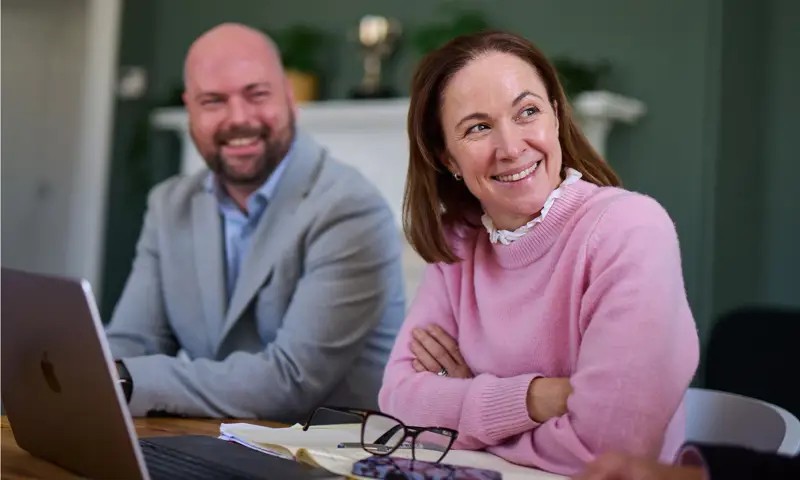
Bonobos co-founder Andy Dunn and Network of Executive Women board member Lori Stockel on how high EQ, curiosity and moments of sudden clarity can transform male privilege into male allyship.
Ask who should drive gender equality in the workplace and few people will point to men. Andy Dunn and Lori Stockel think that has to change. The two sat down for a frank conversation, first published in TNS magazine by The Gap Partnership, the global negotiation consultancy and training specialists, about what turns a well-meaning bystander into an active ally. Some of the figures they cite date from the time of the conversation. The argument holds up.
Andy Dunn
Andy co-founded Ecommerce retail sensation, Bonobos, after graduating from Stanford University. Named after a matriarchal chimpanzee, the company specializes in well-fitting pants for men. After serving as CEO for 11 years, Andy sold Bonobos to Walmart for $310 million and joined the Network of Executive Women board on their behalf. In 2011 he cofounded angel investment firm, Red Swan, which invests in retail and internet companies. Andy has blogged and written extensively on his own journey of self-awareness about male privilege and the role men can play as allies to women on the path to gender equality.
Lori Stockel
Lori is a Director of Learning and Development for a global consumer company. She also serves as Regional Officer and Board Member for Network of Executive Women, Metro NY Region, a New York-based 800+ member organization dedicated to the advancement of women and transforming workplaces through the power of community. During Lori’s tenure, she has had responsibility for college outreach, membership, onboarding, events and mentoring. She is passionate about the issue of gender differences and inequality and has been an outspoken advocate of women’s rights throughout her career.
Setting the scene
Lori: Andy, it’s great to be chatting to you today on a subject that’s so important to both of us. Without wishing to start on a downer, let me set the scene with a reality check. Despite the fact that women represent over 50% of the population, The World Economic Forum’s December 2019 report states that gender parity in the workplace will not be achieved for 100 years. Although the trajectory is improving, it’s staggering. And it gets gloomier because the numbers are even worse when it comes to female leaders. There are just 33 female CEOs in the Fortune 500 today and only two of them are women of color.
So, there is certainly work to do. The good news is it’s no longer debated whether this is good for business and many organizations are making efforts to improve with systematic approaches. But the question remains, how do we get there? I strongly believe male allies can kickstart the change that’s needed and I applaud you for being one. Can you explain what it means?
Andy: Hey Lori. Great to be speaking to you too. It might help if I also set the scene about me and my journey. Let’s start on International Women’s Day, 2017. I was due to speak in front of 5,000 people about the journey for women’s advancement in the workplace which, frankly, was terrifying. A man speaking about gender in front of an audience full of women…what could possibly go wrong?
But I thought I had the perfect story to tell about my maternal grandmother. She was married at 12, had miscarriages at 13 and 14, two kids at the ages of 15 and 16, 7 surviving children. The five eldest were all girls, the middle one being my mum, who was born in a refugee town in Pakistan at the time of partition.
I thought this beautifully explained my passion for gender equality: having a grandmother only educated to 6th grade, culturally raped as a child, who had no choice whatsoever in her life. I remember asking her shortly before she passed away what age she’d have chosen to have children. She said probably 30 or 35 would have been about right… So, yeah, I was pretty pleased when I told Manuela, my wife, about the plan for my speech. But she was horrified and said, “I don’t want to be compared to a child bride! That’s not useful. It’s way too extreme.” Um, wait..what? She explained: “What I’m fighting for, what I want, is what you have. I want male privilege. I want to be listened to even when what I’m saying isn’t particularly awesome. I want to be accepted as a leader without a fight. I want to sometimes be mediocre and still have power.” Her words completely reframed the way I thought about the issue. And she laid down a challenge: why not write about all the times you’ve got it wrong in our relationship?
“My viewpoint is that to become a male ally, you have to get to benevolent outrage.”
From lip service to benevolent outrage
Lori: Manuela is smart! So did you?
Andy: Well, yes, I did. I wrote until 5:00 a.m. the next morning, called my story Swimming in Privilege, sent it straight to my CEO and asked him whether I could publish it. He responded within five minutes and said yes. Then I talked about it to the group of women. After that I was invited to join the board of Network of Executive Women, or NEW.
That was the beginning of my education on what it’s like to be a woman. I spent the next two years just sitting and hearing women talk about their experiences. One module at a conference I attended particularly resonated with me. It was on women getting promoted after they’ve proven themselves and men getting promoted prior to that same proof. Then I realized: I’m doing this! I had a female executive who I’d told I’d promote once she’d done xyz. But I had a male one who I’d promoted to CEO without those conditions. I went on to have probably ten or so of those “Aha!” moments. Once I had them, I went from paying lip service, vaguely curious, to being immersively aware, then to being outraged. “I can’t believe this is the shit you deal with every day!” So my viewpoint is that to become a male ally, you have to get to benevolent outrage. For women, people of color, intersectionality, you have to be outraged at the structural inequality they face, to feel you are empowered and then, finally, responsible. I am no longer a bystander. I am part of the challenge and I need to flip it on its head to move towards equality. And we won’t be there until 252 of the Fortune 500 companies have female CEOs.
Lori: That’s an amazing story. I loved hearing about the stepping stones you went through, starting with discomfort and fear, getting past that and then having epiphanies on the reality of what institutional biases are out there. And from there your awareness really translated into a passion to talk about it, to have outreach and change mindsets. Now I see you are almost evangelical. So, from the perspective of an evangelist, what are the things we can do as an organization, or as a father or a husband, to help break down these biases?
Call people in, not out
Andy: One of my favorite ways is to call people in, not call them out. It’s useful for someone to tell me that they are disappointed in me if I’ve got something wrong. An example of that, for me personally, is social time outside of work. When I took inventory of all the hours of dinners and drinks and time I’d spent socializing with my colleagues, I realized that 90% of those hours were with men. But I hadn’t seen it. When I mentioned it to my senior female execs, they were like, oh yes and confirmed it.
To women I say, you have an opportunity to change that. We have to get comfortable with having uncomfortable conversations, to increase awareness but not guilt-trip or blame.
And as guys, we have to get a lot more curious. Curiosity is bred through spending time hearing about other people’s experiences. My dream is to bring 20 mid-senior male executives to the NEW forum. They can spend 3 days, just 1% of their year, hearing this topic. You need to do a year of listening before these realizations will dawn on you.
Let me give you an example of curiosity. Just recently I decided I wanted to support the US airline industry in these tough times. I was interested in Delta. But I looked at their leadership team and 11 out of 12 leaders were men. I decided not to buy stock, because I was curious and checked.
I’m also a big believer in change through laws, because let’s face it, no powerful majority has ever voluntarily ceded control to a minority.
Lori: Indeed! You mentioned women having the courage to have those uncomfortable conversations. But the person receiving the feedback needs to have the humility and EQ for it to be absorbed in a way that’s productive. Too many women in my age group have found those conversations don’t go over very well and I’ve seen women suffer as a result of that courage and have to step back.
Andy: Right. What do you think is the answer, given so many people in power are non-humble, non-EQ-aware white guys? How do they change?
Lori: You have to give them a reason to be curious. It can boil down to a conversation about, what do you expect for your daughter, when she’s advancing in career, academics, sports? What would you want for her? And what about your wife, sister, mother? Sometimes it sticks when it’s closer to home. Having a personal connection or an experience can help set a path for men to influence the dynamics for gender equality and it’s exciting for everyone when it happens.
Andy: I totally agree. That’s why the male ally is so interesting. And I’m fortunate to have that personal perspective you talk about: growing up biracially, dealing with a mental health vulnerability, having a wife who’s an immigrant, a mother-in-law who’s a feminist anthropologist. The deck was stacked for me to move to “woke”.
“Having a personal connection or an experience can help set a path for men to influence.”
A nontraditional path to the top
Lori: Right! Achieving that level of self-awareness for some is so tough. Even the phrase male privilege is polarizing and potentially harmful, putting men on the defensive. But, if you give our future male CEOs mentors who give them that perspective and explain the potential harm institutional bias can breed, that could be powerful. And then we can pave the way for CEOs who facilitate a less traditional path to the top for women. We benefit from more diversity of thought, backgrounds and gender…resulting in better business results!
Andy: I love that idea of a nontraditional path to the C suite. That’s partly why I’m excited that I now invest in entrepreneurs in at least a 50:50 ratio of women to men. Well, actually it’s more women, because for me we have to distort our energy and attention as sponsors now. The problem with entrepreneurship is that 90% of venture capitalists are men. And only 3% of founding CEOs are women, even in Silicon Valley. I believe the DNA of a company should reflect diversity from the beginning, so that’s what my VC firm Red Swan is trying to build with the start-ups it invests in.
Lori: Absolutely! I have a daughter who’s just graduated college and I don’t want her to experience gender inequities. When you’re at the top Andy, you can help create a level playing field for women. Your ability to influence at this point is so much greater than mine. Your role as a VC and having conversations about criteria could create seismic change and help collapse the depressing projection of 99 years before there’s gender equality on boards. It’s huge that you are even thinking about things like that. Lastly, before we go, I want to ask you specifically about negotiation. What role does it play in this area?
Permission to start over
Andy: OK, I began with a story and I’ll end with one too. It’s about a female executive I knew who was in a negotiation over the terms of her promotion with her company, a large retailer. She had a strong sense of what she wanted. But the discussions weren’t going well. Her male counterpart said to her, I know what you’re going for and I’m impressed. But come back tomorrow and let’s do it again. She came back, got the promotion and a big raise. That really stuck with me. Negotiation isn’t easy. If it’s not going well, we have to have permission to come back and do it again. It’s the same with conversations about gender equality and diversity. There has to be an environment of open-mindedness and permission to start over if things don’t go right the first time.
It is a point that reaches well beyond promotion talks. Few negotiations land first time, which is why preparation and planning carry so much weight when the outcome is uncertain. The executive in Andy’s story did not win on the first day. She won because she knew what she wanted and was given room to come back for it.