
Juneteenth’s Unfinished Legacy
By Diana Williams
The slavery that ended should never have happened. Modern forced labor means it still hasn’t.
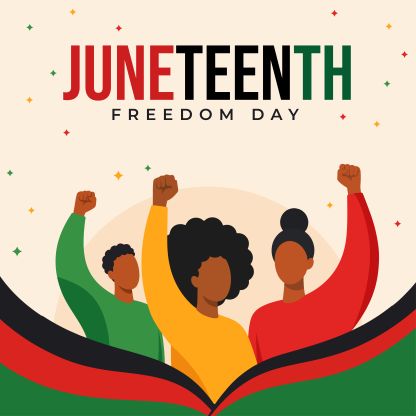
On June 19, 1865, Union General Gordon Granger rode into Galveston, Texas, and issued General Order No. 3, informing the people of Texas that all enslaved people were now free. The Emancipation Proclamation had taken legal effect more than two years earlier, on January 1, 1863. But freedom had not yet reached the enslaved people of Texas, the far edge of the Confederacy, until that summer day. The news came late. It came, though. We have marked it as Juneteenth ever since, and in 2021, it became a federal holiday.
We rightly celebrate the moment freedom finally arrived. But there is a harder truth folded inside the joy of the day. The bondage that General Granger announced the end of should never have existed at all. Millions of human beings were stolen, sold, and forced to labor for the profit of others. No proclamation, however welcome, can undo that original wrong. So Juneteenth carries two obligations at once: gratitude for the end of slavery and a moral demand that it never return.
That second obligation is more urgent than most of us realize. Forced labor and human trafficking did not end in 1865. They persist today, in our country and in our own neighborhoods.
The scale of the problem today
Slavery did not disappear; it went underground and changed its language. The International Labor Organization, Walk Free, and the International Organization for Migration estimate that on any given day in 2021, about 50 million people were living in conditions of modern slavery worldwide, with roughly 28 million of them in forced labor. That is close to 1 in 150 people alive. Far from improving, the number had grown by 10 million since the previous estimate in 2016, and women and children remained disproportionately at risk.
The United States is not an exception to this. In 2024, the National Human Trafficking Hotline received more than 32,000 substantive signals and identified close to 12,000 potential trafficking cases, involving both sex trafficking and labor trafficking. These are only the cases that surfaced. By its nature, the crime depends on isolation, fear, and silence; its true scale is larger than any hotline can capture.
The youngest victims
Children and teenagers are among the most heavily targeted, precisely because they are easier to control and harder to protect. Among the case demographics the National Human Trafficking Hotline recorded in 2024 were 2,666 minors. The same year, the National Center for Missing and Exploited Children received more than 27,800 reports of possible child sex trafficking, and estimated that one in seven of the more than 29,000 children reported missing was likely a victim of it.
Forced labor of young people is just as real, and frequently misunderstood. A study supported by the National Institute of Justice, conducted by researchers at Northeastern University, New York University, and Loyola, examined dozens of prosecuted cases and found that child labor trafficking is not a story about foreign migrants alone. Fifty-eight percent of the young victims were from other countries, but 42 percent were American citizens. Strikingly, in roughly 40 percent of the cases the trafficker was a parent or another family member. The children were exploited across a wide range of industries, including domestic work, agriculture, entertainment, and forced criminality.
Traffickers do not choose their targets at random. They look for vulnerability, and they find it in foster youth, runaway and homeless teenagers, children living in poverty, young people with disabilities, LGBTQ+ youth, and immigrant children without stable support. Discrimination, instability, and lack of opportunity are not background details in this crime. They are the conditions that make it possible.
This is happening in New York
It is tempting to imagine trafficking as something that occurs far away. The data says otherwise. In 2025, New York State confirmed 379 individuals as victims of human trafficking. Notably, more of them were victims of labor trafficking (204) than of sex trafficking (129), with another 48 subjected to both. That detail matters because it corrects a common assumption that trafficking is only about commercial sex. In New York, forced labor is the largest share, and New York consistently ranks among the states with the highest prevalence of labor trafficking, alongside California, Texas, and Florida.
These cases are not confined to one corner of the state, either. In recent reporting years, confirmed victims have been identified in New York City, on Long Island, and throughout the lower Hudson Valley, and across the rest of the state. The lower Hudson Valley includes Westchester. This is our region, our communities, and our young people, not someone else’s problem in some other place.
What we can do, and why it matters
The good news is that ordinary people are often the first to notice that something is wrong, and ordinary attention saves lives.
Learn the signs. Trafficking hides in plain sight: a young person who is never allowed to speak for themselves, who works long hours but controls no money, who shows signs of fear, who is closely monitored by an adult who answers every question for them, who lacks identification or appears to be coached. You do not need to be certain. You only need to notice.
Know the number. The National Human Trafficking Hotline operates around the clock at 1-888-373-7888, and you can text “HELP” or “INFO” to 233733. New York also maintains a state Interagency Task Force on Human Trafficking with confirmation and support services. Report what you see; do not try to investigate or intervene on your own, which can put both you and the victim in danger.
Support survivors and the organizations that serve them. Survivors need housing, legal help, counseling, and a path back to safety and stability. Local nonprofits and service providers do this work every day and are chronically under-resourced. Volunteer, donate, or simply learn who they are in your county.
Invest in young people before they become targets. The single most powerful protection against exploitation is opportunity. In my work with young people in Westchester, I have seen what opportunity can prevent. Mentorship, education, job training, and stable housing are not separate from anti-trafficking work; they are anti-trafficking work. Every young person who has a future they can see, and adults who show up for them, is far harder to coerce. This is why workforce development and youth leadership are not soft causes. They are the practical, ground-level defense of human freedom.
Use your voice and your wallet. Forced labor is woven into global supply chains, from the food we eat to the goods we buy. Supporting transparency, asking where products come from, and backing legislation that strengthens protections and survivor services all move the system in the right direction.
Here is why this belongs in the same breath as Juneteenth. In 1865, freedom was delayed but finally delivered, and a community that had every reason to despair chose instead to celebrate, to remember, and to build. The honest way to honor that is not nostalgia. It is to recognize that the work of ending human bondage is not finished, and that no child anywhere should still be waiting for the freedom that Juneteenth promised. We mark the day not only to look back at what ended, but to commit to what must never begin again.
It should never have happened. It should never happen again. And it is within our power to make sure it does not.
Diana Williams is the founder and executive director of Environmental Leaders of Color (ELOC), a Mount Vernon–based nonprofit focused on environmental justice, youth leadership, and workforce development.
If you or someone you know may be a victim of human trafficking, call the National Human Trafficking Hotline at 1-888-373-7888 or text 233733.—