
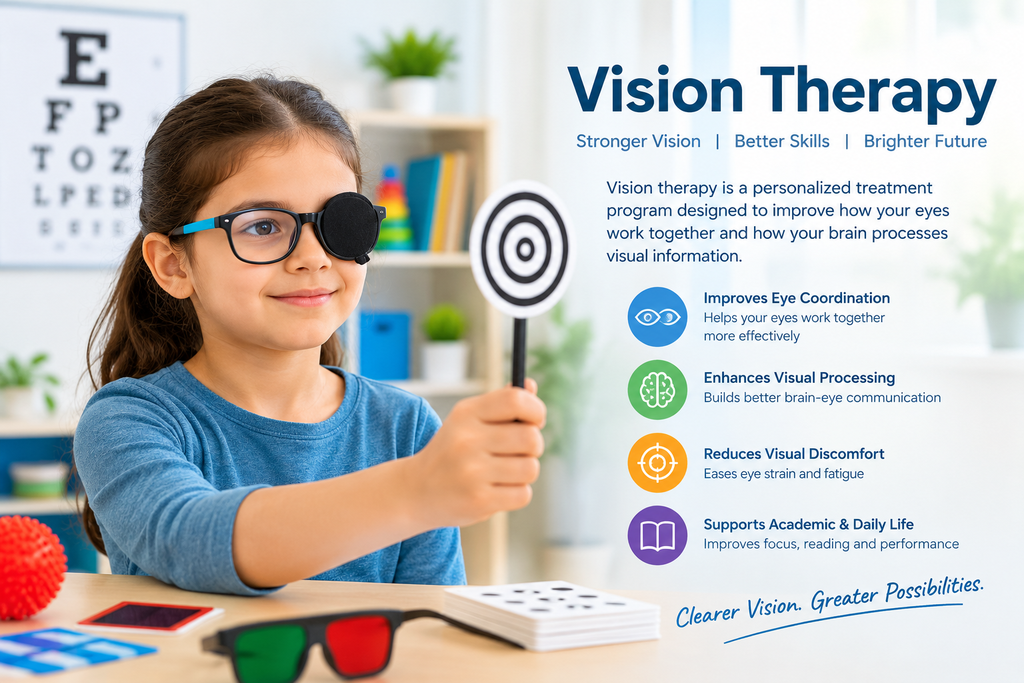
Most of us think of vision in simple terms. Either you can see clearly, or you need glasses. But there is a second, less talked about layer to how our eyes work, and it has nothing to do with clarity. It has to do with coordination, the ability of both eyes to work together smoothly, track moving objects, and shift focus without strain. This is the layer that a standard eye chart simply does not measure.
Passing the Eye Chart, Yet Still Struggling
It is entirely possible to sit down for a routine eye exam, read every line on the chart correctly, and walk away with a clean bill of health, while still dealing with headaches by the end of the workday, eyes that feel tired after twenty minutes of reading, or a persistent difficulty staying focused on a page.
This mismatch confuses a lot of people, because they assume that if their eyesight is “20/20,” their eyes must be functioning perfectly. In reality, an eye chart only tests how sharply you see letters at a distance. It says nothing about how well your eyes team up, track a line of text, or refocus when you look from a book to a whiteboard and back again.
For someone dealing with unexplained eye strain, this gap between clear sight and comfortable, efficient use of the eyes is often where the real story lies, and it is part of why searching into vision therapy in TorontoTonic often leads people to a more complete explanation than a typical exam ever gave them.
The Difference Between Seeing and Using Both Eyes Efficiently
Think of it this way. Clarity is about the lens system of the eye, whether light is focusing correctly on the retina. Coordination is about the muscles and neural pathways that let both eyes aim at the same point, move together across a page, and adjust focus quickly. These are separate systems, run largely by separate parts of the visual process.
A person can have excellent clarity and still have inefficient teamwork between the eyes. When that happens, the brain has to work harder to merge two slightly different images into one, or to keep tracking smoothly along a line of text.
Over time, that extra effort can show up as headaches, blurred or doubled vision during close work, losing your place while reading, or a general sense that concentrating on a page takes more energy than it should. None of this shows up on a standard chart, because the chart was never designed to catch it.
Where Vision Therapy Comes In
This is where vision therapy enters the conversation. Vision therapy is a structured, supervised program that some eye care providers use to help patients build stronger, more efficient visual skills, things like eye teaming, tracking, and focusing flexibility.
Rather than correcting how sharply someone sees, it works on how well the two eyes cooperate and how efficiently the visual system responds to changing demands, whether that is reading a paragraph, following a moving object, or shifting attention between near and far distances repeatedly.
Programs are typically built around a series of exercises and activities, often introduced gradually and adjusted as a patient’s skills develop. It is worth being clear that vision therapy is not a guaranteed fix for every visual complaint, and providers who take it seriously will usually avoid promising specific outcomes before a proper assessment has taken place. It also is not meant to replace glasses or contact lenses when those are needed for clarity, it addresses a different piece of the puzzle entirely.
Getting a Proper Assessment First
One important thing to understand is that this kind of visual inefficiency is not something a person can self diagnose from a list of symptoms online. Headaches, fatigue, and trouble concentrating while reading can have many causes, and narrowing down whether eye coordination is actually the issue requires a more detailed look than a routine eye exam provides.
This typically means a separate visual skills assessment, one that specifically evaluates things like how well the eyes team together, how smoothly they track, and how quickly they can refocus. These assessments are usually done by providers who have training beyond the standard optometric exam.
As one example, Tonic Eye Care & Vision Therapy in Toronto is a clinic that offers this type of in depth evaluation, giving patients a way to find out whether coordination issues, rather than clarity issues, might be contributing to what they are experiencing. Clinics like this are a useful starting point for anyone whose symptoms have not been explained by a standard exam, though the right next step will always depend on what the assessment actually finds.
Why This Distinction Matters
The broader point here is not that everyone with tired eyes needs vision therapy. It is that “seeing clearly” and “using both eyes efficiently together” are genuinely two different things, and conflating them can leave people without an explanation for symptoms that are real and persistent.
A clean eye chart result is good news for clarity, but it was never designed to speak to coordination. For anyone who has been told their eyes are “fine” while still struggling with discomfort during near work, understanding this distinction can at least open the door to asking better questions, and possibly to seeking out a more targeted evaluation.
Conclusion
Vision is more layered than a single eye chart can capture. Clarity tells only part of the story, while coordination, the ability of the eyes to team up, track, and refocus efficiently, tells another part entirely, one that often goes unmeasured in a routine visit. For people who pass their eye exam yet still deal with headaches, strain, or trouble concentrating while reading, it may be worth looking into whether a visual skills assessment, separate from a standard exam, could shed some light on what is actually going on.
It is not a self diagnosis, and it is not a guarantee of a particular outcome, but it is a reasonable next question to ask when something still feels off.