
A buyer emailed a certificate of analysis to the laboratory named at the top of it and asked one question: did you write this?
The lab said no.
That is the entire problem with buying research compounds online, compressed into one exchange. Every supplier publishes a purity figure. Most publish a PDF with a lab’s name on it. Almost none of it gets checked, because checking feels like the vendor’s job and the PDF looks official enough. So a number like 99.2% goes straight from a product page into your notes, and it might be a measurement or it might be a design choice made in Canva.
You can close that gap in about twenty minutes. Below are seven checks, in the order I’d run them, using free public tools. Some suppliers make this easy. Vendors like UK Peptide Lab publish a batch certificate directly on each product page with the testing lab and report number printed on it, which is the format you want to see before you go further. Whether any given certificate survives contact with the lab that allegedly issued it is exactly what check one is for.
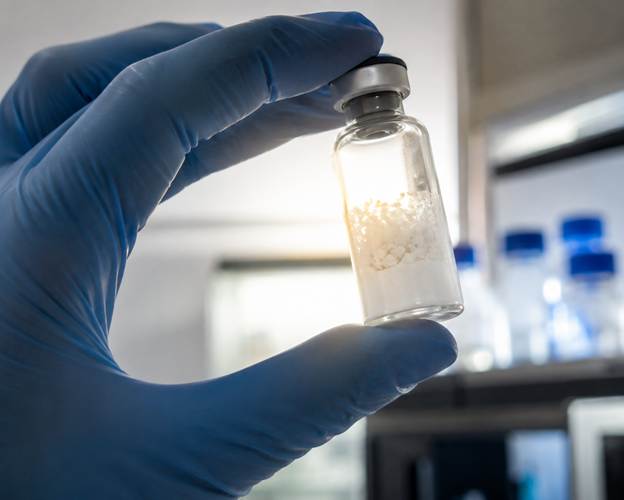
Alt text: Researcher inspecting a lyophilized research compound vial against the light
The certificate is the whole ballgame
Here’s what you’re actually buying when you order a lyophilized compound: a sealed glass vial of white powder that looks identical to every other sealed glass vial of white powder on earth.
You can’t assay it. You can’t smell it. You reconstitute it, and if it dissolves clear you assume it’s fine, which is a terrible assumption because plenty of wrong things dissolve clear. Your only real information about what’s in that vial is a document someone else wrote.
So the certificate isn’t paperwork attached to the purchase. It is the purchase. Everything below is about pressure-testing that one document.
Check 1: Call the lab that supposedly signed the certificate
This is the check that catches the worst cases, and it takes one email.
Find the laboratory name on the certificate. Find its own report or reference number, which is different from the supplier’s batch number. Then contact the lab directly through the address on its own website, not any address the supplier gave you, and ask whether that report number belongs to them.
Analytical labs answer this. Their commercial reputation depends on their name not appearing on documents they didn’t produce, so you’re doing them a favor by asking.
Without a laboratory report number, without an analyst signature, without any laboratory contact information on the supplier’s certification, there is no way to verify it and one may consider the purity as marketing text.
Check 2: Verify that the number of the vial matches the number on the certificate
Once your order arrives, check the label before looking at the invoice.
The vial carries a batch or lot number. The certificate carries a batch or lot number. They have to be the same string. If the vial says one thing and the published PDF says another, the certificate describes a different production run than the one sitting in your freezer, and it tells you nothing about your material.
Watch for one certificate reused across every strength of the same compound. A 10mg vial and a 40mg vial are separate fills from separate runs. Two products, two batch numbers, two certificates. A single PDF stretched across a catalog is a sign nobody is testing per batch.
Check 3: Confirm the testing lab is actually accredited
A lab name on a PDF proves a lab name went on a PDF.
For UK testing, run the name through the UKAS accredited organisation directory. UKAS is the national accreditation body, and ISO/IEC 17025 is the standard that covers testing competence: staff qualifications, calibrated equipment, documented methods, and independent assessment on a cycle.
Plenty of analytical labs used in this sector are not UKAS accredited, and that isn’t automatically disqualifying. But you should know which you’re dealing with, because an unaccredited lab’s number carries a different weight than an accredited one’s, and the supplier is unlikely to volunteer the distinction.
Check 4: Look up who owns the company
UK suppliers must publish a company number. Take it to Companies House and spend five minutes.
You’re looking for incorporation date, registered office, named directors, and filing history. A company incorporated eleven months ago with one director and a mail-forwarding address in central London isn’t necessarily bad, and plenty of legitimate businesses start exactly there. But it changes what you’re risking on a first order, and it should push you toward a small trial purchase rather than a bulk one.
Note that Companies House does not verify what gets filed with it. The register tells you what a company claimed, not what’s true. It’s a starting point, not a clean bill of health.
Check 5: Read the method and the date, not just the purity number
Most people read one thing on a certificate: the percentage. That’s the least useful figure on the page.
Look for the method. HPLC with UV detection tells you about purity by peak area. Mass spectrometry tells you about identity, meaning whether the molecule is the one on the label. Purity without identity is a hole in the data, because a vial can be 99% pure something else.
Then look at the test date. A certificate dated eight months before your batch shipped isn’t describing your batch. And check the detection wavelength if it’s listed, usually 220nm for peptide bonds. Certificates that skip method details and lead with a big percentage are optimized for the screenshot, not the scientist.
Check 6: Email support before you order, not after
Send a question you actually want answered. Ask for an older certificate for the same compound, or for the analyst’s contact at the testing lab.
What you’re measuring is whether anyone replies, how fast, and whether the answer engages with the question or bounces back a template. A supplier that ignores a pre-sale question about test data will definitely ignore a post-sale one about a vial that arrived cloudy.
This costs you nothing and it’s the single best predictor of how the relationship goes when something breaks.
Check 7: Understand what “research use only” actually obligates you to
No reputable source selling anything in this realm ever markets their products for human or animal consumption but for in-vitro lab testing only.
None of these products is a licensed drug. Neither the MHRA nor the FDA have reviewed them for any kind of safety and efficacy.
Nobody has established what a safe exposure looks like in a person, because that work hasn’t been done. The MHRA is direct about the risk of buying unauthorized products online: there’s no guarantee they meet any standard of quality, safety, or effectiveness, and the agency prosecutes offenses under UK medicines law.
If you’re ordering these compounds for anything other than bench work, the six checks above don’t protect you. They tell you what’s in the vial. They tell you nothing about what it does to a person, and a verified certificate on an unapproved compound is still an unapproved compound.
Certificate red flags, at a glance
| What you see | What it usually means |
| No lab report number | Nothing to verify with the issuing lab |
| One certificate across several products | No per-batch testing |
| Batch number missing from the vial label | Certificate can’t be tied to your material |
| Purity given, method omitted | Peak area with no identity confirmation |
| Test date long before dispatch | Document describes an older run |
| Lab absent from the UKAS register, undisclosed | Unaccredited testing presented as third-party |
| Support ignores pre-sale questions | Post-sale problems go the same way |