By Dan Murphy
State Senator Pete Harckham said something on Earth Day in April that I have been thinking about since. “Today is Earth Day, and a day when we all stop and think about how we can make the earth a better place. We do roadside cleanups, park cleanups, plantings, all very beneficial things. But we’ve got to get serious. Our planet is in serious trouble.
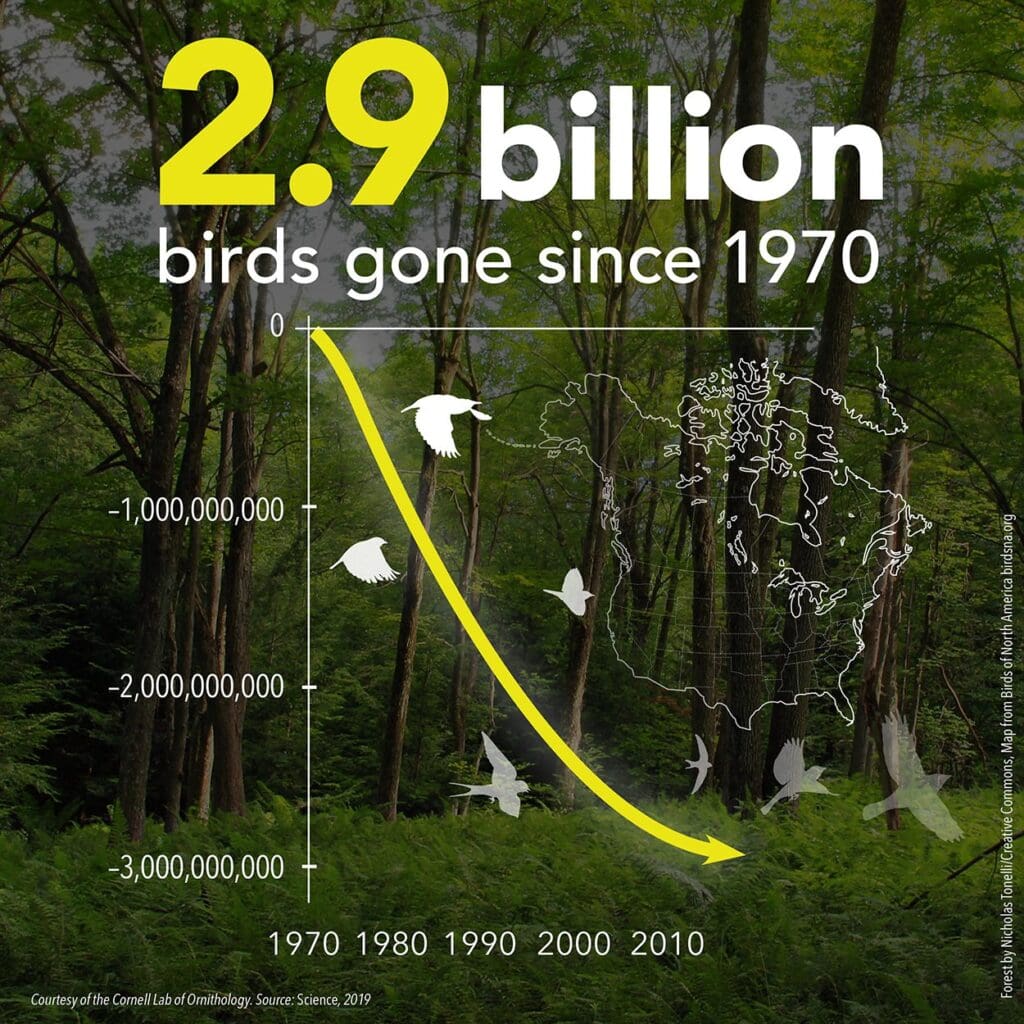
“We’ve lost 30% of our Bird species in North America, over 3 billion birds since the 1970s.”
The Cornell Lab (www.birds.cornell.edu) reports, “If you were alive in the year 1970, more than one in four birds in the U.S. and Canada has disappeared within your lifetime.
“According to research published online in September by the journal Science, wild bird populations in the continental U.S. and Canada have declined by almost 30% since 1970.
“We were astounded by this net loss across all birds on our continent, the loss of billions of birds,” said Cornell Lab of Ornithology conservation scientist Ken Rosenberg, who led an international team of scientists from seven institutions in the analysis of population trends for 529 bird species.
The study quantifies for the first time the total decline in bird populations in the continental U.S. and Canada, a loss of 2.9 billion breeding adult birds, with devastating losses among birds in every biome. Rosenberg, who leads joint research initiatives by the Cornell Lab and American Bird Conservancy, says these study results transcend the world of birds.
“These bird losses are a strong signal that our human-altered landscapes are losing their ability to support birdlife,” he said. “And that is an indicator of a coming collapse of the overall environment.”
Forests alone have lost 1 billion birds. Grassland bird populations collectively have declined by more than 50%, or more than 700 million birds. Habitat loss is likely to be a driving factor in these declines, say the authors, particularly agricultural intensification and development.
“I think this analysis shows that we’re eating away at the foundations of all of our major ecosystems on the continent,” said Arvind Panjabi, study coauthor and avian conservation scientist at the Colorado-based Bird Conservancy of the Rockies. “These numbers show that the world has changed a lot since 1970.”
For Adam Smith, the Environment and Climate Change Canada biostatistician, the numbers call out for a radical shift in conservation strategy.
“It’s really a wake-up call for the importance of moving beyond just a single species, endangered species conservation framework,” Smith said. “We rescued the Trumpeter Swan and the Peregrine Falcon, and we should be proud and happy about those successes. But we’re at a stage where, given these extreme declines in so many species, we need to move beyond that framework.
“These are systems and biomes in serious trouble. I think we need to approach conservation of these endangered systems at a much more holistic level.”