
By Matthew Gluck, Founder & Principal Broker, NestEdge Realty
The moving truck is booked, your Westchester home is scheduled to close, and you expect to pick up the next set of keys that afternoon. Then the purchase closing slips by a week. Where will you sleep, and where will everything on the truck go?
For homeowners downsizing, relocating or moving closer to family, that question belongs near the beginning of the process. The sale, the purchase and the physical move each have their own timetable. A workable plan needs to connect all three.
Start with when you need the money
Before committing to your next purchase, determine whether you need proceeds from your current home for the down payment, closing costs or other expenses.
Ask your lender what you can qualify for before the sale closes and what documentation will be required afterward. Review your estimated net proceeds with your agent and attorney. The sale price alone does not tell you how much money will be available for the next purchase.
Also distinguish money needed before closing—such as a contract deposit—from money needed at closing. Ask your transaction team when funds must be available rather than assuming the sale will cover every payment along the way.
Compare the sequence, not just the dates
Selling first can clarify your available budget, but it may require temporary housing and moving twice. Buying first may simplify the physical move, but it can mean overlapping housing expenses and additional financing requirements.
Neither sequence suits every household. Compare the costs and practical demands of each, including what happens if the next home takes longer to find. A short rental, an extended stay with family or another temporary arrangement should be evaluated for accessibility, pets, commuting and everyday routines—not just its advertised price.
Build a backup for a delayed closing
Coordinating two closings on the same day may be possible, but it leaves little room for a change in either transaction.
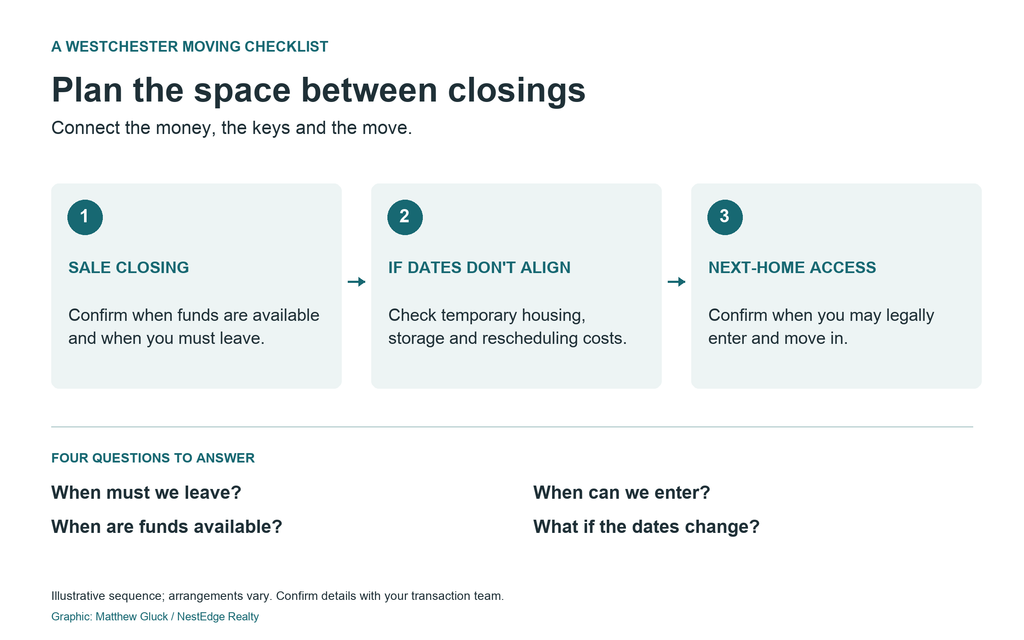
Before booking the moving truck, discuss the proposed schedule with both transaction teams. Confirm when you must leave the old home, when you can legally occupy the new one and how funds will move between closings.
Then ask: If one closing moves by a week, what changes? Identify where you could stay, where your belongings would go and what rescheduling might cost. A backup plan is more useful when its availability and terms have been checked.
A hypothetical seven-day closing delay
Consider a hypothetical household selling in Pleasantville and buying in Chappaqua. Their sale closes on Friday morning, and they must leave that day. Their purchase, planned for Friday afternoon, is postponed until the following Friday because the lender needs additional documentation. That creates a seven-day gap between leaving one home and gaining access to the next. This is an illustration, not an actual client transaction.
Their backup plan needs seven nights of temporary housing, storage for their belongings and a revised delivery date. They confirm availability, extension options and charges before relying on those arrangements. Their attorney and lender confirm when sale proceeds can be used for the purchase. Early access to the next home would require a separate agreement and any necessary approvals.
Treat a stay after closing as a separate agreement
Some sellers ask to remain in their former home briefly after the sale. That possibility should be discussed early, rather than assumed.
Have the attorneys address any proposed occupancy arrangement in writing, including the departure date, payment, security, utilities, insurance and responsibility for damage. Confirm any lender or insurer requirements that apply. The buyer’s agreement and the necessary approvals cannot be taken for granted.
Budget for the move between the homes
Include temporary lodging, storage, packing, a second delivery, utility overlap and possible cancellation or rescheduling charges.
For interstate moves, the Federal Motor Carrier Safety Administration recommends checking the mover’s registration and obtaining a written estimate describing the services and charges. Ask specifically what happens if delivery must be delayed.
For a smaller next home, decide what will fit before paying to move and store everything. Keep medications, identification, closing documents and everyday essentials accessible.
Before finalizing your moving arrangements, be able to answer four questions:
When must we leave?
When can we enter the next home?
When will the money be available?
What is our backup if the dates change?
Those answers give your household a practical plan for the space between handing over one set of keys and receiving the next.