
If you’ve ever tried to exhibit at a U.S. trade show from another country, you already know it’s not exactly a walk in the park. There’s shipping, customs, booth regulations, labor rules, venue deadlines, and that’s before you even think about what your booth is going to look like. I’ve watched plenty of international companies show up underprepared and spend more time putting out fires than actually talking to potential customers.
So let’s do this properly.
Why Los Angeles Is a Strong Exhibition Destination in 2026
Los Angeles is one of those cities that sounds glamorous on paper, and honestly, for trade shows, it actually delivers. The city sits right at the intersection of multiple massive industries: entertainment, tech, beauty, fashion, health, logistics, and international trade. That’s not an accident. LA’s ports handle more cargo than almost anywhere else in North America, which means the infrastructure for moving things in and out is genuinely solid.
For international companies, the appeal goes deeper than geography. California is the largest state economy in the U.S., something like the fifth largest in the entire world if you treat it as its own country. Getting in front of buyers, distributors, and decision-makers here can open doors that no other U.S. city quite replicates. The Expo Center, the Petersen, the Convention Center downtown, these aren’t small venues running small events. 2026 is shaping up to be a particularly busy year for LA trade shows as post-pandemic event calendars have fully normalized and international travel is flowing again. If your company has been waiting for the right time to plant a flag in the U.S. market, this is probably it.
Choosing Trade Show in Los Angeles
Not every trade show deserves your budget. This sounds obvious, but I’ve seen companies spend $80,000 to exhibit at an event where their exact target customer wasn’t in attendance. Painful. Start with your industry. Los Angeles has strong recurring shows in beauty (Cosmoprof, IECSC), tech and consumer electronics (influenced by CES), food and beverage, cannabis, healthcare, and apparel. Match the event to what you actually sell, not what’s closest or cheapest. you can see full Calendar of Los Angeles shows in 2026
Then look at visitor quality, not just visitor volume. A niche show with 4,000 serious buyers will outperform a massive general event with 40,000 tire-kickers. Ask the organizer for last year’s attendee demographics. If they’re cagey about sharing that data, that tells you something.
Booth costs in LA range from a few thousand dollars for a small inline 10×10 space to well over $50,000 for a large island booth in a premium location. Factor in not just the space fee but everything that goes around it, furniture, flooring, signage, electricity, Wi-Fi, lead scanning, and cleaning. It adds up faster than you’d expect. Budget roughly 3x the raw floor space cost to cover the full exhibiting reality.
Trade Show Planning Timeline in 2026
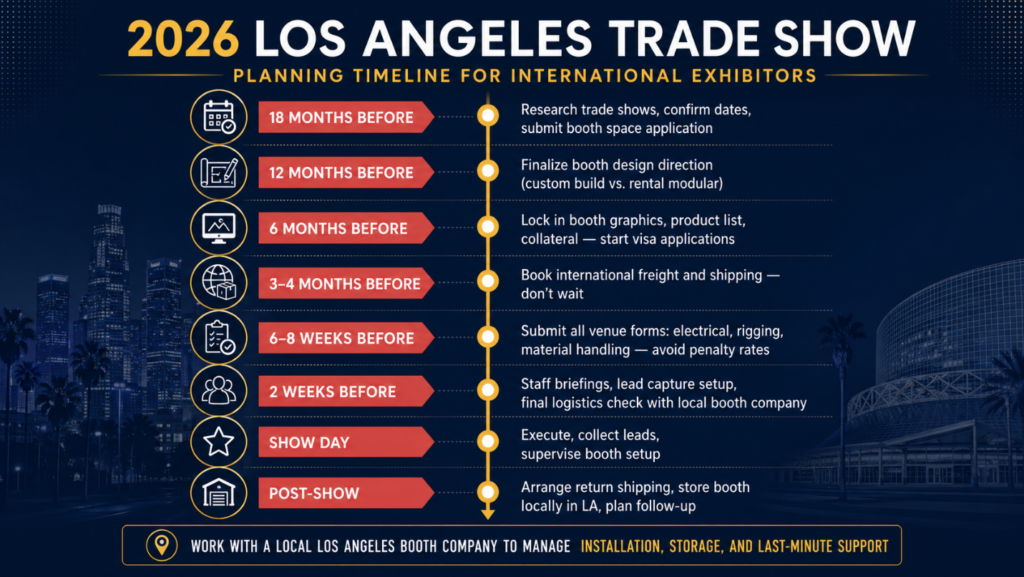
LA Show’s Planning Timeline for 2026
This is where most international companies get into trouble. They think six weeks is enough time. It’s not, not even close.
12–18 months out: Start researching events, confirm dates, and, if you’ve settled on one, submit your booth space application. Popular shows sell out priority placement early, and international companies often don’t realize that until they’re stuck with a corner nobody walks past.
9–12 months out: Confirm your booth design direction. Are you building custom? Renting a modular system? Decide now so your booth partner has enough lead time to do the job right.
6 months out: Finalize booth graphics, product list, and marketing collateral. Start your visa applications if your team needs them, U.S. B-1 business visas can take longer than people expect, depending on your country of origin.
3–4 months out: Book shipping. Seriously, don’t wait. International freight, especially ocean freight, needs this much runway to clear customs, hit the advance warehouse window, and arrive on time.
6–8 weeks out: Submit all venue forms. Electrical orders, rigging requests, and material handling estimates. Miss these deadlines, and you’ll pay penalty rates that will make your accountant wince.
2 weeks out: Staff briefings, lead capture setup, and final walk-through of logistics with your local booth company.
Understanding U.S. Trade Show Rules and Venue Requirements
American trade show venues operate with a very specific rulebook, and it’s different from what you might be used to in Europe, Asia, or elsewhere. The exhibitor manual, sometimes 80 to 120 pages long, is not optional reading. I know it’s boring. Read it anyway.
Booth heights are regulated. A standard inline booth is typically capped at 8 feet. Island booths get more latitude but still need approval for anything over 16 or 20 feet. Structural components sometimes require engineering sign-off. Electrical connections must go through the venue’s contracted provider, you cannot just plug into a wall with your own gear.
Labor rules in Los Angeles follow union jurisdiction guidelines for certain venue contracts. What this means practically: at some venues, your own staff cannot set up your own booth. Specific tasks, hanging signs, certain electrical work, carpeting, must be handled by union labor. This surprises many international exhibitors and can add real costs if they haven’t budgeted for it.
Insurance is non-negotiable. Most LA venues require exhibitors to carry a minimum liability policy and name the venue as an additional insured. Your domestic business insurance from your home country almost certainly won’t satisfy this requirement. Work with a U.S.-based provider or your booth company to arrange a short-term exhibitor policy.
Deadlines in American trade shows are hard deadlines. Not suggestions. Missing the advance warehouse cutoff means your freight goes to show-site delivery, which costs more and creates risk. Missing electrical or rigging deadlines means you pay floor-order rates, sometimes double or triple the advance pricing.
Why Work With a Local Los Angeles Trade Show Booth Company
This one I feel strongly about.
You could theoretically ship your entire booth from your home country, manage installation remotely, and cross your fingers. Some companies try it. Most regret it. A local Los Angeles booth company already knows which venues have which quirks, which labor rules apply where, and, crucially, can send someone over when something inevitably goes sideways at 7am on setup day.
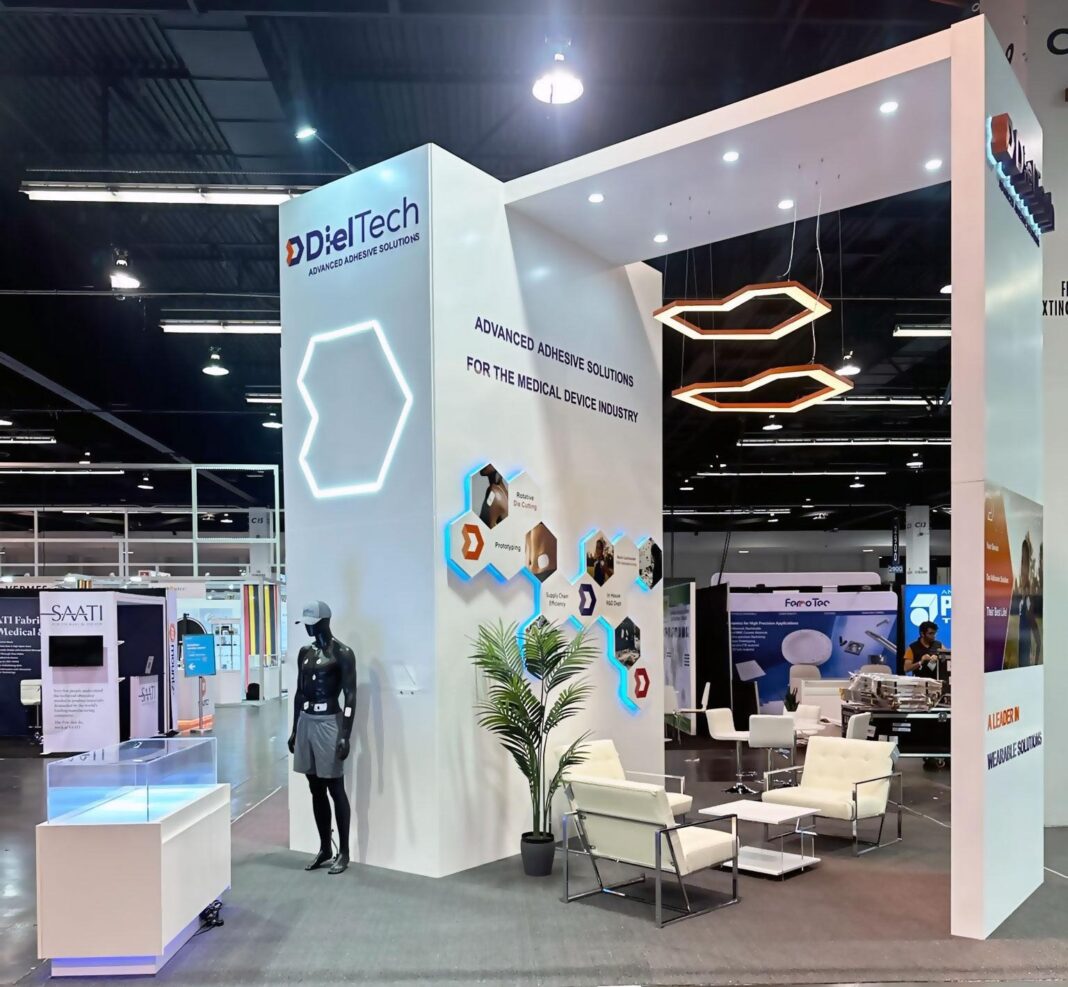
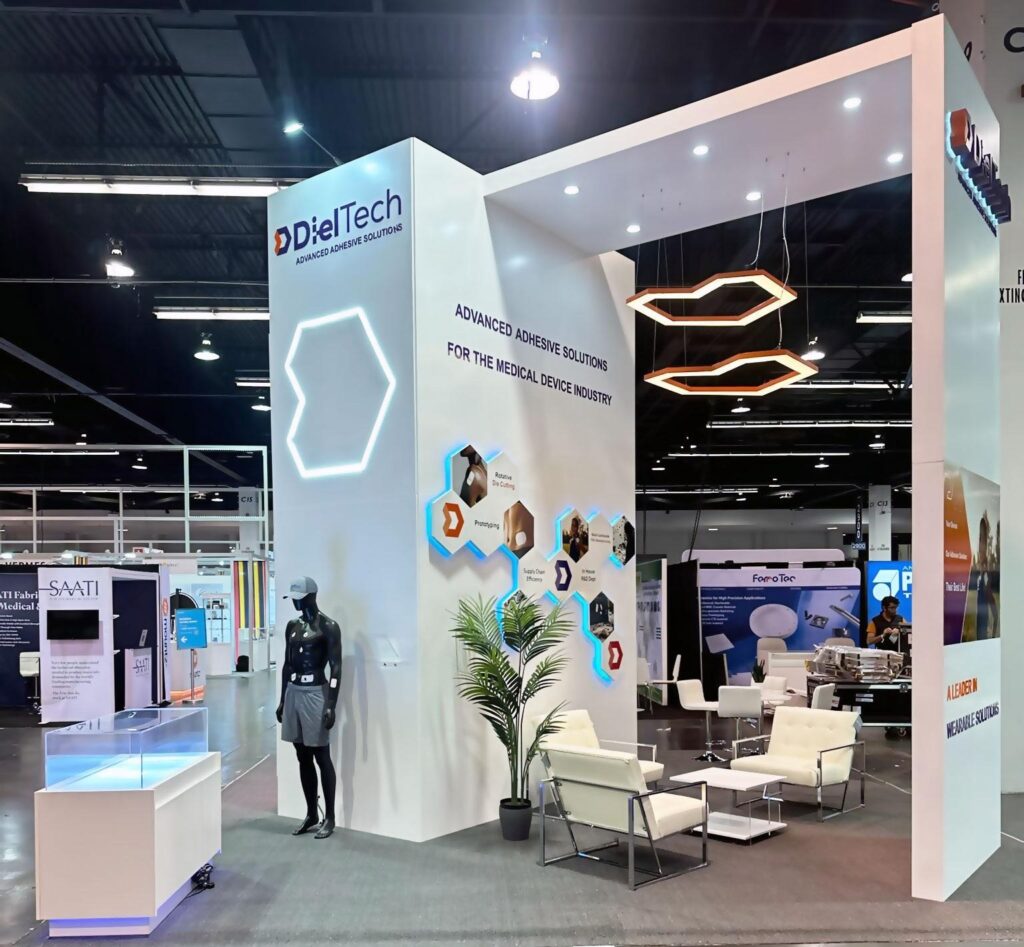
What a good local booth partner actually handles: design and fabrication of the booth itself, rental of components if you don’t want to own everything, on-site installation and dismantling, on-site supervision during setup, and storage of your booth between shows. That last one matters more than people realize, especially if you plan to exhibit at multiple U.S. events throughout the year.
There’s also the question of the graphics refresh. A reputable local company can update your booth panels between shows, new product, updated messaging, different sizing for a different venue, without you having to ship anything internationally again. Over time, that storage-and-reuse model saves significant money.
Choose a company with verifiable LA venue experience, not just a national provider who’ll subcontract the work locally without telling you.
Shipping, Customs, and Product Samples
International shipping to a U.S. trade show is genuinely complicated, and I say that as someone who has watched it go wrong in creative ways more times than I care to count.
You need a freight forwarder who specializes in trade show freight, not just general cargo. These are different skill sets. Trade show freight has strict advance warehouse windows, specific labeling requirements, and a unique chain of custody once it enters the venue’s material handling system.
Customs documentation needs to be immaculate. Commercial invoices, packing lists, and ATA Carnets if you’re bringing items back out of the country (especially useful for booth components and demo equipment). Product samples brought in for display, not for sale, are subject to specific classification rules. Get this wrong, and your products sit in customs while your show starts without them.
Plan for both inbound and return shipping before you travel. Return shipping is an afterthought that becomes a crisis on the last day of the show when you realize you haven’t arranged anything and need to get everything back to a warehouse or out of the country.
On-site, goods delivered directly to the convention center almost always go through the venue’s drayage system, meaning the official material handling contractor moves your freight from the loading dock to your booth. This costs money per hundredweight and can’t be bypassed. Budget for it.
Booth Storage and Reuse After the Show in Los Angles
If you’re only planning one U.S. trade show ever, this section is less relevant. But most companies that exhibit once in the U.S. come back, because it works, or because they want it to work better next time.
Storing your booth in Los Angeles between events is almost always more cost-effective than shipping it back home. A local booth company with warehouse space will store your components, protect the graphics, and have everything ready for your next show on a timeline you actually control.
Between events, it’s worth reviewing what worked visually and what didn’t. Maybe the backlit header landed well, but the product display shelving was awkward. Update those elements. Refresh graphics for a different show’s audience. A stored booth isn’t a static object, it should evolve.
And if you start exhibiting at other U.S. shows, say, something in Las Vegas or Chicago, a Los Angeles-based partner with national reach can often extend that same booth to other venues, managing the logistics so you’re not reinventing the wheel each time.
Final Checklist for Exhibiting in Los Angeles in 2026
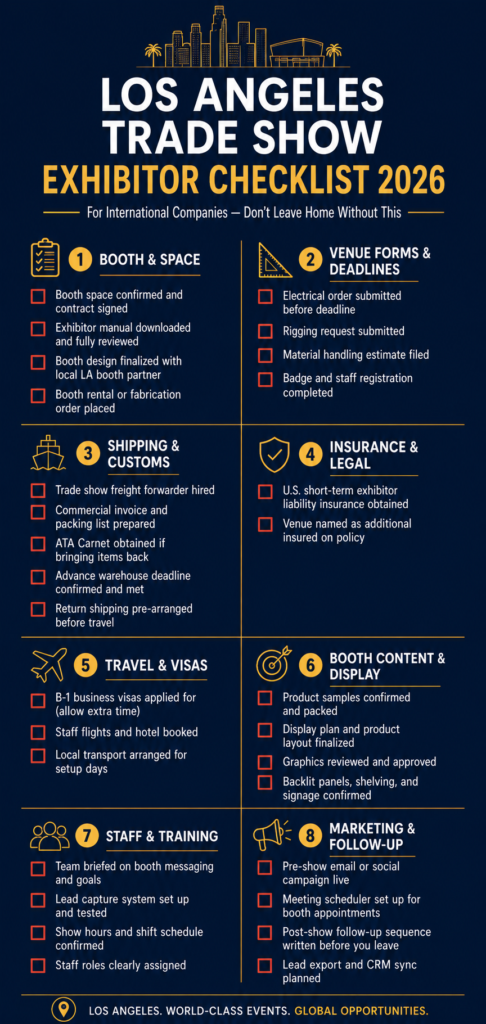
Here’s the practical rundown, because sometimes you just need a list:
Booth space confirmed and contract signed. Exhibitor manual downloaded and reviewed in full. Booth design finalized and approved by your local booth partner. All venue forms submitted before deadlines, electrical, rigging, material handling, badge orders. International shipping arranged through a trade show freight forwarder. Customs documentation prepared, commercial invoice, packing list, and ATA Carnet if applicable. Advance warehouse deadline noted and freight scheduled to arrive on time. Return shipping pre-arranged. Short-term U.S. exhibitor liability insurance obtained. Staff visas and travel booked. Staff briefed on booth messaging, lead capture process, and show hours. Lead scanning or collection system set up and tested. Product samples confirmed and display plan finalized. Post-show follow-up sequence prepared before you leave home.
Print that out. Put it somewhere you’ll actually see it.
Exhibiting internationally is genuinely hard, but Los Angeles rewards companies who do it right. The market access, the quality of buyers, the industry variety, it’s worth the effort. Just don’t try to wing it six weeks before the show. Trust me on that one.