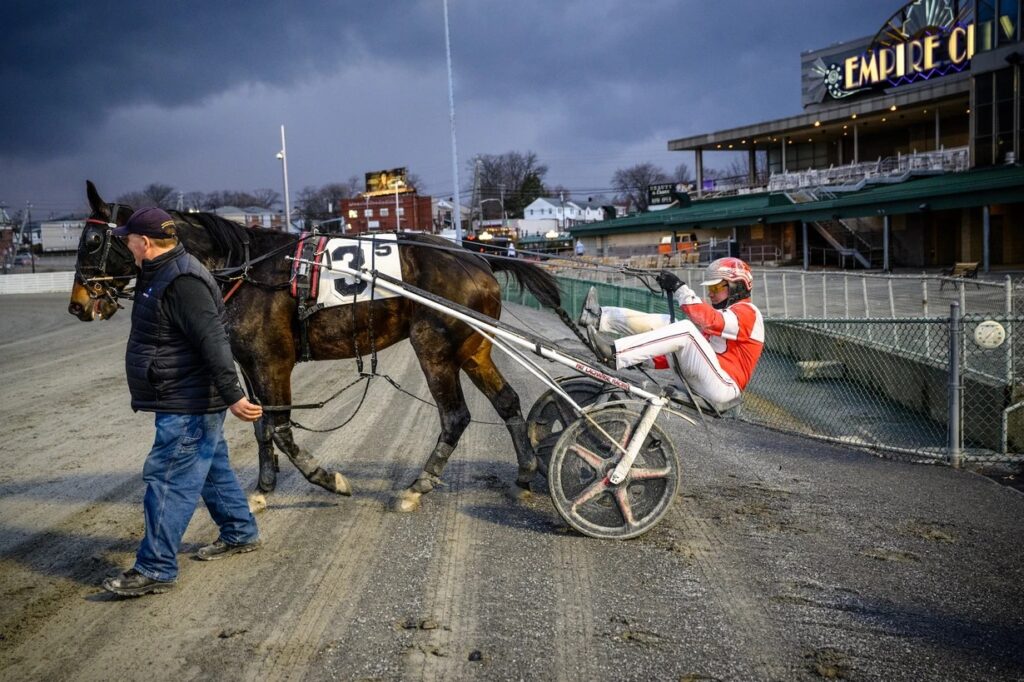
Yonkers Raceway, December 19, 2025. | Katie G. Nelson / New York Focus
The feds gave New York key evidence on horse racing’s largest doping ring. State regulators have done nothing with it for years
By Sam Mellins, NY Focus, (https://nysfocus.com/2026/01/07/horse-racing-new-york-illegal-drugs-dopers)
This story originally appeared in New York Focus, a nonprofit news publication investigating power in New York. Sign up for their newsletter here.
On a frigid weeknight last month, the grandstand at the Yonkers Raceway was nearly deserted when Heave Away surged from behind to win the final race of the evening. It was the 153rd victory of the year for the horse’s trainer, Nicholas DeVita.
DeVita was lucky to still be racing. Two years earlier, a former FBI agent sent New York racing regulators evidence that numerous owners and trainers, including DeVita, had purchased illegal drugs meant to make their horses run faster. The veterinarian who sold the drugs, Seth Fishman, is now serving an 11-year sentence for running an international doping ring.
Despite this evidence, the New York State Gaming Commission never punished DeVita — or hundreds of other trainers and owners implicated in the scandal. According to New York Focus’s analysis of FBI documents and court records, at least 280 people or stables purchased illegal drugs from Fishman. Collectively, they have won over $40 million since the veterinarian’s conviction.
Yet aside from 12 people convicted as co-conspirators, the gaming commission has not banned, suspended, or fined anyone for buying Fishman’s drugs.
Instead, state taxpayers continue to subsidize the struggling racing industry with $250 million annually, funding the prizes that the alleged cheaters collect, while politicians promote the sport rather than police it.
Last month, New York Focus asked the gaming commission how it had handled the documents from the FBI.
Spokesperson Lee Park repeatedly denied that the commission had received any evidence. But just before Christmas, Park made an about-turn, admitting that an investigator had received key documents in 2023 “but failed to take any action or share with relevant staff over the course of the following two years.”
Editor’s Note: The photos of the Yonkers Raceway used in this article were taken in December 2025. The people pictured in the photos have not been accused of any wrongdoing.
The investigator has been placed on administrative leave, Park said, and the commission “is now reviewing” the material.
For nearly two decades, Florida-based veterinarian Seth Fishman sold drugs to clients across the country and as far as the United Arab Emirates, where, he said, a member of the royal family offered him immunity from potential US money laundering accusations.
Fishman promised that the drugs — which he developed himself and described as “chemical warfare” — would increase an animal’s speed but be undetectable in tests. Some of the drugs were numbing agents that can cause horses to run through the pain of injuries, leading to broken legs and euthanasia.
The drugging scheme would end up killing at least 20 horses, according to prosecutors.
Fishman’s downfall began in 2017, when private investigators supplied the FBI with evidence of the doping ring. That sparked a sweeping multiyear investigation headed by former FBI agent Naushaun Richards, who went undercover at the New Jersey Meadowlands racetrack, collecting horse blood samples to be tested for drugs at a specialized lab in Hong Kong. Agents also wiretapped Fishman and many of his key conspirators. Nineteen people received prison sentences by the end of 2023, and five more got probation.
The takedown was the biggest horse doping case in the history of the Department of Justice, prosecutors said.
Once they had the ringleaders in prison, federal law enforcement moved on. But in 2023, Richards gave New York a chance to continue the work. The state’s gaming commission had banned 12 of the defendants in the Fishman case from racing after they were indicted in 2020, but Richards sent regulators evidence from the investigation that could have enabled them to do much more.
The documents, which New York Focus has reviewed, appeared to offer a slam-dunk: They included financial records showing several dozen owners and trainers buying illegal drugs from Fishman. A gaming commission inspector thanked Richards for sharing them.
Regulators could have used the documents to drastic effect. They have broad powers to punish cheaters, including banning them from the sport. In New York, they can deny a license to anyone if they decide it is in “the best interests of racing.” Federal law prohibits buying unlicensed animal drugs, regardless of whether they are used; Fishman and his co-conspirators were convicted without prosecutors ever proving that they had used the drugs on racehorses.
Last month, when it denied that the FBI sent the records, the commission also told New York Focus that it doesn’t have enough evidence to issue bans or fines to Fishman’s clients.
The following week, after acknowledging that it had in fact received the evidence, the commission declined to stand by this statement.
“The agency cannot comment on an active investigation,” said Park, the spokesperson.
In 2023, Richards also sent his evidence to staff at the Meadowlands, where the track’s owner, Jeffrey Gural, immediately banned the implicated Fishman clients from racing at his facility. Gural said he urged New Jersey Governor Phil Murphy, whose office did not respond to a request for comment, to take action against the alleged cheaters. He also contacted the sport’s governing body — the US Trotting Association — as well as other regulators. Nothing happened.
“I thought I was going to clean up racing,” Gural told New York Focus. “But now I think nobody cares.”
Horse racing attendance and related wagering have plummeted in recent decades as scandals have rocked the sport and other gambling options have proliferated.
Crowd sizes are a fraction of what they were in the 20th century. Most of New York’s racetracks survive only because taxpayer-funded subsidies pay for new grandstands, workers’ benefits, and even prize money for race winners.
The decline has been especially sharp in harness racing, the lesser-known cousin of the thoroughbred racing on display in the Kentucky Derby. Rather than carrying jockeys on their backs, harness horses pull small carts carrying drivers. They’re slower than thoroughbreds, but they still work hard — they’re routinely given medication to prevent their lungs from hemorrhaging mid-race. Many of Fishman’s clients came from this world.
The days when Yonkers, New York’s flagship harness racing track, could draw tens of thousands of daily fans are long gone. On the recent night when DeVita scored a win, the only trackside spectators were a dozen greying men clustered around the betting terminals, ignoring the many “no smoking” signs.
Their attention was fixed on wall-mounted televisions showing races from around the country. As horses in Louisiana and Kentucky approached their finish lines, the men swore loudly at the screens, urging their picks to run faster. The live horses passing behind them barely caught their notice.
Times may get tougher still. The sport has been steadily losing its fight with other forms of gambling, particularly as sports betting has exploded in popularity. Three new casinos coming to New York City, including one just 20 minutes from Yonkers, may be the killing blow for the track there.
But the industry is still trying to hang on, lobbying New York’s lawmakers to the tune of $6 million last year.
Yonkers takes the charm offensive even further. Every year, the track invites state lawmakers to race against each other with the help of trained drivers. An announcer booms over the PA system and cameras follow the horses around the course, just as they would in a professional race.
Senator Joseph Addabbo, who heads the Senate committee overseeing racing, won the race several years ago. Afterward, the track announcer asked him what he had learned from the experience.
“Harness racing — I’m a big fan,” Addabbo said. “It’s an industry that we have to help in the state, so I look forward to doing that.”
He did not respond to a request for comment on this story. Neither did Assemblymember Carrie Woerner, the current chair of the Assembly racing committee.
REPORTING THIS STORY: This article is based on thousands of pages of records that federal prosecutors used as evidence against Seth Fishman during his 2022 trial, including a log of Fishman’s sales from 2009 to 2019, showing which drugs trainers and owners bought for their horses, and when.
In many cases, buyers were identified only by an account number. To find their identities, we searched the horses’ names in a US Trotting Association database that matches horses with owners.
That database also allowed us to calculate an individual’s total winnings. We relied on Freedom of Information Law requests to obtain documents from the New York State Gaming Commission, such as its correspondence with Fishman’s clients.
Two weeks after Fishman’s conviction in 2022, New York’s gaming commission sent letters to more than 200 of his clients, asking for details on their relationship with the doctor and the products they purchased from him.
Less than a third of them responded, with many denying all knowledge of Fishman’s illegal operation. The commission didn’t send follow up letters to those who ignored the request, nor did it punish those who lied about buying from Fishman, according to documents obtained by New York Focus through a Freedom of Information Law request.
One denial came from a repeat Fishman customer, according to federal evidence: DeVita.
“I had no relationship or even contact whatsoever with Dr. Fishman at any time,” DeVita wrote to the commission, adding that he hadn’t bought anything from the veterinarian since 2017.
That was a lie. DeVita bought drugs from Fishman as late as 2019, evidence from Fishman’s trial shows.
But DeVita, who did not respond to phone calls, texts, or emails from New York Focus, was allowed to continue training horses and winning money. In November, the US Trotting Association suspended DeVita’s membership — though he is allowed to continue racing while he appeals the ruling. The USTA did not respond to requests for comment.
DeVita’s career winnings total over $13 million, according to a USTA database, with more than half of that sum coming after Fishman’s conviction.
Phil Fluet, a major horse owner and trainer based in Saratoga Springs, responded to the commission’s letter by admitting that he had purchased a Fishman drug called “homeopathic bleeder” that was specifically targeted by federal prosecutors.
Reached by phone, Fluet told New York Focus that he doesn’t know what the drug is for, denied that he had used it on his horses, and refused to say why he purchased it.
“It sounds like you’re trying to make a problem for me, so I’m going to end this conversation,” he said before hanging up.
Fluet’s New York racing license remains valid. His horses won over $380,000 in New York in 2025 alone.
Michael Casalino Jr. bought more than one custom Fishman drug per week, on average, from 2012 to 2018, according to FBI evidence. He and his co-owners won over $6 million racing in that time span, and his racing license is still valid. A man who answered a phone number listed for Casalino hung up when this reporter identified himself.
Park, the agency spokesperson, said that many of the employees involved with sending the letters to Fishman’s customers no longer work at the commission, and so he was “unable to identify contemporaneous records that confirm or deny actions undertaken.”
“A two- or three-second improvement in a week’s time? Hay and oats doesn’t do that.”
—Robert Corey, Delaware racing judge
Ronald Ochrym, the commission’s former director of horse racing who sent the letters, declined to comment. The state’s equine medical director, Scott Palmer, backed out of a promised interview. No memos about horse drugging have been prepared for commissioners since at least 2020, according to the commission’s response to a public records request. Governor Kathy Hochul’s office did not respond to requests for comment.
Steve Sitkoff, a retiree who has raced horses in New York for decades, was disappointed by regulators’ failure to crack down. Sitkoff wanted drug buyers “barred from racing for a year or two,” even if regulators couldn’t prove that the drugs were used on horses.
But New York Assemblymember Gary Pretlow, who chaired a legislative committee overseeing horse racing until last year, disagreed.
“If they weren’t convicted of anything, we can’t stop them from earning a living,” Pretlow told New York Focus. “Just buying it doesn’t necessarily mean that they administered it to horses.”
“They may have bought it to kill rats.”
While New York was still ignoring the FBI evidence, one state decided to take its role as a regulator seriously.
Delaware, which hosts only two harness racing tracks, is attempting to ban racing mogul Howard Taylor, a Philadelphia lawyer who is one of the sport’s biggest names.
Taylor was also one of the biggest buyers of Fishman’s illicit drugs, racking up over 400 purchases from 2012 to 2018 and, along with his co-owners, more than $26 million in winnings during that time. Delaware’s regulators denied Taylor’s license renewal application in October, citing his ties to Fishman and their own “responsibility to protect the health and welfare” of horses. Taylor is appealing the ban, but if it stands, it will apply until 2035.
Every state with harness racing can enforce every other state’s licensing decisions. So a ban in Delaware — or anywhere else — could apply nationwide and end Taylor’s career.
Taylor is fighting back aggressively. After learning of the denial, he warned Delaware racing judge Robert Corey in a text message that Corey would not like finding out “what happens to people who screw around with me.”
“This is intentional and you will pay,” Taylor wrote.
He brought two lawyers with him in November to the appeal hearing at the Delaware Department of Agriculture, a one-story building on a highway near Dover.
Before it began, New York Focus asked Taylor what he thought of the day’s business.
“It’s a joke, and it’s disgraceful,” he said. “You’ll hear that there’s nothing that ties me into anything.”
A few minutes later, a state lawyer rolled a cart stuffed with binders of evidence against Taylor into the conference room. For five hours, a panel of judges listened to the two sides.
Corey, the racing judge, testified that he suspected foul play when he saw Taylor’s horses make dramatic gains in a matter of days.
“A two- or three-second improvement in a week’s time? Hay and oats doesn’t do that,” he said.
Taylor didn’t dispute that he paid for the drugs. Instead, he said that his trainers ordered them and that he didn’t know that what he was paying for was illegal.
But Taylor knew the drugs well enough to once tell one of his trainers which specific drug to buy, according to texts obtained by federal prosecutors. He suggested one particularly powerful drug that Fishman sold only to trusted clients.
Taylor refused to answer New York Focus’s follow-up questions after the hearing.
He has already lost his racing license in Kentucky after facing questions about his drug purchases, but the state didn’t formally ban him. Instead, in July, regulators allowed Taylor to withdraw his license application before their final vote.
Delaware’s regulators appear to be the first in the United States to ban any of Fishman’s customers outside the FBI’s initial sweep. Ontario, Canada, has brought down the hammer on a single individual, issuing a ban and $40,000 fine in May to Jeffrey Gillis, a major figure in the sport who was caught in the FBI wiretap ordering drugs from Fishman in 2019.
In 2020, after a string of brutal racehorse deaths, Congress decided it had seen enough inaction from state-level regulators. It created the Horseracing Integrity and Safety Authority, a federal body that enforces a uniform set of anti-doping rules across the US.
But it doesn’t have power over harness racing, thanks to heavy lobbying from industry groups to keep themselves excluded. In 2023, one major owner called HISA “an existential threat to harness racing.”
The New York lawmakers who oversee horse racing are aware of drug use in the sport and the problems it can cause. The state Assembly held a hearing on the topic in December 2024. Both legislators and the witnesses who testified acknowledged that inspections and drug testing aren’t vigorous enough to dissuade cheaters.
“People, the players, the bettors, think that there’s cheating going on,” said Pretlow, the assemblymember who headed the hearing. “Whatever we can do to make it cleaner, basically, is a good thing.”
But this hasn’t spurred Pretlow to take action. He “didn’t really follow” the Fishman case, he told New York Focus.
“Someone sent me about 300 pages of testimony that I didn’t get a chance to read,” he said.
Zachary Groz contributed research.
Do you have information we should know about drugs in racing? Contact Sam Mellins at sam@nysfocus.com or on Signal at mellins.613. Your information will not be published without your permission.