
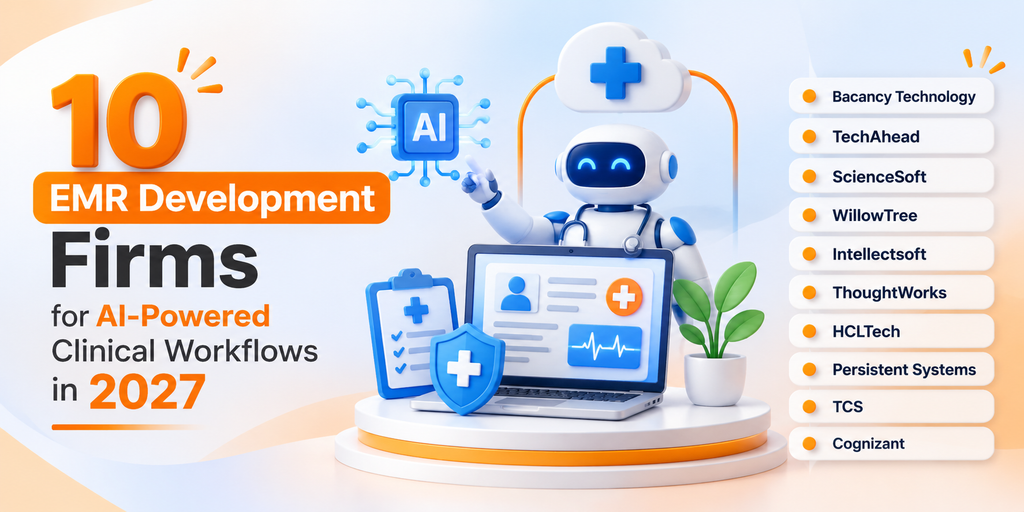
Compare 10 EMR software development companies building AI-Powered Clinical Workflows, with two-way EMR integration, HIPAA controls, and live proof.
According to the survey by AMA carried out in 2026, eighty percent of doctors in America use artificial intelligence in their medical practice, while in 2023 only thirty-eight percent did so. With time, the discussion moves from concerns about how to adopt AI in practice to creating AI-Powered Clinical Workflows that are compatible with EMR systems.
There are numerous companies that still use specialized, legacy, or custom-developed EMRs that lack any AI capabilities or integration. An experienced development partner becomes an absolute necessity. The present paper examines current market trends, determines features of AI-driven workflows, defines criteria for selecting a partner, and suggests ten companies to consider.
EMR Market Overview and Key Trends
Electronic Health Records (EHRs) Market is still growing at a steady pace with artificial intelligence (AI) currently serving as the main force that drives the development and acquisition of EHRs. Numbers shown below show why AI has moved from an auxiliary element into a necessary feature for potential customers.
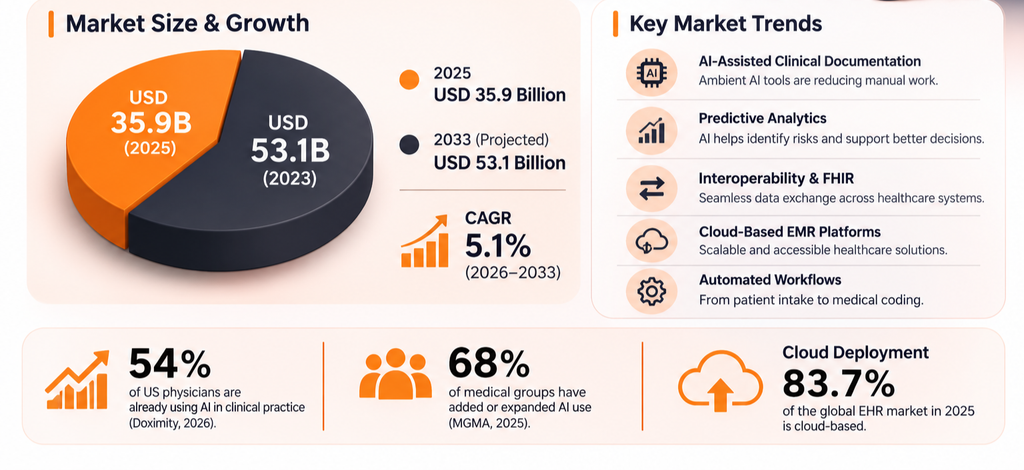
- Market size: According to the report from Grand View Research, the size of the global market of EHRs amounts to USD 35.89 billion in 2025 and will amount to USD 53.11 billion in 2033, which represents a 5.1% yearly increase in the period from 2026 to 2033.(source: Grand View Research)
- Physician adoption: According to Doximity’s survey conducted in 2026 among 3,151 American physicians, 54 percent of them use AI in their work, and its use grew from 47 percent to 63 percent between the two surveys.(source: Doximity 2026 AI Report)
- Medical group adoption: As per MGMA poll, 68 percent of medical groups introduced or expanded the use of AI technology in 2025. By August 2026, MGMA reported that AI was utilized during patients’ visits in 83 percent of medical groups. (source: MGMA 2025)
- Cloud deployment: As per IndustryARC, the share of cloud deployment for EHR software amounts to 55 percent in 2025, while together with web-based, it constitutes 83.7 percent of the market.
Key market trends shaping EMR development
- AI-assisted clinical documentation: In a survey by Duke Health that covered 43 U.S. healthcare systems, ambient notes proved to be the only use case of AI mentioned by all respondents as being the one that the organizations were working on.
- Workflow automation: Healthcare leaders that extended the use of AI in 2025 paid attention to ambient documentation, dictation, and charting. Epic plans to take its Penny AI solution to the next level with fully automated coding starting from visits to the emergency department and radiology.
- Predictive analytics: Epic claims that more than 85% of its customers use Epic AI and offered an update on risk prediction with the help of Cosmos data platform.
- Interoperability and FHIR: ONC HTI-5 rulemaking was aimed at prioritizing FHIR-based APIs over the legacy data exchange solutions and positioning FHIR as a default way of connecting AI to the patient record.
- Cloud-based platforms:Cloud computing became dominant in the industry and made it easier to incorporate AI features without the need for new hardware.
A Closer Look at AI-Powered Clinical Workflows in EMR Systems
AI that uses separate window clicks whereas AI that works in EMR does not click. To implement AI in EMR properly, there should be taken into account three main factors: the place where the AI reads data, the place where the results are written, and who will look at the results before they are recorded in the chart.
The presented workflow of the prior authorization shows how it functions in practice. Everything takes place in the EMR, and there is human interference only when it is necessary.
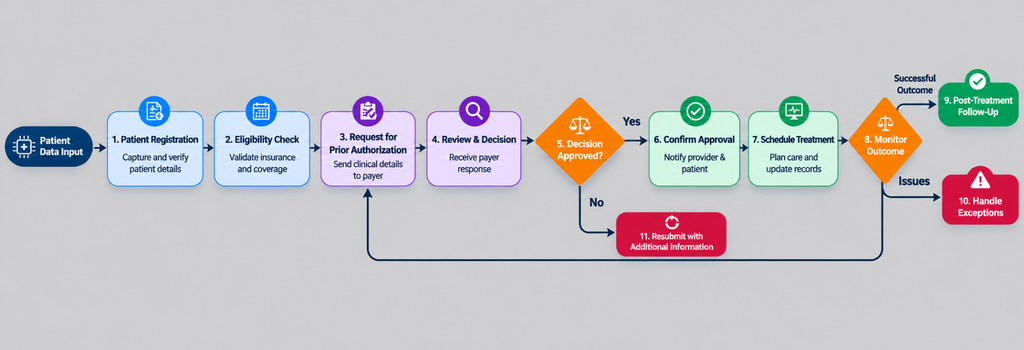
1. Intake (Steps 1 and 2): Patient information is entered into the system, and the AI finds and verifies the information. Then, the AI checks the insurance before sending the request to avoid preventable denials.
2. Authorization (Steps 3 to 5): The AI selects the clinical information that the payer needs from the chart and sends the prior authorization request to the payer. When the response comes, the decision is interpreted and the case is routed to the appropriate place.
3. Resubmission (Step 11): In case of denial, the AI detects if some information is missing and makes a more informed resubmission, which will be verified by the staff and then sent to the payer again.
4. Care delivery (Steps 6 and 7): After obtaining authorization, the system informs the provider and the patient about the results, schedules the treatment and records it.
5. After care (Steps 8 to 10): The AI tracks the outcomes of the procedure.
- If treatment goes as planned: the system triggers post-treatment follow-up.
- If issues appear: the case is flagged for staff to handle as an exception. If the care plan has to change, the case loops back to a new authorization request.
Deployment in real-world practice clearly shows some benefits. The time needed to request prior authorization for medicines at Summit Health with the help of Epic’s Penny assistant has been cut down by 42%.
Same is true of AI-assisted clinical documentation where the technology produces the documentation through ambient listening in the presence of the patient, which is then approved by the physician. Here the benefits may vary. In one JAMA study involving 8,581 physicians from five academic health systems, 16 minutes were saved for the documentation process per eight scheduled patient hours.
It all comes down to one thing AI-Powered Clinical Workflows work best when designed to match existing clinical workflows.
When Is the Right Time to Work With a Custom EMR Development Partner?
AI is now provided by large EHR providers as part of their platform solution. The Epic company, for example, offers Agent Factory, a platform for creating and managing AI agents within a variety of AI-Powered Clinical Workflows. In case you have a big EHR and all the functionality needed for your AI-based clinical work processes is already included in your system, it is unnecessary to develop anything custom.
A custom partner makes sense in these situations:
- You run a specialty or non-Epic EMR, such as behavioral health, home health, or oncology, where native AI options are limited.
- You are building your own EMR product and want a custom EMR with AI features as your main strength.
- You need AI for a workflow that your vendor’s roadmap does not cover.
- Your aim is to have total control over the code, the data flow, and the models without having to pay any seat-based AI cost.
In all cases, an experienced EMR software development partner who specializes in custom EMRs will be able to either integrate the AI into your current system through interfaces or develop a new EMR for you.
Factors to Consider Before Hiring an EMR Software Development Company
Normal standards of evaluation like HIPAA Awareness and positive references are not enough where AI plays its role in a project. The evidence of capability to run AI-based clinical workflow safely in a live clinical setting should be obtained. Below are the six considerations that guided to develop the following list.
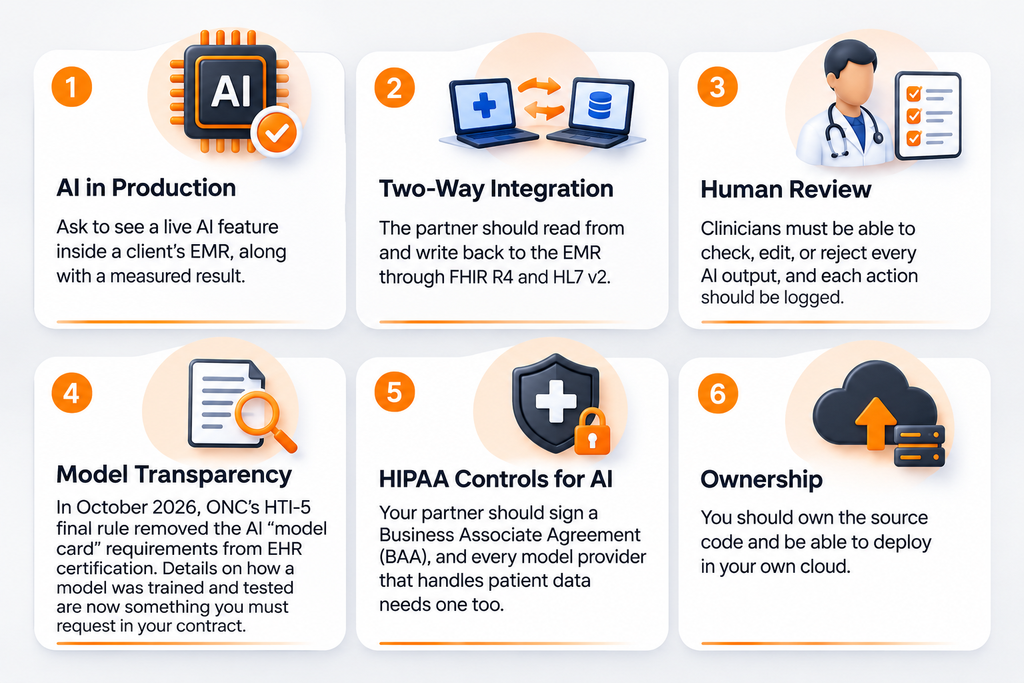
- AI in production: Ask to see a live AI feature inside a client’s EMR, along with a measured result.
- Two-way integration: The partner must be able to read data from and write data into the EMR using the FHIR R4 and HL7 v2 protocols. Integration of the AI tool through FHIR into the EMR will keep all information in one record rather than a separate supplementary system.
- Human review: The clinicians should be able to validate and adjust each AI result, and any of their actions should be logged.
- Model transparency: In October 2026, ONC’s HTI-5 final rule removed the AI “model card” requirements from EHR certification. Details on how a model was trained and tested are now something you must request in your contract.
- HIPAA controls for AI: The partner must put a Business Associate Agreement in place, as well as the model provider for processing personal information in every case.
- Ownership: Source code ownership needs to be in your control, along with the possibility of running it in your own cloud environment.
A respected electronic medical record (EMR) software development agency will handle all of these points on the basis of factual information.
Top 10 EMR Software Development Companies for AI-Powered Clinical Workflows in 2027
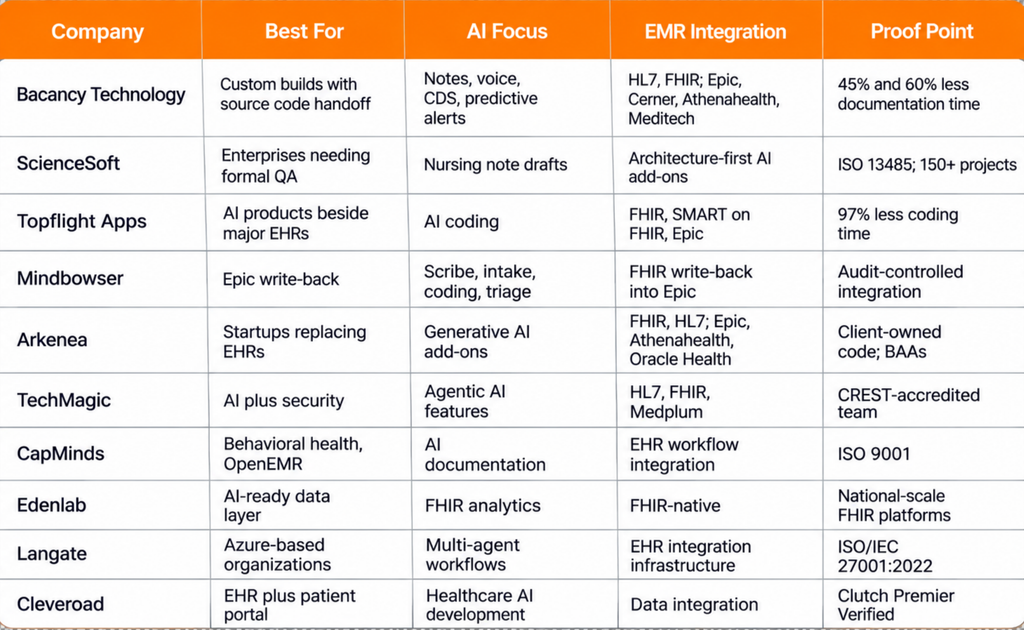
The organisations mentioned below have been analysed based on their services and case studies till November 2026, with the help of the above-mentioned six criteria. The table mentions each organisation’s strengths, AI technology, level of EMR integration, and proof points for AI-Powered Clinical Workflows.
1. Bacancy Technology
Bacancy Technology is an AI-powered consulting and enterprise software development partner for AI, Data, Healthcare, and Finance. Since 2011, 500+ enterprises across 30+ countries have trusted its 1,050+ engineers, and the company is ISO/IEC 27001:2022 certified. Bacancy builds custom EMR systems and adds AI to the EMR you already run. Its forward deployed engineers work inside your systems, data, and security rules. You can bring in one engineer or a dedicated pod with a named lead.
- Best for: Ideal for service providers, specialty clinics, hospital systems, and healthcare technology organizations which want their own AI-enabled EMR where they have full ownership along with transfer of source code and zero dependence on the SaaS version.
- AI strength: Clinical workflow automation, speech to documentation system, clinical decision support, predictive analysis, and alerts for drug interactions and allergies. Review is done by clinicians in crucial stages while making decisions and every action is tracked in an audit trail.
- EMR integration: Interoperability in real time through HL7 and FHIR with Epic, Cerner, Athenahealth, and Meditech systems. It also interfaces with LIS and RIS.
- Proof: Bacancy Technology created an AI-supported EMR that brought down documentation time for therapists by 45% at a mental healthcare network. An EMR that was customized to a hospital with multiple specialties cut down documentation time by 60% without any loss of crucial data at migration stage.
2. ScienceSoft
ScienceSoft has been working in the field of healthcare information technology since 2005 and has claimed its involvement with artificial intelligence technology since 1989. The company is certified according to ISO 13485 standard, which is important for software related to medical devices. The company claims that it has completed more than 150 healthcare projects. Before adding AI to the custom electronic health record (EHR), the company reviews the existing architecture to make sure that it is ready for such augmentation.
- Best for: Enterprises and product companies looking for an experienced partner with proper quality procedures.
- AI strength: AI for nurse’s records that transforms dictations into drafts and finds obsolete or inconsistent information for review.
3. Topflight Apps
Topflight Apps is based in Irvine, California, and builds digital health products and AI tools that work alongside major EHRs. Its integration work covers FHIR, HL7, and SMART on FHIR. The team integrated patient and provider apps with Epic for an Orange County hospital. Its GaleAI claims 97% faster coding and 15% higher revenues thanks to increased coding accuracy.
- Best for: Medical technology firms that incorporate AI products into Epic, Cerner, or Athena systems.
- AI strength: AI-based coding of medical procedures, enhanced by applications for patients and physicians.
4. Mindbowser
Mindbowser focuses on bringing AI into existing EHR workflows rather than running it in a separate tool. Its AI EHR integration service uses prebuilt FHIR pipelines with policy-controlled write-back into Epic. Audit controls are part of the design. The approach is built to keep patient data inside your security boundary.
- Best for: Organizations using Epic that need AI-derived findings to be documented back into the chart, such as EMR integration of ambient AI scribe.
- AI strength: Scribe, patient intake, coding, and triage workflow automation.
5. Arkenea
Arkenea has worked within the healthcare industry since 2011, and its generative AI services are based on more than a decade of expertise in developing electronic health record (EHR) systems. Integration with EHR systems is done using FHIR and HL7, and the company has experience integrating with Epic, Athenahealth, and Oracle Health. Arkenea signs Business Associate Agreements (BAAs) with customers, and customers own the code developed by Arkenea.
Best for: Healthcare startups and clinics looking to switch from an onerous out-of-the-box EHR system.
- AI strength: Generative AI abilities incorporated into healthcare software without having to rewrite the entire thing.
6. TechMagic
TechMagic has been building healthcare applications since 2014, developing custom Electronic Health Records (EHR) and Electronic Medical Records (EMR) for providers in America and Europe. TechMagic implements HL7 and FHIR APIs and builds custom FHIR systems on Medplum platform. Their engineers accredited in CREST can build secure pipelines for Large Language Models in healthcare using PHI-safe architecture.
- Best for: Health tech organizations that need AI engineering together with cybersecurity provided by one team.
- AI strength: Agentic AI functionality for telemedicine, remote patient monitoring, EHRs.
7. CapMinds
CapMinds offers AI documentation services alongside EHR development, integration, and OpenEMR support. Its documentation work is designed to fit into existing EHR workflows. The team works with speech tools such as AWS HealthScribe, Azure AI Speech, and Whisper.
Best for: Behavioral health groups and practices on open-source EMRs.
- AI strength: AI clinical documentation built on source-grounded AI with clinician review.
8. Edenlab
Edenlab is a FHIR-first engineering company known for its Kodjin FHIR data platform. It builds FHIR-native applications and data repositories. Edenlab has delivered FHIR platforms for national health information exchanges, provider networks, and payers in several countries. That scale of FHIR work gives it depth in complex data exchange across many systems.
- Best for: Organizations that need clean and structured data before implementing AI solutions.
- AI strength: AI-capable data layer with analytics capability for conversation queries without using SQL.
9. Langate
Langate, which was founded in 1996, has an artificial intelligence unit known as Nextigent AI that deals with agentic automation in the healthcare industry. Langate is a Microsoft Gold Partner in Azure AI and has ISO/IEC 27001:2022 certification. Langate created the cloud infrastructure, data pipelines, and APIs to allow for integration with a third-party EHR platform for a healthcare AI startup.
- Best for: Organizations built on Microsoft Azure.
- AI strength: Multi-agent workflow design for revenue cycle, scheduling, and documentation, which makes it a fit for clinical workflow automation.
10. Cleveroad
Cleveroad was founded in 2011 and specializes in EHR, EMR, and portal creation, among others including telemedicine and health care data integration services. Cleveroad has a Clutch Premier Verified status. Cleveroad’s EMR projects include data integration in clinical systems. Same as all the vendors listed here, ask for live AI demonstration in an EMR before working together.
- Best for: Companies looking for integrated EHR and simultaneously developed patient portals.
- AI strength: Healthcare software development with AI incorporated into the practice.
Challenges in Implementing AI-Powered EMR Systems
The development of the AI EMR involves as many processes as the software development. Many problems occur once you start implementing AI after the pilot stage when AI works with actual clinical volumes. Be prepared for the following four problems:
- Poor workflow fit: AI that complicates your workflow will not be used no matter how accurate it is. Involve clinicians right from the beginning since the AMA discovered that 85% of physicians want their input regarding adopting AI.
- Read-only integrations: When AI does not provide write-backs to the EMR, clinicians will copy-and-paste the results that may lead to mistakes.
- Weak governance: Since HTI-5 got rid of model card requirements from certification, you have to develop your own policies for testing, monitoring, and approving AI outcomes.
- Patient data exposure: Every AI vendor participating in the data flow should have Business Associate Agreement and data usage restrictions.
Conclusion
The ideal AI EMR partner isn’t the one who boasts the most features; it’s the one who demonstrates the workings of AI within the EMR system, documents the output back to the EMR, and ensures all actions remain under the complete control of the clinician.
Start with your existing workflow. For needs like ambient note-taking, code generation, or AI clinical decision support, use the six criteria above to analyse your partner companies and request proof. AI-Powered Clinical Workflows are only going to work if they fit your workflow.
.