
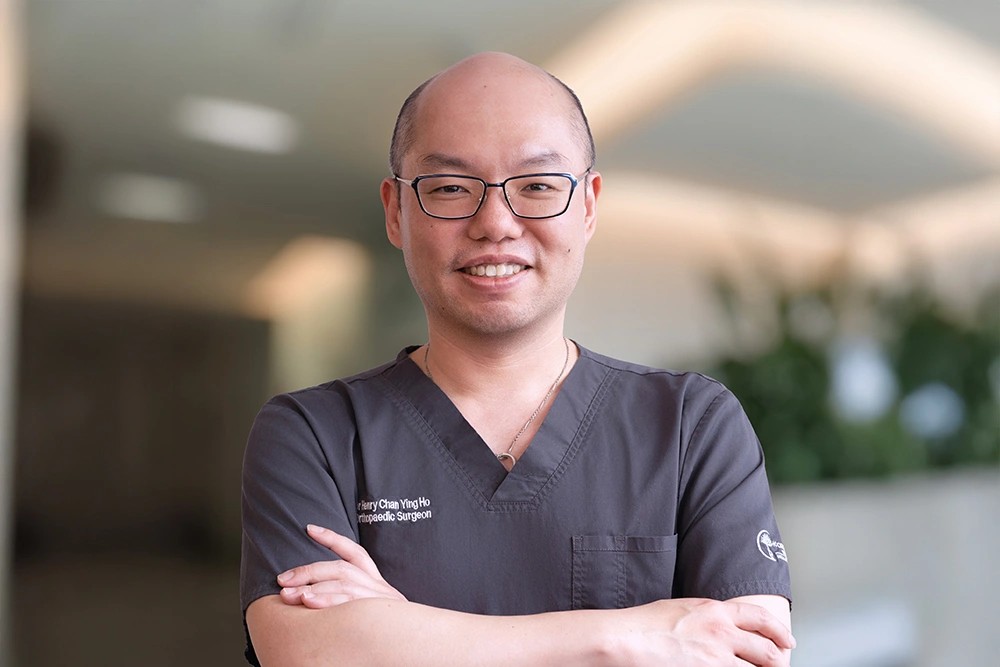
Dr Henry Chan Ying Ho is a Singapore orthopaedic surgeon whose work centres on hip and knee replacement, from first-time operations to complex revision surgery. He is the Medical Director and a Senior Consultant Orthopaedic Surgeon at HC Orthopaedic Surgery, and previously led the Joint Replacement Unit in the Department of Orthopaedic Surgery at Tan Tock Seng Hospital.
His career combines three threads: hands-on surgical practice, published clinical research, and teaching surgeons in Singapore and across Southeast Asia and India. This profile looks at each.
Training and experience
Dr Chan trained in Singapore and in Germany, and completed his specialist training in Singapore’s public hospital system.
| Year | Milestone |
| 2004 | MBBS, National University of Singapore |
| 2008 | MRCS, Royal College of Surgeons of Edinburgh |
| 2009 | MMed (Orthopaedic Surgery), National University of Singapore |
| 2013 | FRCS (Orthopaedic Surgery), Royal College of Surgeons of Edinburgh |
| 2014 | Revision Hip and Knee Arthroplasty Fellowship, Helios Endo-Klinik, Hamburg, Germany |
| 2014 onwards | Joint Replacement Unit, Department of Orthopaedic Surgery, Tan Tock Seng Hospital, which he went on to lead |
| 2017 | Founded HC Orthopaedic Surgery |
His fellowship at the Helios Endo-Klinik was supported by a Health Manpower Development Plan (HMDP) scholarship from Singapore’s Ministry of Health. The Hamburg centre focuses on hip and knee reconstruction and handles a large volume of revision cases, where a previous joint replacement has worn out, loosened, or become infected.
According to his clinic, Dr Chan has performed more than 1,000 computer-navigated joint replacements since 2013.
Areas of expertise
Dr Chan’s main focus is joint replacement using technology that helps the surgeon place implants accurately.
Computer-assisted joint replacement
- Total knee and total hip replacement
- Unicompartmental (partial) knee replacement
- Pinless computer navigation, which guides bone cuts without extra pins in the thigh and shin bones
- Patient-specific instrumentation (PSI), cutting guides made from the patient’s own scans
- Robotic-assisted surgery (MAKOplasty)
Revision and complex reconstruction
- Infected joint replacements
- Fractures around existing implants
- Loose, stiff or unstable replacements, including recurrent hip dislocation
- Persistent pain after joint replacement
General orthopaedics
- Sports injuries such as ligament ruptures and meniscus tears, including arthroscopy
- Adult and children’s fractures and trauma
He consults in English, Mandarin, Cantonese, Hokkien and Malay.
Research and publications
Dr Chan’s published work tackles questions surgeons face in everyday practice, where the evidence is thin.
Knee replacement in ochronosis arthropathy (2019)
In “Total Knee Arthroplasty in Ochronosis Arthropathy: A Case Report and Systematic Review”, published in Case Reports in Orthopedics, Dr Chan and colleagues at Tan Tock Seng Hospital described a 54-year-old man whose knee cartilage and ligaments were found to be stained black during surgery. The cause was alkaptonuria, a rare inherited disorder affecting roughly 1 in 19,000 to 1 in 1,000,000 people.
The team also reviewed 19 published reports covering 26 knee replacements in this condition. In just over half the patients, the diagnosis was only confirmed after surgery. Because the disease appears to have an inflammatory element, the authors suggest a cemented, posterior-stabilised knee replacement with resurfacing of the kneecap. Their patient’s Oxford Knee Score rose from 9 to 40 out of 48 two years after surgery.
Wrist fractures in active older adults (2014)
In “Comparison between cast immobilization versus volar locking plate fixation of distal radius fractures in active elderly patients, the Asian perspective”, published in Hand Surgery, Dr Chan was the lead author. The study followed 75 patients with an average age of 74 for at least 12 months: 35 were treated with a cast, and 40 had surgery with a metal plate.
Patients who had surgery regained wrist movement and grip strength sooner. By six months, however, the difference between the two groups was no longer statistically significant. The findings help older patients and their surgeons weigh the faster early recovery of surgery against the risks of an operation.
Teaching and contribution to the profession
Alongside his practice, Dr Chan teaches surgeons at home and abroad.
- Regional faculty: invited instructor for basic and advanced joint replacement courses in Malaysia, Vietnam, Thailand and India.
- University teaching: Adjunct Assistant Professor, Department of Orthopaedic Surgery, NUS Yong Loo Lin School of Medicine.
- Specialist training: core faculty member of the National Healthcare Group orthopaedic residency programme, which trains Singapore’s future orthopaedic surgeons.
Where Dr Chan practices
Dr Chan sees patients at HC Orthopaedic Surgery, Mount Elizabeth Orchard Medical Centre, 3 Mount Elizabeth, #13-09, Singapore 228510 (tel 6732 8848). He is accredited at Mount Elizabeth, Gleneagles, Farrer Park, Thomson Medical Centre and Parkway East hospitals.
More about his background and clinical interests: Dr Henry Chan at HC Orthopaedic Surgery.
This article is for general information and does not replace a consultation with a doctor.
Sources
- Dr Henry Chan, HC Orthopaedic Surgery
- LYC Medicare, executive officers
- Dr Chan Ying Ho Henry, Mount Elizabeth Hospital
- Lee WC, Tan TL, Chan YH. Total Knee Arthroplasty in Ochronosis Arthropathy. Case Rep Orthop. 2019;2019:1871856.
- Chan YH, Foo TL, Yeo CJ, Chew WY. Cast immobilization versus volar locking plate fixation of distal radius fractures in active elderly patients. Hand Surg. 2014;19(1):19–23.