
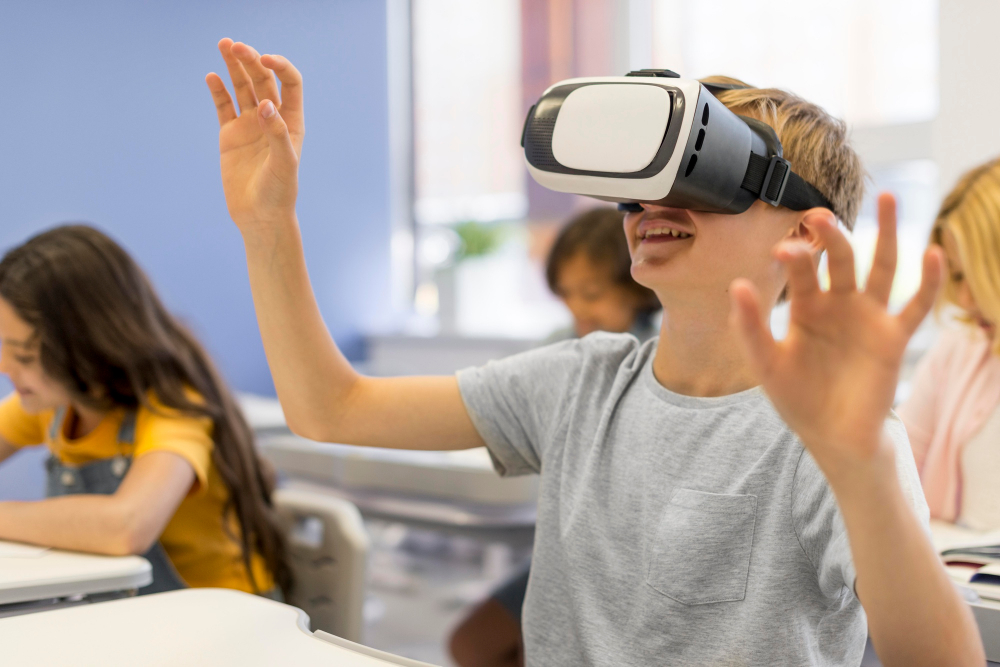
Education is one of the biggest beneficiaries of the ever-evolving technology. From traditional classrooms to online mediums and now to virtual reality (VR), education has embraced technology with open arms.
Today, in addition to reading geography books, students can also visit historical sites while sitting in VR classrooms. Remote students, who generally miss out on a traditional classroom setting, can also benefit from this immersive learning technology.
Besides offering an interactive learning experience, VR classrooms, which were once considered futuristic, are a great way to increase student engagement.
In this blog post, I will explain in detail how VR classrooms offer an interactive learning experience for remote students.
So, let’s get started:
What is Virtual Reality?
VR uses computer-generated simulations to mimic different locations or scenarios in three dimensions (3D). By doing so, it allows us to interact with computer-generated simulations with the help of special headsets and controllers, which are specifically designed to assist our senses.
VR devices can simulate different visuals, auditory, touch, and even motion to mimic scenarios. This way, it offers an immersive learning experience to students. Also, VR is widely used in various industries, such as gaming, construction, healthcare, and entertainment, to name a few.
What are Virtual Reality Classrooms?
It wouldn’t be an overstatement to say that VR brings education to life. VR-based education is a massive step in bridging the gap between theory and learning.
It’s an undeniable fact that online learning has made education more accessible. Remote students can access various online educational platforms, for instance, Coursera, Udemy, or Khan Academy, to learn complex concepts.
However, it is VR that offers a remote learning innovation by allowing students to apply those concepts within a simulated, controlled, and safe environment.
For instance, human anatomy, breaking a nucleus, and engineering, to name a few, are such complex subjects that cannot be learned just by theory, and students might not grasp such concepts without practice.
Here, VR classrooms step in to assist students, who can apply learned concepts in VR simulation and strengthen their knowledge about concepts.
That being said, as VR-based education continues to promote interactive digital learning, the need for a high-speed internet connection remains critical.
Keep in mind that besides the must-have VR gadgets, such as headsets and control sticks, you will also need a top internet connection that meets your VR bandwidth needs. Apart from communicating with your peers remotely in VR, a reliable internet connection also provides a seamless computer-simulation experience.
Fortunately, several platforms are available, for instance, LocalCableDeals, that let you explore different internet service providers (ISPs) and compare plans so you can subscribe to one that meets your needs.
How Effective are VR Classrooms?
In the Cone of Experience theory, Edgar Dale explains that people remember only 10% of the information they read and 20% of what they hear. However, what people practically do and experience can be remembered up to 90%.
This theory emphasizes the importance of VR-based education, as it mainly focuses on experimentation in a safe environment. Another study published in the Journal of Computer-Assisted Learning states that VR-based education boosts student engagement by 30% when compared to traditional learning methodologies.
The above statistics pretty much explain the effectiveness of immersive learning technology. They also highlight the positive impact of metaverse classrooms on student engagement.
Major Advantages of VR Classrooms
VR-based education empowers students to experiment and engage with complex concepts like never before. The immersive learning technology allows students to apply theoretical concepts in a safe environment, which eventually leads to effective learning.
Below, I will explain some major advantages of VR classrooms:
- Increases Student Engagement
Traditional education practices heavily rely on textbooks and demonstrate concepts on a whiteboard. However, VR replaces the whiteboard teaching methodology with more interactive digital learning.
This approach not only increases student engagement but also impacts their learning ability positively.
- Encourages Interactive Learning
Traditional teaching methodologies might bind students within a classroom. They might study ancient Rome or other civilizations, but never explore them. However, VR-based education complements their learning journey as students can virtually visit different places in real-time.
- Ensures a Safe Learning Environment
Textbooks may offer detailed and thorough theoretical knowledge; however, in fields like aviation, healthcare, engineering, etc. where lives are at stake, practice is significant.
With VR-based education, students can engage in different experiments and test their knowledge in different scenarios in a virtual environment. This way, they can safely improve their skillset without risking valuable lives.
- Promotes Creativity
It wouldn’t be wrong to say that VR-based education gamifies textbook learning. The near-perfect simulations of different concepts allow students to brainstorm different possibilities that they might not learn by just reading a textbook.
Additionally, VR classrooms ingrain an element of creativity in students and empower them to think out of the box.
Potential Roadblocks in Establishing VR Classrooms
Many institutions have developed sophisticated frameworks to deliver VR-based education to remote students. However, some major barriers still exist in implementing interactive digital learning across the entire education sector.
Below, I will explain some potential roadblocks in the implementation and wide adaptation of VR classrooms:
- High Cost of VR Classrooms
Developing VR classrooms comes at a cost. Many institutions might not have the capital or resources to integrate this immersive learning technology, unfortunately.
Typical metaverse classrooms are powered by hardware and software. The cost of VR gadgets and software alone can be in thousands of dollars. In addition, creating custom simulations requires technical expertise, such as 3D modeling, development engines, and tools.
Needless to say, institutions also require the constant support of a reliable IT team to monitor, optimize, update, and troubleshoot the operations of VR classrooms.
Lastly, they might also need to modify existing classrooms to add the equipment and make them VR-friendly.
- Lack of Technical Expertise to Design Curriculum
Another major barrier to deploying meta-classrooms is the lack of technical expertise to design a VR-friendly curriculum. Typically, educational institutes create and follow a well-thought-out curriculum.
However, they might need to restructure or redesign it again for immersive learning technology. Institutions might need to simulate different concepts in textbooks to effectively teach students and provide interactive learning experiences.
Unfortunately, most educational institutions lack the in-house expertise and required skills to do it. Most educators might be untrained and have no experience with interactive digital learning.
- Massive Digital Gap Among Students
The digital divide among the student fraternity is an obstacle to the widespread adoption of VR classrooms. The VR technology is evolving at a rapid pace.
And while it’s a positive development, VR hardware and software become obsolete quickly. So, students might need to purchase new equipment to continue their education in metaverse classrooms.
Additionally, beyond the digital divide, low-income groups might not allocate the required space at home for a VR classroom.
The Future of VR Classrooms
Considering how beneficial VR classrooms are for the education sector, their future looks bright. As VR technology evolves and becomes more affordable, it will pave the way for more educational institutions to adopt it.
Similarly, VR-enabled gadgets might also become more affordable and accessible to remote students and lead to better engagement and learning experiences.
Frequently Asked Questions
How can immersive learning technology help in skill-based education?
Based on the respective skill, educators can design different simulations and teach students in a safe, engaging, and immersive environment.
Can metaverse classrooms offer real-time feedback?
Yes, with the help of AI-backed tutors and adaptive learning systems, metaverse classrooms can offer real-time progress and feedback to students.
How can VR-based education help in teaching abstract concepts?
In abstract subjects like chemistry, students can visualize different concepts like molecules or atoms with the help of VR-based education.