
A fire pump is only as dependable as the power behind it. When the utility grid drops out during a storm, a substation fault, or a planned shutdown that runs long, the fire protection system in a high-rise, hospital, warehouse, or data center still has to be ready to deliver water at full pressure. If the fire pump loses power at the wrong moment, sprinklers and standpipes may not perform the way the building’s fire protection design assumes they will.
That is why experienced facility teams treat fire pump power as its own discipline. It is not enough to have a generator on site. The entire chain, from the utility service to the transfer switch to the controller and motor, has to be designed, tested, and maintained so the pump keeps running no matter what happens upstream. This article walks through how facility teams keep fire pump power online during utility outages, including the role of the transfer switch, where the Eaton ATC-300+ automatic transfer switch controller fits in a broader emergency power strategy, and the testing habits that separate ready systems from risky ones.
Why Fire Pump Power Is Held to a Higher Standard
Most building loads can tolerate a brief interruption or a temporary shutdown. A fire pump cannot. It exists to boost water pressure when the municipal supply alone cannot meet the demand of the sprinkler or standpipe system, and it may be called on during the very events that knock out utility power, such as severe weather, earthquakes, or electrical fires.
Because of that, fire pump power is governed by specific code requirements. In the United States, NFPA 20 (Standard for the Installation of Stationary Pumps for Fire Protection) and Article 695 of the National Electrical Code (NEC) set the rules for how fire pumps receive and maintain power. While the details depend on the edition your jurisdiction has adopted, a few principles show up consistently:
- Reliability of the source. The normal power source must be considered reliable. If it is not, an alternate source such as an on-site generator or a second independent utility feed is required.
- Protection that favors running. Fire pump circuits are protected differently from typical motor circuits. Overcurrent devices are sized to let the motor run rather than trip on locked rotor current, because sacrificing the motor is preferable to losing the pump during a fire.
- Dedicated, listed equipment. Transfer equipment serving a fire pump must be listed for fire pump service and is typically located in or next to the fire pump controller.
- Minimal points of failure. Disconnects, routing, and conductor protection are restricted to reduce the chance that something upstream interrupts the pump.
The takeaway for facility teams is simple. Fire pump power is not just another branch on the emergency system. It has its own rules, and the people responsible for it should know which code editions apply to their building and what their authority having jurisdiction (AHJ) expects during inspections.
How the Transfer Switch Keeps the Pump Energized
The automatic transfer switch (ATS) is the hinge point between normal and emergency power. When it works as designed, an outage is little more than a few seconds of transfer time. When it does not, the fire pump can sit idle even with a perfectly healthy generator running outside.
During a typical utility outage, the sequence looks like this:
- The controller senses that normal power has dropped below acceptable voltage or frequency limits.
- After a short programmed delay, which filters out momentary dips, it signals the generator to start.
- Once the generator reaches stable voltage and frequency, the switch transfers the load to the emergency source.
- When utility power returns and stays stable for a set period, the switch transfers back, and the generator runs through a cooldown before shutting off.
Each of those steps depends on accurate sensing and well-chosen time delays. Delays that are too short can cause nuisance transfers during brief utility flickers. Delays that are too long leave the pump without power for longer than necessary. Getting these settings right, and documenting them, is one of the most important things a facility team can do.
Where the Eaton ATC-300+ Automatic Transfer Switch Controller Fits
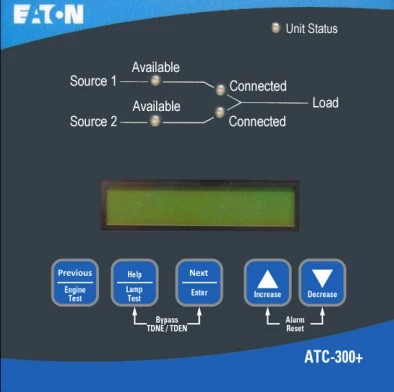
The brain of a modern transfer switch is its controller. The Eaton ATC-300+ automatic transfer switch controller is a microprocessor-based, panel-mounted unit designed to replace older relay and solid-state logic panels. It is used across Eaton’s ATC family of transfer switches, including contactor-based, molded case, power breaker, and bypass isolation designs, which makes it a familiar sight in emergency and standby power rooms.
Features that matter most to facility teams include:
- Dual source monitoring. The controller watches line-to-line voltage and frequency on both Source 1 (utility) and Source 2 (generator), and it can be set up for single-phase or three-phase systems from 120 to 600 volts at 50 or 60 Hz.
- Protective sensing. It detects undervoltage, overvoltage, underfrequency, overfrequency, phase rotation problems, and voltage unbalance or phase loss.
- Field-programmable time delays. Seven adjustable delays let teams tune engine start, transfer, retransfer, and cooldown timing to the site.
- Pre-transfer signaling. Pre-transfer contacts can alert elevators, drives, or other equipment before a transfer occurs.
- Built-in diagnostics. An LCD supports programming, system diagnostics, and help messages, which shortens troubleshooting during a stressful event.
One important caution applies here. A transfer switch that directly serves a fire pump must be listed for fire pump service, and fire pump transfer equipment is often integrated with the fire pump controller itself. Many facilities rely on the ATC-300+ to manage transfer switches that feed the broader emergency and life safety distribution, such as the generator path, egress lighting, and supporting loads, while a separate listed fire pump transfer switch handles the pump. Before specifying, replacing, or reprogramming any transfer equipment tied to a fire pump, confirm the listing and arrangement with the equipment manufacturer, your engineer of record, and the AHJ.
Whatever role the controller plays at your site, the same habits apply. Record every setpoint, keep a copy of the programming at the switch, and review the controller’s diagnostic and status information after each outage or test so small problems are caught before they become big ones.
Generator and Fuel Readiness
A transfer switch can only move the pump to a source that is ready to carry it. Fire pump motors draw a large inrush current on startup, so the generator has to be sized to start the pump while also carrying any other loads already on the emergency system.
Facility teams keep the generator side ready by focusing on a few essentials:
- Correct sizing. Confirm the generator can start and run the fire pump motor without excessive voltage dip, especially if other large motors could start at the same time.
- Fuel on hand. Keep fuel levels at or above the required minimum, track consumption during tests, and have a delivery contract that holds up during regional emergencies.
- Fuel quality. Diesel degrades over time. Periodic sampling, filtration, and water removal help prevent clogged filters during a long outage.
- Batteries and chargers. Starting batteries are a leading cause of failed generator starts. Inspect terminals, test battery health, and verify the charger is working.
- Cooling and block heaters. Make sure coolant levels are correct, and block heaters are energized so the engine can accept load quickly in cold weather.
Testing and Maintenance Routines That Prevent Surprises
The most reliable fire pump power systems are the ones that get exercised regularly. Testing is not just a compliance task. It is how teams find weak batteries, sticky contacts, incorrect settings, and wiring issues while the building is not on fire.
NFPA 25 covers inspection, testing, and maintenance of fire pumps, and NFPA 110 covers emergency generators and their transfer switches. Exact intervals vary by edition and local adoption, but a typical program includes:
- Routine pump runs. Fire pumps are run on a set schedule, often weekly or monthly depending on the pump type and code edition, while staff check pressures, motor condition, and controller alarms.
- Monthly generator exercise. Generators are run under load on a regular schedule so the engine, fuel system, and transfer equipment all see real operating conditions.
- Annual flow test. The pump is tested at rated flow to confirm it still meets its performance curve.
- Annual transfer test. Normal power is interrupted, either by opening the normal source or simulating a failure, to confirm the pump transfers to the alternate source, starts, and runs. The transfer back to normal power is verified as well.
- Infrared and torque checks. Thermal scans and connection inspections catch loose lugs and overheating terminals in the transfer switch and controller.
Good documentation ties it all together. Log each test with dates, run times, readings, and any alarms. When an inspector or insurer asks for records, a clean log shows the system is being cared for, and it gives technicians a baseline to spot trends.
Common Failure Points Facility Teams Watch For
When fire pump power fails during an outage, the cause is rarely dramatic. More often, it is a small issue that went unnoticed. Experienced teams keep a close eye on:
- Switches left in the wrong position. A transfer switch or controller left in manual, test, or off after maintenance will not respond automatically when it matters.
- Open disconnects. A disconnect that was opened for service and never closed can isolate the pump from one or both sources.
- Drifting or undocumented settings. Time delays or pickup and dropout values changed during troubleshooting and never restored can cause late transfers or nuisance operation.
- Phase rotation errors. After utility work or generator replacement, a reversed phase sequence can cause the pump to run backward or the controller to refuse the source.
- Dead control power. Controllers need control power to sense and act. A failed control transformer or fuse can leave the switch blind.
- Aging contacts and mechanisms. Wear, dust, and heat degrade switching components over time, which is why regular exercise and inspection matter.
A simple walk-down checklist after any maintenance work, confirming that every switch, selector, and disconnect is back in its normal position, prevents many of these problems.
Building an Outage Response Plan
Equipment is only half of readiness. The other half is people knowing what to do when the lights go out. A written outage response plan gives staff a clear script instead of leaving them to improvise.
An effective plan typically covers:
- Roles and contacts. Who checks the fire pump room, who monitors the generator, and who calls the electrical contractor, fuel supplier, and fire alarm company.
- Verification steps. Confirm the transfer switch has moved to emergency power, the fire pump controller shows power available, and no trouble alarms are active.
- Fire watch triggers. Define when the system is considered impaired and when a fire watch or notification to the fire department and insurer is required.
- Fuel and runtime tracking. Estimate how long the generator can run on current fuel and when to call for a delivery.
- Return to normal. Confirm a clean retransfer to utility power, reset any alarms, and record the event in the maintenance log.
Practice the plan at least once a year, ideally alongside the annual transfer test. Drills reveal gaps, such as a locked door to the pump room or a phone number that is out of date, that are much easier to fix on a calm day.
Frequently Asked Questions
Does a fire pump always need a generator? Not always. If the utility source is considered reliable under the applicable code and the AHJ agrees, a single source may be acceptable. Otherwise, an alternate source such as a generator or a second independent utility feed is required.
Can any automatic transfer switch serve a fire pump? No. A transfer switch serving a fire pump must be listed for fire pump service. Standard emergency or standby transfer switches do not meet that requirement on their own.
What does the Eaton ATC-300+ automatic transfer switch controller do? It monitors voltage and frequency on both power sources, decides when to transfer, controls programmable time delays, and provides diagnostics through an LCD. It serves as the control logic for Eaton ATC series transfer switches.
How often should the transfer to emergency power be tested? Most programs perform a full transfer test at least once a year, with regular generator exercise in between. Follow the editions of NFPA 25 and NFPA 110 adopted in your jurisdiction.
Why does the fire pump circuit not trip like other motor circuits? Fire pump overcurrent protection is designed to let the motor keep running under conditions that would normally trip a breaker. Losing the motor is considered less harmful than losing fire protection.
What should staff check first when utility power fails? Confirm the transfer switch has moved to emergency power, the fire pump controller shows power available, and the generator is running without alarms.
How long can a fire pump run on generator power? That depends on fuel storage, generator load, and consumption rate. Teams should know their estimated runtime in advance and have a fuel delivery plan for extended outages.
Keeping Fire Protection Ready When the Grid Is Not
Utility outages are inevitable, but losing fire pump power during one does not have to be. Facility teams that keep pumps online share a common approach. They understand the code requirements behind fire pump power, they use dependable transfer equipment with clearly documented settings, and they keep generators and fuel ready to carry the load.
Most of all, they test. Regular pump runs, generator exercise, annual transfer tests, and post-maintenance walk-downs turn a complex system into a predictable one. Whether your site relies on an Eaton ATC-300+ automatic transfer switch controller across its emergency distribution or a dedicated fire pump transfer switch at the pump itself, the goal is the same: when the power goes out, the water keeps flowing. Partner with qualified electrical and fire protection professionals, keep your records current, and treat every test as a rehearsal for the day it really counts.