
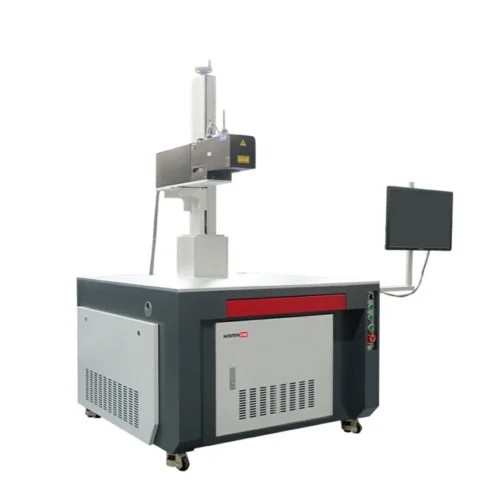
By applying Direct Part Marking (DPM) to the product, manufacturers can easily identify products throughout the entire product life cycle. Makes permanent marks on component surfaces. These are generally used to contain serial numbers or barcodes and/or product information. DPM marks do not become detached from the original part, like printed labels. They contribute to traceability, quality control, and are compliant with regulations. DPM is beginning to be used more by industries to increase the identification rate. With the knowledge of the available marking methods, businesses can use an appropriate solution.
Direct Part Marking – What is it?
Direct Part Marking is an identification marking process that applies identification marks directly on parts. These marks may take the form of text, logos, QR, and/or Data Matrix codes. DPM finds application in a variety of manufacturing sectors such as automotive, aerospace, electronics, and medical. A particular identity is assigned to each component chosen to be marked; each identity is uniquely signable. This will allow the monitoring of products up to the point of manufacture.
Laser Marking’s Precision and Versatility
By focusing the light energy, laser marking can produce permanent marks on the surface. Can create detailed characters, codes, and graphics. It can be used with numerous metals, plastics, and some other materials. The dependability depends on the material and type of laser.
Companies assessing the tools must look for a solid laser marking machine manufacturer. It will depend on which system is used, depending on the marking depth, material, and the amount of production. Fiber Laser might be appropriate for metal parts. Some CO₂ and ultraviolet laser beams are more suitable for a particular nonmetallic material. Before the actual production, testing for good marking will assist in ascertaining the quality of the marking.
Dot Peen Marking: Durable Mechanical Identification
Dot peen marking is a process that forms characters by using controlled impacts. The marking pin bounces on the surface of the component. These impacts make letters, numbers, and codes that are readable to a machine. It is especially helpful in creating metallic parts and components.
Deep and lasting signs can be created using dot peen systems. They are appropriate for parts that are exposed to challenging industrial environments. They are used by manufacturers to produce parts for heavy vehicles and vehicles in general. However, in the impact process, noise and surface deformation will occur. The setting and hardness of materials are also important in marking/setting.
Inkjet Marking: Fast, Contactless Coding
Industrial inkjet marking uses inkjet printing on the surfaces of components. It is capable of quick printing of dates, batch numbers, and production codes. It is commonly used in the manufacturing industry, such as for packaging materials and in manufacturing lines. It can be used on diverse materials and even surface forms.
It is appropriate to use inkjet marking where there is no need for the image to be permanently marked. To evaluate durability and readability, be sure to check it with manufacturers prior to implementation.
Electrochemical Etching: Marking Conductive Metals
Electrochemical Etching designs by using current and chemistry. The process develops a mark on an ‘electrically conductive surface ‘. Very common for use in stainless steel parts and identification plates for metals.
This technique will allow clear markings without any substantial material removal. It is suitable for applications including parts with detailed identification. The equipment could also be rather small-scale. Yet, it is necessary to have appropriate consumables and attentive handling during the process. Chemical management issues and surface compatibility should continue to be key considerations.
For specialized applications, electrochemical etching could be suitable. Manufacturers should consider its operation and see if there’s any other way.
Selecting the best DPM Method
There are a number of considerations to make when choosing a marking system. One of the initial factors considered is usually difficult material. Determining difficult material is frequently the most critical factor. Different materials like metals, plastics, ceramics, and coatings react differently. The minimal depth of mark will also be a factor in equipment selection.
In mass production, the time it takes to produce a good or service is significant. Businesses should develop an awareness of the need to mark online. Functionalities such as automation can help to increase throughput and decrease handling. It is also important to code so that it’s readable for traceability systems.
To ensure the quality of the marks.
Deciding on appropriate equipment is just one part of successful DPM. Marks should correspond with the material of the made items. The width, height, line gaps, and code size impact the readability. In some applications, surface preparation may help to achieve better results.
Manufacturers will need to ensure codes are scanned with appropriate scanners for confirmation. Early detection of marking defects is possible through regular inspection. Codes can also be automatically checked during production, using automated vision systems. To ensure consistent identification quality, these controls are used. Also, they decrease errors in downstream tracking processes.
Conclusion
Direct Part Marking helps to identify and enables product traceability. There are various types of methods available, and each has its own advantages and disadvantages, including laser, dot peen, inkjet, and electrochemical types of methods. The choice will depend on a variety of factors, including material, durability, production time, and cost. Manufacturers have a way of achieving good results, with a good idea about testing. View more information on solutions and technical solutions for industrial marking, and check resources more useful to your application.