
Charlotte’s resale market is tight and pricey. Here’s why building a custom home on your own lot often beats buying existing — and how to decide.
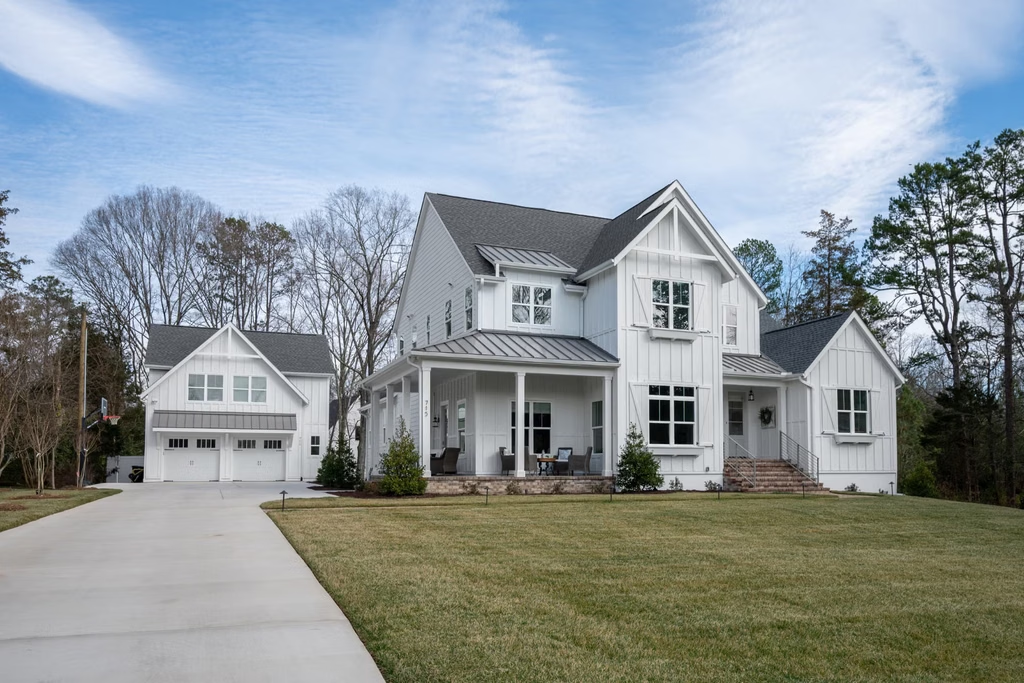
The average Charlotte resale home closes in 27 days. That’s fast enough to force a bad decision. You tour six houses on a Saturday, none of them are quite right, and then Monday morning your agent calls to say the least-bad option already has three offers. This is the resale trap, and a lot of Charlotte buyers keep falling into it year after year.
Building a custom home on your own lot is the alternative most people talk themselves out of before they even look into it. The process sounds complicated, the timeline sounds long, and the cost sounds unpredictable. All three concerns are real, but none of them are as big as people assume once you have the right builder and understand what the process actually looks like.
Here’s a concrete comparison followed by the framework you need to decide which path actually makes sense for your situation.
What Charlotte’s Housing Market Is Actually Telling You
Charlotte is one of the fastest-growing cities in the country right now. Between 2020 and 2025, the 14-county Charlotte metropolitan region added 289,331 residents, pushing the total population past three million people, according to 2025 census data published by the Charlotte Urban Institute at UNC Charlotte. That’s not a blip. It’s structural, long-term demand.
The median home price in the Charlotte market rose from $429,945 in September 2024 to $443,850 in September 2025, a year-over-year increase of 3.24%, per UNC Charlotte’s 2025 State of Housing Report. That steady appreciation matters because it changes the math on a custom build. When the resale market keeps climbing, paying a premium to get exactly what you want on land you already own starts looking less like a luxury and more like a sensible hedge.
The broader inventory story also favors building. Resale supply in Charlotte is competitive, median days-on-market have ticked up slightly, but well-located lots in desirable suburbs still represent real value if you know what to do with them.
The Resale vs. Build-on-Lot Reality Check
Most people assume resale is cheaper. That assumption deserves scrutiny. A resale home at $450,000 in a Charlotte suburb rarely comes configured the way you actually want it. The kitchen is 12 years old. The primary suite is smaller than what you’d spec. The lot is 6,200 square feet with neighbors close enough to smell their grill on a Saturday. So you buy it and spend another $60,000 on renovations that still don’t get you all the way there.
A build-on-lot project starts from your priorities, not someone else’s. You pick the floor plan, you adjust the rooms, you decide how the covered porch faces. The timeline is longer, typically 9 to 18 months depending on design complexity, but you end up in a home that fits rather than one you’re perpetually accommodating.
This is where quality builders operating in the on-your-lot space, like luxury new construction homes in Charlotte, NC by Classica Homes, distinguish themselves from production builders. You’re not choosing from a fixed menu. You’re working through a design process measured in months, not weekends, with architects and builders who adjust the plan to your land and your life.
The LSDB Framework: Four Questions That Tell You Which Path to Take
Deciding between resale and a custom build doesn’t require a spreadsheet with 40 lines. It requires honest answers to four questions. I call this the LSDB test: Land, Specificity, Duration, Budget.
- Land: Do you own a lot, or is there one in a neighborhood you’d genuinely love that you could acquire? If yes, the foundational cost of a build-on-lot project is already resolved or resolvable.
- Specificity: Are your requirements specific enough that no resale home in your target area is likely to satisfy all of them? If you want four bedrooms, an oversized garage, a covered outdoor living room, and a primary suite on the main floor, that combination exists in resale maybe once a year in your zip code.
- Duration: Do you plan to live there for at least seven years? The upfront friction of a custom build amortizes across time. Buyers who plan to sell in three years should probably take the resale path.
- Budget: Can your budget absorb design and construction costs without requiring you to carry two significant housing payments simultaneously? This is the one most people underestimate — not the build cost itself, but the overlap period.
If you answer yes to Land, yes to Specificity, yes to Duration, and yes to Budget, a custom build is almost certainly the better decision. If two or more answers are no, resale starts making more sense. Most buyers who walk through the LSDB test discover they’re more buildable than they thought.
What You Actually Get With New Construction
Beyond customization, new construction carries structural advantages that resale can’t match. Everything is under warranty. The mechanical systems are current. The insulation, windows, and HVAC are built to today’s standards, which matters for both comfort and utility costs over a 10-year horizon.
New construction homes are also getting smarter about square footage. According to the U.S. Census Bureau’s 2025 Characteristics of New Housing report, the median size of a completed single-family home nationwide was 2,142 square feet — a deliberate shift toward efficient design rather than excess square footage. The Census Bureau’s 2025 Characteristics of New Housing data also shows that 63% of new homes in the South now use a heat pump system, reflecting a shift toward more efficient, lower-operating-cost builds that owners of older resale homes rarely get without a costly retrofit.
This is a meaningful shift. Builders are designing for how people actually live. Larger great rooms, smaller formal spaces that nobody uses, and covered outdoor areas that function as an extension of the interior rather than an afterthought.
A Practical Pre-Build Checklist for Charlotte Buyers
If you’re leaning toward the build-on-lot path, work through this before you do anything else:
- Pull the zoning and setback requirements for your lot from Mecklenburg County or the relevant municipality. This tells you the buildable envelope before a builder draws a single line.
- Get a topographic survey. Slope, drainage, and tree positions directly affect your floor plan options and your foundation cost.
- Confirm utility connections: water, sewer, gas, and power. Rural lots sometimes require well and septic, which adds cost and timeline.
- Set a realistic contingency. A 10% to 15% contingency on the construction budget is not pessimism; it’s standard practice.
- Interview at least two builders. Ask specifically about their process for on-your-lot projects, their average timeline from design to move-in, and whether they do fixed-price contracts.
- Walk their model homes before you commit. You want to see how they finish a trim detail and how a floor plan flows before you trust them with yours.
The Confidence Factor Nobody Talks About
There’s a psychological dimension to this decision that the financial comparisons miss. When you buy a resale home in a competitive market, you’re always accepting trade-offs under time pressure. You waive inspection, you skip the negotiation, you close fast and figure out the surprises later.
Building custom does the opposite. You spend months making deliberate choices. The ceiling height, the cabinet style, the orientation of the primary bedroom window. By the time you move in, there are no surprises because you made every decision yourself. Buyers who go through a full custom build almost universally report that the process, while demanding, leaves them with a level of confidence in their home that a resale purchase never could.
“Promises always kept,” is how one Classica homeowner in Charlotte summed up their build-on-lot experience — a short phrase that says everything about what separates a builder worth trusting from one who isn’t.
Charlotte’s population is still growing, resale competition isn’t disappearing, and the gap between what existing homes offer and what today’s buyers actually want keeps widening. If you own a lot or have one in mind, this market rewards those who build rather than settle. The question isn’t whether building is possible. It’s whether you’re ready to stop compromising.
| Decision Factor | Resale Home | Build on Your Lot |
| Design control | None — take it as-is | Full — every room your choice |
| Timeline to move-in | 30 to 60 days after contract | 9 to 18 months from design start |
| Mechanical systems | Variable age and condition | New, under full warranty |
| Renovation surprises | Common and costly | Rare — you built it from scratch |
| Fit to your lifestyle | Compromise is the norm | Designed around your actual needs |
| Best for | Buyers with flexible preferences and short horizon | Buyers with specific needs and 7+ year plans |