
Learn what causes post tensioning tendon corrosion, how to spot the warning signs early, and which inspection methods protect your concrete structure.
Post-tensioning tendon corrosion is one of the few structural problems that can advance for years without showing itself on the surface. The strands sit inside ducts, wrapped in grout and sealed at each end, so the damage happens out of sight while the concrete above looks sound. Nearly every case traces back to the same starting point: water and chlorides reaching high-strength steel through a gap in the protection system. Understanding where those gaps form, what warning signs appear first, and how inspections confirm internal condition gives owners a realistic way to manage the risk.
What Causes Post Tensioning Tendon Corrosion?
Post-tensioning tendon corrosion is caused by moisture and chlorides reaching the prestressing strand after the grout, duct, or anchorage protection has been breached. Grout voids left during installation, cracked or leaking ducts, poorly sealed anchorages, and failed end caps all create a path for water. Once that water carries chlorides from de-icing salts or a marine environment, the steel begins to lose section under permanent tensile stress, which accelerates the damage compared with ordinary reinforcement.
Finding those breaches before they matter is the hard part for owners, because the evidence sits inside the duct rather than on the surface. Specialty contractors such as Freyssinet USA approach this through post tensioning inspection services that pair a records review with nondestructive screening and direct viewing of the grout and strand. The aim is to work out which tendons are holding water now, not to open every duct in the structure.
How Do Grout Voids Expose Strands to Moisture?
Grout voids expose strands because the missing grout leaves an open pocket where air and water collect against bare steel. Voids form when grout bleeds, settles, or fails to fill high points in a draped tendon profile, and they tend to concentrate at the crown of the duct and just behind anchorages. A void by itself does not corrode steel, but it becomes a reservoir as soon as water finds its way in through a crack, a vent, or a leaking grout cap.
Why Are Chlorides so Damaging to Prestressing Steel?
Chlorides break down the passive film that alkaline grout and concrete normally maintain around steel, which lets localized pitting start even when the overall environment still looks protective. De-icing salt runoff on bridge decks and airborne salt in coastal areas are the two common sources. Pitting matters more on a tendon than on rebar because the loss of metal is concentrated in small spots rather than spread out, so a strand can lose a large share of its capacity at one cross section.
Where Do Anchorages and End Caps Fail First?
Anchorages and end caps are usually the first components to let water in, since they sit at the ends of the tendon where the protection system has the most joints. Grout caps can crack, gaskets dry out, and the pocket concrete placed over the anchor head often cures with shrinkage cracks. Water entering at an anchorage also tends to travel along the duct, so a small end detail failure can feed corrosion well inside the structure.
How Does Tendon Corrosion Differ From Ordinary Rebar Corrosion?
Tendon corrosion differs from rebar corrosion because the steel is stressed, stronger, and hidden inside a duct instead of being embedded directly in concrete. Corroding rebar expands and cracks the cover, which gives inspectors a visible signal. A corroding tendon can stay sealed inside its duct and give almost no surface evidence until a strand or a full tendon fails.
What Makes High-Strength Strand Vulnerable to Stress Corrosion and Hydrogen Embrittlement?
High-strength prestressing steel is drawn to a hardness that makes it sensitive to cracking mechanisms that mild steel shrugs off. Under sustained tension, a pit can act as a crack starter and propagate through the wire, a process known as stress corrosion cracking. Hydrogen embrittlement works differently: hydrogen produced by the corrosion reaction diffuses into the steel and reduces its ability to deform, so wires snap in a brittle manner with no necking and no warning.
Why a Single Strand Break Matters in a 4 to 37 Strand Tendon
A single broken strand removes a measurable share of the force a tendon delivers, and post-tensioning tendons are not built with spare capacity. In a tendon of 4 to 37 strands, one failure can reduce the effective prestress by several percent, and the conditions that broke the first wire usually affect neighboring wires in the same wet pocket. Progressive loss within one tendon is the pattern that concerns engineers, not the first break on its own.
Which Structures Face the Highest Risk of Tendon Corrosion?
The highest risk sits with structures that combine sustained moisture exposure, chloride sources, and tendon details that are hard to inspect. Bridges in salted or coastal environments, segmental decks with many joints, and parking garages subject to years of salt carried in on vehicles top the list. Age plays a role as well, since older grouting practices and end-cap details were less developed than current ones.
Bridges, Segmental Decks, and Coastal Exposure
Bridges carry the greatest consequence if a tendon fails, and their exposure is the harshest. Deck drainage that leaks onto anchorage zones, expansion joints that pass chloride-laden water into the box girder, and salt spray on coastal spans all concentrate moisture where tendons terminate. Segmental construction adds many joints between precast units, and each joint is a potential path into a duct.
What Puts Parking Garages and Post-Tensioned Slabs at Risk?
Parking garages are at risk because vehicles bring salt and slush directly onto post-tensioned slabs, and those slabs often use unbonded tendons with greased sheathing rather than grouted ducts. Damaged sheathing, drilled or saw-cut penetrations, and standing water at low points give chlorides a route to the strand. Anchorage pockets along slab edges are a frequent trouble spot, since a cracked patch over the anchor head lets water reach the wedges.
What Are the Warning Signs of a Corroding Tendon?
The warning signs are usually indirect: rust staining at anchorage pockets, cracked or bulging patch material, water seepage from grout vents, and localized cracking that follows a tendon line. In unbonded systems, a loud report during quiet hours or a small cone of blown-out patch material can mean a strand released. Because these signs are subtle, an owner who relies only on casual walkthroughs will often miss the early stage.
Which Visual Indicators Should Owners Track?
Owners should track rust bleeding at anchor pockets, efflorescence and staining along duct alignments, cracked grout caps, wet or discolored soffits, and any spalling near tendon ends. Documenting the location and growth of these features from one inspection to the next matters more than any single observation. A stain that expands over two inspection cycles is a stronger signal than a larger stain that has not changed in a decade.
How Do Inspection Methods Confirm Internal Condition?
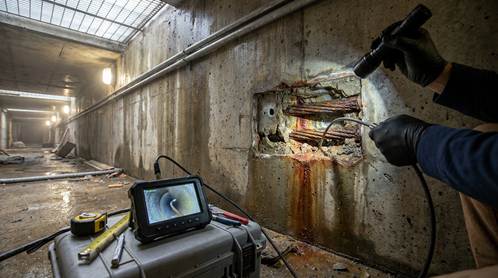
Internal condition is confirmed by combining nondestructive screening with limited openings. Impact echo and ground penetrating radar help locate ducts and suspect voids, borescope inspection through small drilled ports shows the grout and strand directly, and vacuum grout testing evaluates whether a duct holds pressure. Acoustic monitoring adds a continuous layer by recording the energy release of a wire break and locating it along the tendon, which suits structures where access is limited and consequences are high.
How Can Owners Prevent Post Tensioning Tendon Corrosion?
Prevention comes down to keeping water away from tendons and finding breaches before chlorides do their work. That means maintaining deck drainage and expansion joints, repairing cracked anchorage pockets promptly, replacing failed grout caps, and filling documented voids with a corrosion-inhibiting grout. None of this is exotic work, but it needs a schedule and a record, because the failures that surprise owners are almost always the ones no one was tracking.
What Belongs in a Preventive Maintenance Program?
A sound program pairs a tendon inventory with a repeatable inspection routine and a repair backlog that is actually funded. The inventory should record tendon type, profile, anchorage locations, grouting history, and any prior findings. Routine items include cleaning drains, sealing joints, checking and resealing anchorage pockets, verifying grout caps, and re-inspecting locations where voids or water were found earlier.
How Often Should Post-Tensioning Tendons Be Inspected?
Most owners are well served by a visual review every 2 years, aligned with routine bridge or garage inspection cycles, and a detailed tendon investigation every 5 to 10 years depending on exposure and age. Structures in salted or coastal service, or those with a history of voids and water intrusion, justify the shorter interval. After any event that could damage the protection system, such as a vehicle impact, a deck leak, or coring work near tendons, a targeted inspection should follow rather than waiting for the next cycle.
What Owners Should Take Away About Tendon Corrosion Risk
Tendon corrosion is a water management problem before it is a steel problem. The causes are consistent, the locations are predictable, and the tools to evaluate hidden condition are available today. Owners who map their tendons, keep water off anchorages, and schedule real investigations rather than surface glances tend to catch damage while repairs are still simple. The ones who wait usually pay for strand replacement and load restrictions instead.
Frequently Asked Questions About Post Tensioning Tendon Corrosion
Can a Corroded Post-Tensioning Tendon Be Repaired Without Replacing It?
Sometimes. If the corrosion is limited to surface rust on strands with no measurable section loss, cleaning the area, restoring grout, and sealing the entry point can stabilize the tendon. Once wires show pitting, cracking, or breaks, engineers generally look at replacing the tendon or adding external post-tensioning to restore capacity.
How Long Does It Take for Tendon Corrosion to Threaten Capacity?
It varies widely with exposure and the amount of water present. A tendon holding standing chloride-rich water in a void can lose wires within a few years, while a small void in a dry interior may cause no measurable damage over decades. The uncertainty is the reason inspection intervals are based on exposure and history rather than age alone.
Does Grout Injection Stop Corrosion Already in Progress?
Grout injection helps, but only if the water source is cut off first. Filling a void with corrosion-inhibiting grout restores the alkaline environment around the steel and removes the space where water can pool. If the cracked anchorage pocket or leaking joint that admitted the water is left unrepaired, the problem returns at the next weak point.
What Does a Post-Tensioning Tendon Inspection Involve?
A typical inspection starts with a records review and a close visual survey of anchorages, ducts, and drainage, performed from scaffolding or hydraulic platforms where access requires it. Screening with impact echo or ground penetrating radar identifies suspect areas, then small ports allow borescope viewing and grout sampling. The result is a condition report that ranks locations by risk and recommends repairs, further testing, or monitoring.