
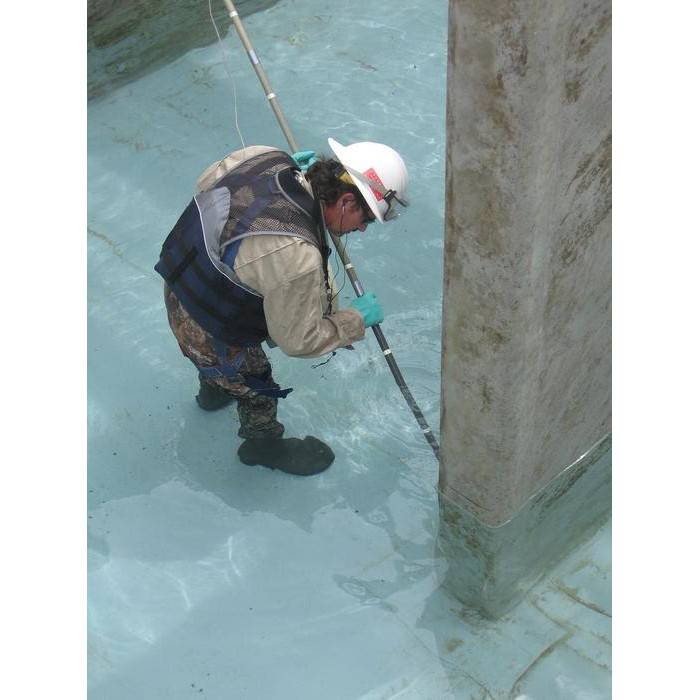
Geomembrane liners are used to contain some of the most consequential materials in modern infrastructure, including landfill leachate, mining process solutions, wastewater, and hazardous chemicals. When these systems fail, the environmental and financial consequences can be severe. Over the past two decades, the electrical leak location survey has moved from a specialty add-on service to something closer to an industry expectation. For engineers, owners, and regulators who take containment seriously, it is increasingly viewed not as optional insurance but as the baseline standard of care.
From Optional Extra to Expected Practice
A generation ago, geomembrane quality assurance relied almost entirely on visual inspection, seam sampling, and non-destructive seam testing methods like air pressure and vacuum box testing. These methods remain important, but they share a critical blind spot. They can only verify what is visible and accessible at the time of testing, which is typically before any protective soil cover or fill material is placed.
The shift toward electrical leak location survey methods happened because engineers and regulators recognized a simple truth: a liner that passes seam testing can still fail if it develops a puncture, tear, or pinhole during the placement of cover soil, drainage stone, or waste. Construction equipment, sharp debris, and even foot traffic can create tiny defects invisible to the eye but large enough to compromise long-term containment.
As electrical leak location technology matured and case studies accumulated showing consistent defect detection even in liners that had passed all prior inspections, the technique earned its place as a core element of construction quality assurance rather than a supplemental extra. Today, many state regulatory programs, engineering specifications, and industry guidance documents reference electrical methods explicitly, and an increasing number of owners will not accept liner installation as complete without one.
How Electrical Leak Location Surveys Work
The underlying principle is straightforward. Geomembranes are excellent electrical insulators. Soil, water, and most liquids stored or contained by these systems conduct electricity readily. By introducing a voltage source across the liner system, either through electrodes placed on the surface, in surrounding soil, or in an overlying water layer, a survey can measure where current passes through the liner. Any point where current flows indicates a breach in the membrane, since an intact geomembrane should block virtually all current flow.
There are several established methods, each suited to different site conditions.
- Water puddle surveys, used on exposed geomembrane before cover material is placed, where a technician moves a probe across the wetted liner surface to identify points of current leakage.
- Water lance surveys, a variation that uses a directed stream of water rather than standing puddles, often used on sloped or textured liner surfaces.
- Dipole surveys, used once soil cover has been placed, in which an array of electrodes is moved across the covered surface to detect anomalies from above.
- Arc testing, a specialized method for detecting defects at pipe penetrations and boots, which are common failure points that other methods can struggle to evaluate.
Each of these approaches allows technicians to detect defects as small as a few millimeters, offering a level of coverage and sensitivity that visual inspection simply cannot achieve, particularly once the liner is no longer exposed.
Why Electrical Methods Have Become the Standard
They Catch What Other Methods Cannot
Seam testing methods like vacuum box and air channel testing are excellent at evaluating the seams themselves, but they say nothing about the condition of the liner sheet away from the seams, and they cannot be used once cover material is in place. Electrical leak location survey techniques close both gaps. They evaluate the entire liner surface, not just the seams, and several methods can be performed after cover soil is placed, which is exactly when many construction-related defects are introduced.
They Provide Objective, Quantifiable Results
Electrical surveys generate data, not just a pass or fail impression from a technician’s visual scan. Survey results include precise coordinates of any anomalies, along with supporting readings that can be reviewed independently. This creates a defensible record that can be referenced during construction closeout, regulatory review, or future disputes.
They Reduce Long-Term Liability
An owner who can document that a liner was verified defect-free at the time of construction has strong protection against future claims that a leak resulted from faulty installation. Conversely, an owner who skipped electrical testing and later discovers contamination has far less ability to demonstrate that reasonable care was taken during construction. Courts, regulators, and insurers increasingly view electrical leak location survey documentation as evidence of due diligence.
They Are Cost-Effective Relative to Failure Costs
The cost of a survey is small compared to the potential cost of remediation, regulatory fines, or facility downtime caused by an undetected leak. For most projects, electrical testing represents a small fraction of overall liner installation cost, yet it can prevent losses that run into the millions of dollars.
Applications Beyond Landfills
While landfill liner systems are among the most well-known applications, electrical leak location surveys are used across a wide range of containment systems.
- Mining heap leach pads and tailings facilities, where liner failures can release process chemicals into surrounding watersheds.
- Wastewater treatment lagoons, where containment failures can affect both groundwater and downstream surface water.
- Potable water reservoirs, where liner integrity protects drinking water supplies from contamination.
- Secondary containment for chemical storage and industrial facilities, where even small leaks can trigger significant regulatory response.
- Floating cover systems, which present unique testing challenges due to the flexible, mobile nature of the cover.
The consistency of the underlying physics, insulating the membrane against conductive surrounding material, means the technique translates well across these varied applications, even though field procedures must be adapted to each site’s specific conditions.
Specifying Electrical Leak Location Testing Correctly
Simply requiring an electrical leak location survey in a project specification is not enough to guarantee good results. Engineers and owners should be specific about several elements.
- Which method or methods will be used, and at which construction milestones testing will occur.
- Minimum defect detection sensitivity required for the project.
- Qualifications and experience required of the testing firm, including independence from the installation contractor.
- Reporting requirements, including defect location accuracy, format, and turnaround time.
- Repair verification procedures, including retesting of any repaired areas before construction proceeds.
Specifications that leave these details vague often result in inconsistent testing quality, delayed reporting, or disputes over whether contractual requirements were actually met.
The Role of Independent Testing Firms
While some installers offer electrical testing as part of their scope, there is a strong argument for using an independent firm with no financial stake in the outcome. Independent testing removes the potential conflict of interest that arises when the same party responsible for installation quality is also responsible for reporting on it. It also tends to produce more consistent, standardized reporting across projects, which is valuable for owners managing multiple facilities or comparing performance across contractors and sites over time.
Regulators and legal counsel generally give more weight to third-party verification than to self-reported results, particularly in cases where liner performance is later called into question. For high consequence facilities such as hazardous waste landfills, mining operations, or drinking water reservoirs, independent electrical leak location survey work is quickly becoming the expected norm rather than a discretionary choice.
Frequently Asked Questions
What is an electrical leak location survey? It is a testing method that uses electrical current to detect breaches in geomembrane liners. Because membranes are insulators and surrounding soil or water conducts electricity, any point where current passes through the liner indicates a defect.
How small a defect can these surveys detect? Most modern electrical methods can reliably detect defects as small as a few millimeters in diameter, which is far smaller than what visual inspection alone can identify.
Can electrical surveys be performed after soil cover is placed? Yes. Dipole survey methods are specifically designed to detect leaks through overlying soil or water cover, which is one of the key advantages over methods limited to exposed liner surfaces.
Do electrical leak location surveys replace seam testing? No. Seam testing methods like vacuum box and air channel testing evaluate seam integrity specifically, while electrical surveys evaluate the entire liner surface. The two methods are complementary and are often used together for comprehensive quality assurance.
Why is independent testing preferred over installer-performed testing? Independent testing removes the conflict of interest that arises when the installer is responsible for both building the liner and verifying its integrity. It also carries more weight with regulators and in legal proceedings if liner performance is ever disputed.
Is electrical leak location testing required by regulation? Requirements vary by jurisdiction and facility type. Many state and federal solid waste and mining regulations recommend or require third-party liner verification, and industry best practice increasingly treats electrical testing as a default expectation even where it is not explicitly mandated.
Conclusion
The evolution of electrical leak location survey technology has fundamentally changed what counts as adequate quality assurance for geomembrane containment systems. What was once considered a specialty service is now widely recognized as the standard of care, driven by a simple reality: liners can develop defects that no amount of visual inspection or seam testing alone can catch. Owners and engineers who build electrical testing into their construction quality assurance plans are not just reducing risk; they are meeting the expectations that regulators, courts, and the broader industry now consider standard practice for responsible containment system construction.