
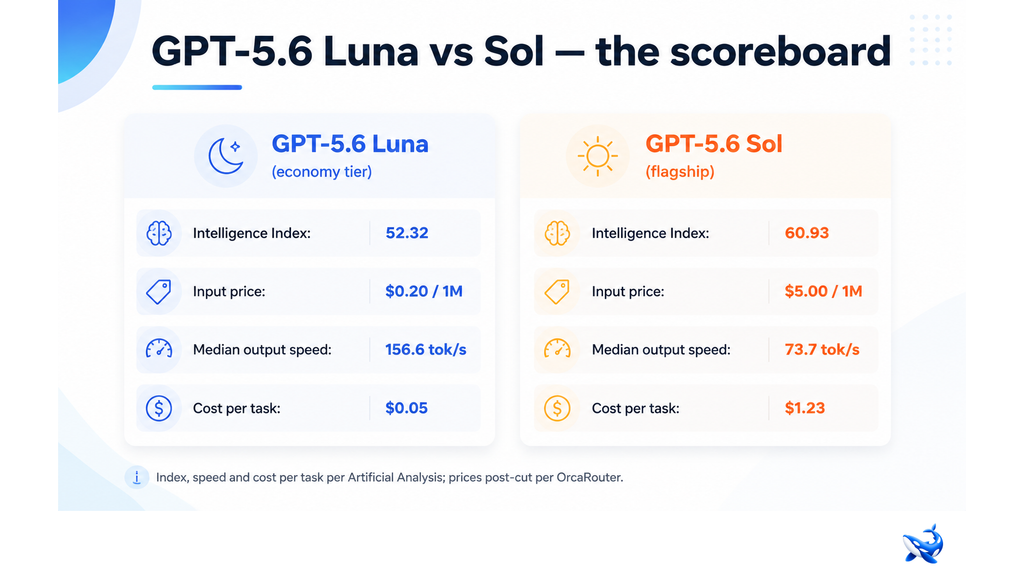
GPT-5.6 Luna API and GPT-5.6 Sol ship in the same family, share the same 1,000,000-token context window, and sit roughly 8.6 index points apart at their best — yet the input-price spread between them is 25×. After OpenAI’s price cut, Luna lists at $0.20 per million input tokens against Sol’s unchanged $5.00, and Artificial Analysis measures the gap on cost per finished task as wider still: $0.05 for Luna versus $1.23 for Sol. The short version is that these are not two trims of the same model; they are two different products wearing the same badge, and GPT-5.6 Luna keeps the flagship’s side of the ledger — this article is the plain decision guide.
That opening sentence sounds like a budget comparison, but it is really a job comparison. Teams that route everything to the flagship pay flagship prices for data-entry-grade work, and teams that route everything to the economy tier watch hard reasoning problems come back shallow. The interesting question is not which model is better; it is which jobs each model should never see.
The two halves of one family
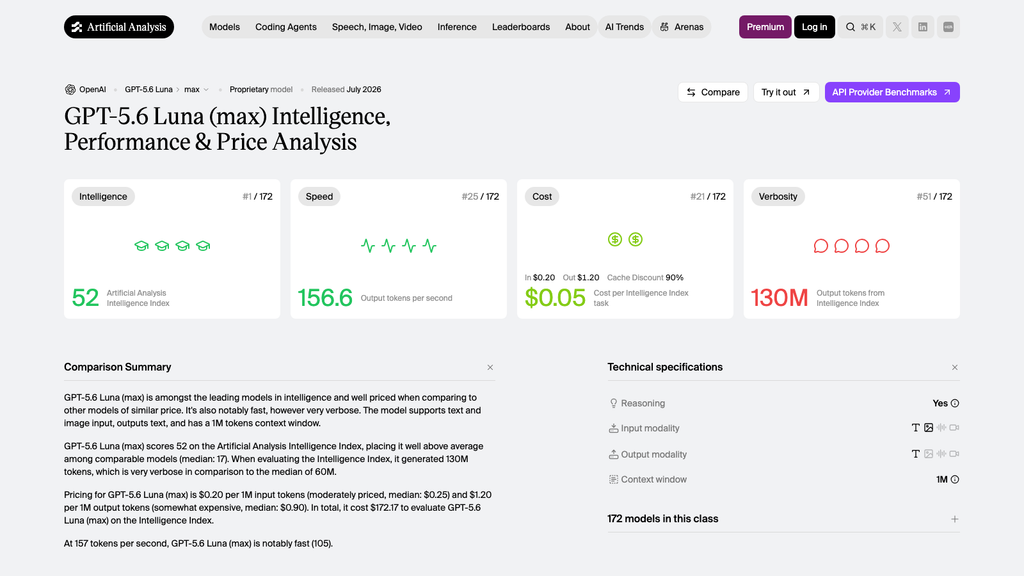
Both models belong to the GPT-5.6 line OpenAI released on July 9, 2026: Sol is the flagship, Terra is the balanced default, and Luna is the economy, high-volume tier — a position Artificial Analysis flags as “notably fast.” At max reasoning effort, the independent live board (checked August 22, 2026) scores Sol at 60.93 and Luna at 52.32, an ~8.6-point gap. Context is identical at 1,000,000 tokens, and both are multimodal (text and image input, text output).
Where they split is price and throughput.
| Spec (max config) | GPT-5.6 Luna | GPT-5.6 Sol |
| Family tier | Economy / high-volume | Flagship |
| Context window | 1,000,000 tokens | 1,000,000 tokens |
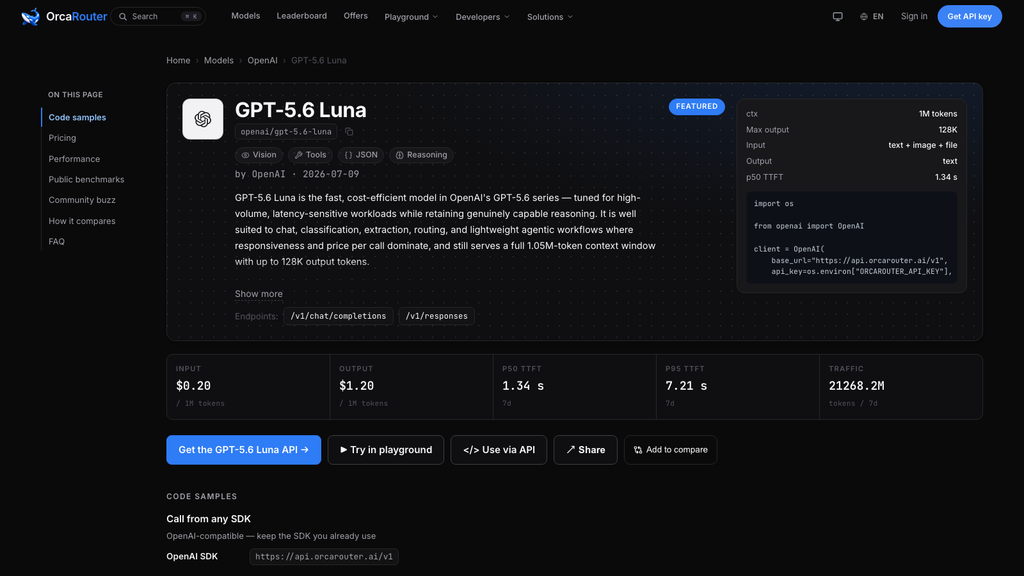
| Input price (post-cut) | $0.20 / 1M | $5.00 / 1M (unchanged) |
| Output price (post-cut) | $1.20 / 1M | $30.00 / 1M (unchanged) |
| Intelligence Index (AA) | 52.32 | 60.93 |
| Median output speed (AA) | 156.6 tok/s | 73.7 tok/s |
| Cost per index task (AA) | $0.05 | $1.23 |
Prices are OpenAI’s post-cut list rates as passed through by OrcaRouter at 0% markup; index scores, median output speed, and cost per task are Artificial Analysis’ live figures. Every number above is the max-effort config — Luna’s 52.32 is its max, not a low-effort setting, so the comparison is fair.
One transparency note on pricing: a single outside listing has quoted Luna at $0.10 / $0.60 with a separate tier above 272,000 prompt tokens. Our catalog and Artificial Analysis both read the post-cut $0.20 / $1.20, so check your own account screen before you build a forecast on it.
Twenty-five times the price, eight points of intelligence
The 25× figure is the input-price ratio: $5.00 divided by $0.20. The output gap is the same 25× ($30.00 vs $1.20). The intelligence gap is 8.6 points. The honest framing is that you pay 25× for eight-plus points — and, more precisely, for the specific kinds of work those points enable.
But per-token price understates how the gap lands on an invoice, because reasoning models bill reasoning tokens as output. Artificial Analysis measures cost per finished task directly: $0.05 for Luna against $1.23 for Sol, a ~24× ratio — and Luna is the cheapest model on the entire board at $0.05 per task, while Sol’s slower median output speed of 73.7 tok/s (vs Luna’s 156.6) means each of its answers also takes longer to finish.
When Sol’s 8.6 points are worth 25×
Eight index points is not a rounding error. It shows up most where reasoning is genuinely hard: long, multi-step agentic work, planning, large refactors, ambiguous prompts, and legal or financial analysis where a shallow miss is expensive.
Sol’s $5/$30 rate and its slower 73.7 tok/s of median output make it a poor fit for anything that runs millions of times. But for the job class where correctness is the product — a hard, one-shot problem where a wrong answer costs more than the model call itself — the premium earns its keep. That is the case where Sol is not expensive relative to what it replaces.
When Luna’s 25× discount is the whole point
Luna is built for the opposite shape of traffic: millions of small-to-moderate tasks that individually need “good enough,” run in parallel, and accumulate into a real bill. At 156.6 tok/s and roughly 102 ms to first token (Artificial Analysis), it clears the bar for interactive-feeling latency on a budget. A summarisation pipeline, a chat history rewriter, a support ticket classifier — the workloads that make up the bulk of most API volume — are exactly where a 25× input-price gap shows up on a monthly invoice without anyone noticing a quality difference.
Our own telemetry makes the pattern visible. In a seven-day window (checked August 22, 2026), Luna handled 21,271.6M tokens on OrcaRouter — by far the highest volume of any model in our data — at a p50 time-to-first-token of 1.33 s and p95 of 7.32 s. That is not a quality score, but it is a strong signal: teams keep putting Luna in the hot path, and the hot path is exactly where cost-per-task math lives.
The routing framework
The decision rule is short. Route hard reasoning and agentic work to Sol; route volume — extraction, classification, tagging, summarisation, and anything that runs a million times — to Luna; and treat Terra as the middle ground. Two checks settle most calls: “will a person read this answer and judge it?” and “will this run more than a few thousand times a month?”
That rule only works when switching costs are near zero — both models behind one OpenAI-compatible endpoint, one key, no second integration. OrcaRouter carries both at 0% markup with provider list prices passed straight through, so the tiering policy is a routing rule rather than a second vendor. The same setup makes the honest experiment possible: run a representative week of real traffic on both, and compare quality against the actual bill.
The one thing to resist in that experiment is judging by anecdote. A single hard task where Sol clearly wins — and Luna’s 52.32 max score guarantees those tasks exist — is not an argument to move everything back to the flagship, any more than a hundred trivial tasks where Luna is indistinguishable is an argument to abandon Sol. Measure both on the same sample, at the same max effort, and let the per-task cost and the quality on your hardest 5% decide the split. Keep the threshold explicit and the data in a sheet, and revisit it after any price change or model refresh — because the 25× gap is precisely what makes these two worth re-balancing whenever the market moves.
The takeaway
GPT-5.6 Luna and GPT-5.6 Sol are the same family, the same 1M context, and 8.6 index points apart at equal max effort — but 25× apart on price and ~24× apart on cost per finished task. Sol earns its premium on hard, low-volume reasoning where correctness is the product; Luna is the correct default for anything high-volume, latency-sensitive, or cheap. Few teams should standardize on one. Most should send the hard problems to Sol, the rest to Luna, and let the routing layer do its job.
Sourcing note: index scores, median output speed, cost per task, output-token counts and TTFT are from Artificial Analysis’ live model pages, checked August 22, 2026; prices are OpenAI’s post-cut list rates as passed through by OrcaRouter at 0% markup; Luna’s traffic and latency figures are OrcaRouter’s own seven-day production telemetry. Note the unresolved external pricing discrepancy for Luna described above.