
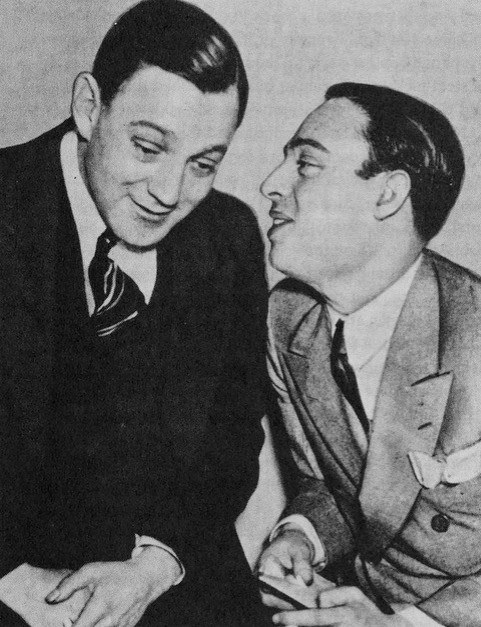
Dutch Schultz, left, with Dixie Davis
By Mary Hoar, City of Yonkers Municipal Historian, 1977 Key to the City of Yonkers recipient, President Emeritus Yonkers Historical Society, recipient of the 2004 Key to History, Yonkers Landmarks Preservation Board Member, Founder of Revolutionary Yonkers 250 and President Untermyer Performing Arts Council
Monday, July 20th
July 20, 1939: According to the Supreme Court testimony attorney “Dixie” Davis gave for a law suit Dutch Schultz’s wife Florence Flegenheimer brought against Yonkers politician Thomas Brogan, Brogan was the “front man” who wangled the operating permit for Yonkers Brewery. The imprisoned Davis, secretly brought to court by guards, testified Schultz bought the brewery for $375,000 in 1932. When prohibition started, Yonkers Brewery was unsuccessful getting an operating permit. Schultz paid Brogan $200 a week to act as Brewery owner… hoping state and federal authorities would issue Brogan the permit to operate the Brewery. Davis testified Brogan paid $50,000 for the Brewery, money Schultz reimbursed. Yet Brogan kept control of the business.
Although the trial was scheduled for the fall, the court wanted Davis’ testimony on record “in case he vanished” after his release from prison.
July 20, 1948: Supervisor John Tobin reported the “vigorous opposition” of First Ward residents against Yonkers proposal to build an incinerator in the Ludlow section. Residents planned protests and personally appeals to City Manager Kennedy, asking him to discard the plan.
Tobin reminded authorities there already was an existing disposal plant in the residential section. The proposed plant would create more odors and heavy truck traffic in a residential area where many children played.
Tuesday, July 21st
July 21, 1943: Bank of Westchester Executive VP Mark Peck announced its South Broadway bank was the first NYS bank appointed to open a branch at Camp Shanks in Orangeburg! Six Yonkers employees were being specially trained to work at the new branch. The bank not only would handle the Post Exchange (PX) receipts, the large civilian and Army staff at Camp Shanks meant the bank would do a “substantial volume of business.” Bookkeeping, however, would be done at the main Yonkers branch through a private wire system.
July 21, 1943: Stewart Stamping Company wanted to open two light manufacturing companies in Yonkers and was negotiating to purchase the John Wanamaker Transfer Center at 630 Central Park Avenue to house them. The companies—Stewart Stamping Company and Electro Products Company—had war contracts. The two war work companies would employ 119 workers; their combined payroll would be more than $300,000.
Wednesday, July 22nd
July 22, 1942: The Alexander Smith Memorial Foundation created an uproar when it announced City Manager League Chairman Horace Gray had accused Draft Board Chairman and former Republican Mayor Ulrich Wiesendanger of granting an “unwarranted deferment” to Democratic Councilman Al Richter.
Richter’s deferment actually was requested by the Navy! Richter applied for three positions; the Navy was considering him for two of the jobs, so asked for the deferment until it decided where Richter would best serve our country.
Thursday, July 23rd
July 23, 1929: The Spreckels Sugar Refinery announced all sugar packets it supplied to hotels and restaurants in the New York area would be labeled “Made in Yonkers!”
July 23, 1949: Austrian born chemical engineer Dr. Fritz Hansgirg, employee of the pioneering metallurgical American Electro Metal Corporation at 300 Yonkers Avenue, passed away.
Hansgirg invented the internationally recognized method of manufacturing superior magnesium. After selling the American rights to Henry Kaiser in 1941, he built a huge plant in California. Because he worked several years in Japan, Hansgirg was arrested as an enemy alien shortly after Pearl Harbor. Hansgirg ran his plant from the San Jose jail! Once released, he expedited production of magnesium for the manufacture planes and bombs.
The “Father of Wartime Heavy Water Production,” Hansgirg’s methods were essential to the Manhattan Project building the atomic bomb.
Friday,July 24th
July 24, 1946: Yonkers’ Tercentennial Commission Chairman Colonel Oliver Troster announced Yonkers would be represented on Radio Station WOR’s tribute to Veterans, “One Year After, The Veteran Reports,” commemorating the first anniversary of VJ Day.
Our veteran would join 15 others from New York, Connecticut, Pennsylvania and New Jersey. Each man would report on his life since coming home, and how his city helped him.
Yonkers was one of the first cities in the country to offer aptitude testing as part of our Veterans’ educational and vocational counseling; it assisted vets to choose an appropriate career. Their vocational training was incorporated into our Yonkers School System.
Saturday, July 25th
July 25, 1946: In the first decision of its kind, Yonkers Judge Boote dismissed charges of “charging over-ceiling prices,” or violating Office of Price Administration guidelines. Merchant Marine Lieutenant Clarence Gilligan had accused the Ashburton Food Center of price gouging, by overcharging for butter Spring 1945. When Judge Boote heard the arguments, he found the Food Center guilty and ordered owner Samuel Bross to return for sentencing. In the interim, the OPA expired. Bross’ attorney argued since OPA was gone, Boote no longer had jurisdiction. The judge agreed!
July 25, 1946: Yonkers Board of Education President John Class suggested Yonkers create a “living World War II memorial” in South Yonkers, a new school! He stated every Yonkers man, woman and child would want to donate.
Funds raised could be used to fully equip a gym or build an amphitheater in memory of the “Yonkers boys” who made the supreme sacrifice.
Sunday, July 26th
July 27, 1946: Yonkers’ Attorney Theodore Sobkow announced plans for a coed Junior College on the Greystone Estate. If plans were viable, the Yonkers college could open September 1947, with tuition of $100.
Long Island University would operate the college; LIU Dean Tristam Metcalfe was part of the executive committee.
Sobkow emphasized planning was “embryonic;” if all went as hoped, he would present the concept to the Common Council in the Fall.
If you have questions on this column, email yonkershistory1646@gmail.com. For information on the Yonkers Historical Society, Sherwood House Museum or upcoming events, please visit their website www.yonkershistoricalsociety.org, call 914-961-8940 or email info@yonkershistoricalsociety.org