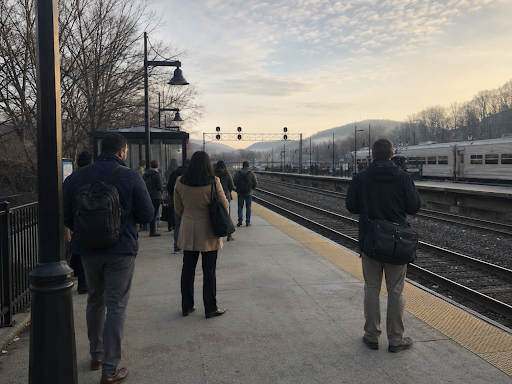

A work outfit that looks fine after a short walk can behave differently after a direct Metro-North trip, a platform wait and another stretch on foot through Manhattan. Current Hudson Line timetables place Yonkers on direct service to Grand Central, and Metro-North carried 69 million riders in 2025, up 6 percent from 2024. For Westchester commuters, that repeated seated-and-walking routine puts more pressure on wrinkle recovery, layering and footwear than generic “business casual” advice usually accounts for.
Why Commuter-Friendly Work Outfits Are Showing Up on the Hudson Line
A direct Hudson Line commute combines several conditions that office-dressing advice often treats separately: time seated, changes between outdoor and climate-controlled spaces, and the weight of a laptop or shoulder bag. A shirt may crease at the waist and elbows, trousers’ knees can stay bent for part of the ride, and a blazer can spend part of the trip folded over an arm. The issue is less about dressing casually and more about choosing workwear that can move through the commute without needing a reset on arrival.
That changes the practical checklist:
- Swapping structured blazers for softer, unlined versions that can be folded or carried with less bulk
- Choosing trousers with a small percentage of stretch, depending on fabric construction, to improve comfort during repeated sitting
- Carrying a second pair of shoes for the platform walk and the walk from Grand Central to the office
- Choosing fabrics or patterns that do not make every small crease immediately obvious under bright office lighting
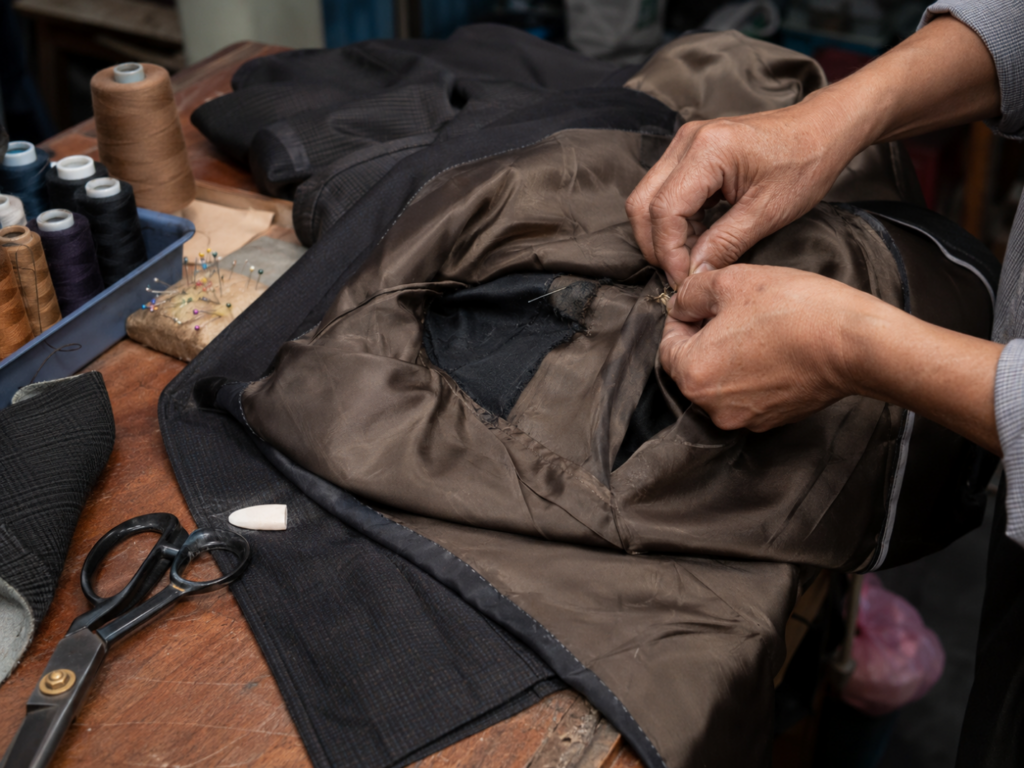
Repairs follow the same logic. Replacing a lining or reinforcing a high-stress area works best when the new material is chosen around the garment already in use, rather than around whatever remnant is available. Retailers such as Global Fabric Wholesale make it possible to compare materials sold by the yard when color, weight and drape need to stay reasonably close to the original garment.
Where a Train Commute Puts Repeated Stress on Workwear
The most commuter-specific wear points are easy to miss because they are not always the places checked during a fitting. A shoulder carried under the same laptop-bag strap can crease differently from the opposite side. Pocket seams take repeated loading from a phone, wallet or transit card. Trouser knees stay flexed for part of the ride, while jacket linings are compressed when a blazer is folded, held on a lap or packed into a bag.
Those patterns do not automatically call for replacing a garment. A tailor may be able to reinforce a pocket seam, adjust a lining or address a recurring fit problem at the shoulder, depending on the garment’s construction. The useful question is not whether a piece still looks presentable on a hanger; it is whether the same stress point keeps returning after the commute. Workwear that repeatedly fails in one place is giving a clearer signal than a one-time wrinkle.
A useful check is to look at the garment immediately after the trip rather than after it has hung overnight. The shoulder beneath the bag strap, the most-used pocket, the trouser knees and the lining at the lower back are the first places worth checking. When the same distortion or seam strain returns in one area, a commuter has a more specific repair question to take to a tailor instead of treating every problem as general wrinkling.
How Commuter-Friendly Work Outfits Handle Early Starts and Temperature Swings
Westchester’s shoulder seasons can make the commute feel like three environments in one trip: an outdoor platform, a climate-controlled rail car and an office. The practical response is a removable layer that can be handled in a train seat without crushing the shirt or blouse underneath. A lightweight zip layer or soft overshirt can be easier to stow than a bulky coat on milder days, provided the weather itself does not require heavier outerwear.
For an existing blazer that needs a lining or facing repair, a closer color and weight match can matter more than buying a large amount of material. In that situation, sourcing fabric by the yard from Global Fabric Wholesale can be more practical than relying on a fixed remnant size, especially when only a small section of the garment is being reworked.
The larger shift is not a new dress code. It is a more commute-aware way of judging whether workwear still performs after sitting, carrying and layering are repeated several times a week. On the Hudson Line, the schedule may be fixed; the outfit is the part commuters can adjust.
MEDIA DETAILS
Contact Person: Media Relations
Company Name: Global Fabric Wholesale
Email: support@globalfabricwholesale.com
Website: https://globalfabricwholesale.com/