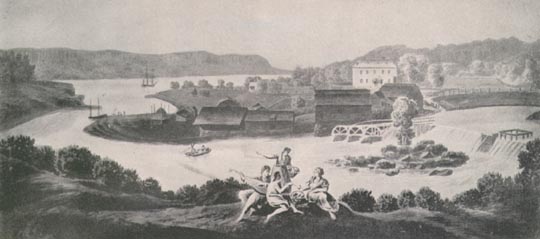
Print of the first known picture of the Saw Mill River by Philipse Manor Hall, 1784
By Mary Hoar, City of Yonkers Municipal Historian, 1977 recipient of the Key to the City of Yonkers, President Emeritus Yonkers Historical Society, recipient of the 2004 Key to History, Yonkers Landmarks Preservation Board Member, Founder of Revolutionary Yonkers 250 and President Untermyer Performing Arts Council
Monday, July 6th
July 6, 1937: Mainstay of Yonkers General Hospital and noted attorney Hampton Ewing notified Yonkers Police of a serious invasion of his Belmont Terrace estate, demanding they “do something about it!”
Who were the invaders? Squirrels! They were gobbling their way through his prize corn and snacking on his peaches! Yonkers police called the SPCA, who called Westchester Game Warden E. T. Townsend! His advice? Write to the State Conservation Department complaining about the squirrels. After perusing the documents, NY would issue a permit for Ewing to kill the squirrels.
July 6, 1937: Yonkers went to war against swimming in the Saw Mill River! Yonkers Health authorities asked area police to help prevent boys from swimming in the river, a main source of Yonkers drinking water. Health Commissioner McGillian reported a problem; when Water Department inspectors stopped boys swimming in the river, they were subjected to abuse by the boys’ mothers!
Tuesday, July 7th
July 7, 1902: Yonkers Police Headquarters received multiple complaints about boys and men swimming in the Hudson “without proper clothing.” Captain Woodruff ordered his men to “stop the nuisance.”
July 7, 1943: Yonkers race for 12th Ward Supervisor would be between two women. Republican Marjory Best Mabie would run against Democrat Ethel Owen. Mabie had been appointed to the seat her husband vacated when he entered the Army a few months earlier, and was serving the district. Mrs. Owen was on the Board of the Yonkers Public Library.
Wednesday, July 8th
July 8, 1918: Yonkers Boy Scouts assisted Sergeant Robert McLean distributing “Devil-dog” US Marine enlistment posters throughout Yonkers.
The name came from the German front lines; they described the fighting abilities of the Americans as “Teufel Hunden” or “Hounds from Hell.”
July 8, 1943: The US Army’s Philadelphia Quartermaster Deport awarded Smith Carpet Factory an order to produce 50,000 yards of Melton cloth, a heavy wool overcoat material. It would be woven on the same looms used to produce blankets for our troops.
Wednesday, July 9th
July 9, 1930: Marion Cook was awarded the title of “Miss Yonkers” and a trip to Atlantic City at the Traymore Hotel as a result of the popularity contest held by the Park Hill Theater. She received 199,890 votes. She left Yonkers the next morning in a car provided by the Yonkers Nash Corporation, accompanied by chaperone Mollie Reife, her employer’s wife.
July 9, 1942: Two hundred Empire City employees—jockeys, trainers, office workers and other track employees who already qualified as air-raid wardens– successfully took part in a successful “monster” artificial respiration drill led by Red Cross First Aid Director John Dougherty.
Friday, July 10th
July 10, 1933: Welfare Commissioner Nicholas Ebbitt’s department operated a highly productive twelve-acre subsistence garden. It not only fed the city’s charges and veterans, it produced surplus vegetables that needed to be preserved for fall and winter use. Ebbitt appealed to Yonkers households to donate unused jars and containers and planned to establish a municipal canning plant.
Which vegetables were abundant? Beets, carrots, string beans and tomatoes!
July 10, 1940: Former Supreme Court Justice J. Addison Young, acting as the Supreme Court referee, shattered Yonkers’ sewer assessment protocol. Young described the existing assessment system was “unlawful, arbitrary and unjust.”
This was the culmination of a long legal battle led by former Mayor William Wallin for Hudson River Country Club owner Purl Wightman and by former Yonkers Judge David Gorfinkel, the attorney for the Untermyer estate. Both would get big cuts in their special assessments; the Hudson River Country Club received a reduction of $1,748.94 and the Untermyer estate received a reduction of $701.41.
Saturday, July 11th
July 11, 1938: Yonkers Police Chief Edward Quirk surprised and arrested two New York City men operating a 100 gallon still in a basement garage at Odell and Bellevue Avenues! The still was discovered by Yonkers Motorcycle Officer David Whalen who smelled the heavy alcohol fumes while riding by the building, and immediately called the Chief.
July 11, 1938: Two Yonkers missionaries, Doctor Edward and Georgina Perkins, were under fire in China while Japanese warships shelled Kiu Kiang. The Perkins, caught in a Japanese infantry line of March, had not managed to board the US Gunboat Monacacy that sailed other Americans out of the line of fire. The Perkins, members of Morsemere Methodist Episcopal Church, founded the Water and Life Hospital in Kiu Kiang.
While in Yonkers, they lived with Georgina’s parents, William and Jane Phillip, on Arthur Street.
Sunday, July 12th
July 12, 1933: Welfare Commissioner Nicholas Ebbitt announced the Commission’s 12-acre subsistence garden was so productive, it not only met the needs of everyone on its rolls, it also met the needs of the Veterans’ Bureau. It planned to preserve all excess volume of its vegetables, so asked anyone who had extra canning jars to donate to their cause. The gardens were maintained by Yonkers unemployed, and each one produced bumper crops of beets, carrots and string beans. They were about to produce huge qualities of tomatoes; they estimated 100 baskets of tomatoes would be harvested daily!
Ebbitt planned a municipal plant to can all excess crops for the winter.
July 12, 1950: Yonkers held a Welcome Home ceremony for Stan Bielat, winner of the National Public Links Golf Championship. Sports clubs, civic groups and veterans’ organizations participated in a huge parade from Lincoln Park to Larkin Plaza, where Mayor Kristen Kristensen addressed the crowd and proclaimed it was “Stan Bielat Day” in Yonkers.
Any questions on this column, email yonkershistory1646@gmail.com.
For information on the Yonkers Historical Society, the Sherwood House Museum on Tuckahoe Road or their upcoming events, please visit their website www.yonkershistoricalsociety.org, call 914-961-8940 or email info@yonkershistoricalsociety.org.